



Battling the Rising Waters
Battling the Rising Waters

Kuot tends to his garden as flooding threatens livelihoods of the internally displaced (IDP) in Mangalla.
The gathering storm clouds that once brought 63-year-old farmer,Kuot Pautum hope now fill him with dread.
"That used to be my garden," says Kuot, pointing across the road from his current field in the Mangalla displacement site, a few kilometres outside the country’s capital Juba, where floodwaters stretch endlessly toward the Nile River. "The sorghum was maturing well when the floods came in 2024. Everything was gone in one night."
Kuot is among nearly two million people internally displaced within South Sudan. His journey began in Bor South, where his family had farmed for generations until recurrent flooding forced them to pack what little they could carry to Mangalla IDP site.
Now settled in Mangalla, he has decided to try his hand again at farming. He has now planted fast-maturing vegetables and maize crops that are now at risk of being affected as the rainy season gains momentum.
"I am here just to watch the crops grow," he says, checking his plants with the careful attention of someone who understands their fragility. But his optimism carries weight: "I fear that if the rains continue to intensify, the water will soon reach this new garden too."
Climate threats intensify displacement
Flooding has pushed Mangalla's 30,000 displaced residents to the frontlines of intensifying disasters, like recurrent flooding and conflict. Among them are former refugees who recently returned from Uganda and Kenya, only to find their homes and farmland underwater, leaving the settlement as their only refuge.
On top of that, ongoing funding cuts have significantly impacted assistance levels including support to enhance people’s resilience to the impacts of weather events such as floods.
"If I had watering cans for the dry season and a way to keep the water out during the rainy season, I would manage. I have been farming my whole life," said Kuot.
Over the years, thousands of displaced families have received seeds, farming tools, and training from UNHCR, enabling them to grow their own food, provide for their families, and face the future with dignity. In some areas, UNHCR has supported communities by building dykes that keep floodwaters from inundating host and refugee settlements.
These investments have proven their worth time and again, enabling displaced people like Kuot to withstand repeated setbacks from flood related disasters.
Building resilience despite ongoing threats
As this year's rainy season gathers pace, displaced populations are yet again on another frontline - the impacts of extreme weather. So far, over 100,000 people mainly in Jonglei, Upper Nile, and Unity states, many of whom have been forced to flee by increasing tensions and insecurity in these areas, have been displaced by the floods, creating persistent challenges for living conditions and livelihood activities such as farming.
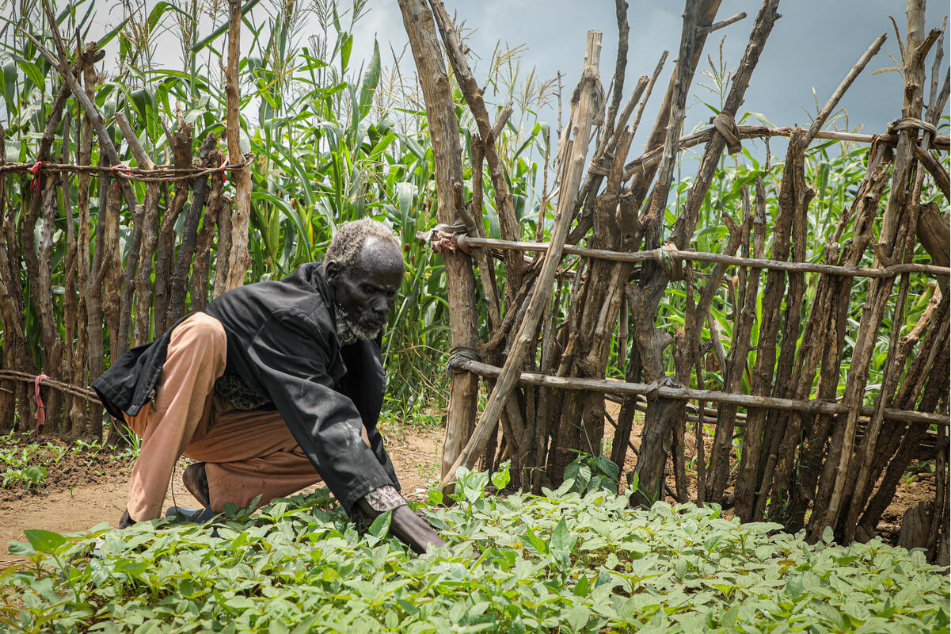
Kuot tends to his garden as flooding threatens livelihoods of the internally displaced (IDP) in Mangalla.
Yet serious funding cuts have significantly curtailed UNHCR’s ability to assist flood affected families like Kuot’s, including through shelter and clean water.
As of 31 July, UNHCR had only received a third of the nearly $300 million required to protect and assist the forcibly displaced and local host communities in the country, including the over 1.2 million people who arrived in the country fleeing war in neighbouring Sudan more than two years ago.
Without additional resources, the impact of the floods will continue to be felt for months to come.
Regardless of the situation, Kuot continues to tend to his crops with patient determination.
"I come here every day to check on them," he explains, moving carefully between the young plants. "They need me, and I need them."


