



“Shelter is the first step”: A South Sudanese father finds safety in Ethiopia
“Shelter is the first step”: A South Sudanese father finds safety in Ethiopia

Joseph and his family sit inside their shelter in Luakdong refugee camp in Ethiopia.
Clouds drift over Luakdong refugee site in western Ethiopia as the rainy season settles over the region. Refugee families know how quickly conditions can change. Just a year ago, floodwaters submerged much of the area where Joseph and his family now live.
Today, Joseph sits inside the shelter he shares with his wife and four of their five children. The family received it just two months ago. Its frame and protective covering offer a safer refuge from the rains that define this time of year and from the intense heat that is a constant too.
For Joseph, however, the shelter is much more than a structure.
“We feel better now,” he says. “Shelter is the first step.”
Just over a year ago, Joseph had no roof over his head and no certainty about where his family would sleep.
Originally from Nasir County in South Sudan’s Upper Nile State, Joseph fled in April 2025 with his wife, Nyahok, and their children after aerial bombardments struck the area at night and violence engulfed the community.
“We left overnight when everything was being set on fire,” he recalls. “People were running in every direction. We had no time to prepare”.
Amid the violence, Joseph became separated from two of his children in Nasir town. The memory still haunts him. Arriving in Ethiopia with little more than the clothes they were wearing, Joseph and his family crossed through Buribey and eventually reached Matar, where, like thousands of other South Sudanese refugees fleeing insecurity, they spent months in difficult conditions.
In September 2025, Joseph and his family were registered and, a month later, relocated to Luakdong refugee site. Established only a few months earlier, Luakdong was set up to receive people fleeing renewed violence in South Sudan. Beyond responding to immediate humanitarian needs, UNHCR and partners are working with Ethiopia's Refugees and Returnees Service (RRS) to develop Luakdong as an integrated settlement where investments in infrastructure, services and livelihoods benefit both refugees and host communities while supporting greater self-reliance and reducing the need for emergency assistance over time.
For Joseph, the relocation brought a sense of safety, something he readily associates with Ethiopia’s long-standing hospitality towards people fleeing conflict.
Ethiopia has long kept its borders open to those seeking safety and today generously hosts more than 1.1 million refugees and asylum seekers from neighboring countries. Gambella remains the country's largest refugee-hosting region, with 446,000 South Sudanese refugees, and continues to receive arrivals across the border.
Once in Luakdong, Joseph quickly understood what his family needed most.
“A family needs a place to stay first,” he says. “Life can be difficult, but without shelter, it is even harder.”
In May 2026, his family finally received their shelter. More than protection from the rain and heat, it restored something less visible: a sense of dignity.
“When we entered this shelter, we felt happy,” Joseph says. “Now we can sleep without fear.”
With support from the European Union, UNHCR and its partner Development Expertise Center (DEC) constructed 2,230 upgradable emergency shelters in Luakdong this year, enabling South Sudanese refugee families to receive safer, more dignified accommodation. The EU support has also helped strengthen the site's resilience to seasonal flooding through the construction of a protective dyke.
Yet Joseph is already thinking beyond the immediate safety the shelter provides.
Before conflict forced him to flee, he was a teacher. One day, he hopes to work again and give his children the opportunities they deserve. Seeing other refugees in Luakdong working as teachers gives him hope that he too may one day be able to use his skills again. But Joseph is also eager to engage in farming if given the opportunity.
“I am a teacher by profession, but if we are given the right tools, I can also farm and provide for my family,”he says. “The land here is fertile and can help refugees support themselves during difficult times.”
When asked whether he hopes to return to South Sudan, Joseph pauses. For a moment, his gaze drops before he answers.
“There is no peace in South Sudan now,” he says. “We will stay here. There are challenges, but at least we are safe.”
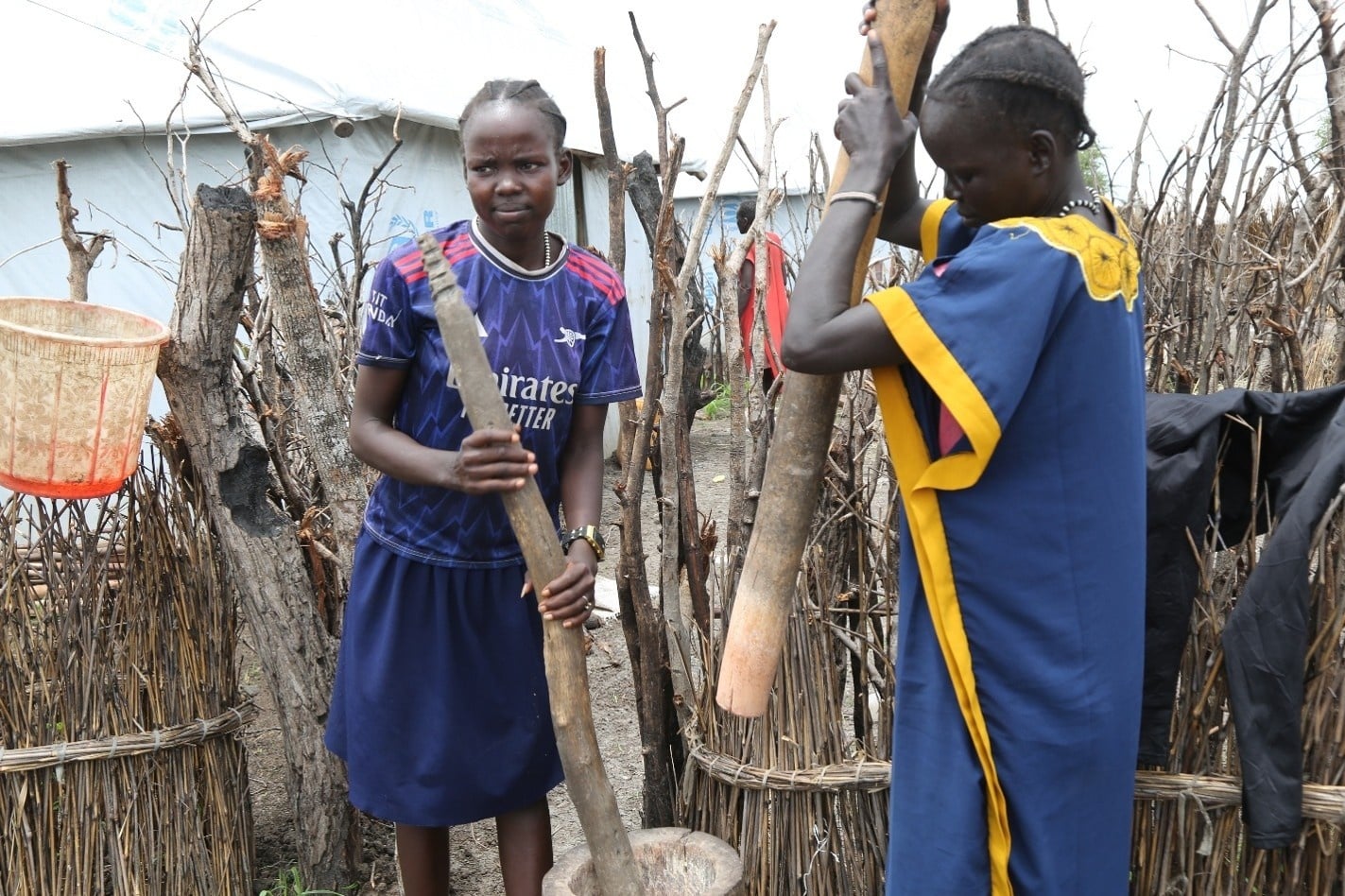
After months of displacement, Joseph's family is rebuilding daily routines in Luakdong. Here, Nyahok, Joseph's wife, and their daughter Nyaruach prepare a meal outside their shelter.
Joseph knows that a shelter alone cannot rebuild a life. But it gives his family a safe place to sleep, protects them and offers the stability from which everything else can begin. As he looks towards the future, he returns to the same thought that has carried him through months of uncertainty: “Shelter is the first step.”


