



South Sudan reintegration and service capacity assessment key findings
South Sudan reintegration and service capacity assessment key findings

UNHCR Protection officer Loku James, speaks with recently arrived returnee Ruot Gatkouch, in the transit centre in Renk, South Sudan.
Returns to South Sudan
"We lost our interest in living in the camp. Instead of the challenges we’re facing in somebody else’s country, we would rather come back and suffer in the place where we originally lived, in South Sudan."
The ongoing crisis in Sudan is worsening humanitarian challenges in South Sudan. Since April 2023, over 1 million people have crossed into South Sudan with 337,000 more expected in 2025. Returnees and refugees are primarily arriving in border areas, overwhelming transit centers and straining South Sudan’s already fragile infrastructure.
Many returnees face severe food insecurity and have limited access to healthcare, education, and clean water. Women and girls are particularly vulnerable, facing heightened risks of gender-based violence and exploitation.
The crisis adds to South Sudan's protracted humanitarian emergency, which is marked by flooding, economic instability, and conflict. Returnees are settling in climate-affected areas, where droughts and severe floods have devastated livelihoods and reduced food production. Food insecurity remains acute, with 7.7 million people projected to face crisis-level hunger during the 2025 lean season.
Meanwhile, land ownership disputes and lack of civil documentation further hinder reintegration, limiting access to resources, secure housing, and essential services.
"This place is my origin. My parents, grandparents, and my late husband are all from here. I didn’t come back for better services—I came because this is home."
Main Takeaways
Strengthening reintegration planning: The Area-based Integration & Absorption Capacity Toolkit identifies gaps in infrastructure and reintegration, offering insights into physical and social barriers to guide planning.
Uneven integration progress: While physical safety is strong in some areas, economic and legal challenges persist. Despite the difficulties, the majority of returnees plan to remain, signaling a strong commitment to staying despite the hardships.
Healthcare is under severe strain: Facilities lack maintenance, medicines, and staff. In Magwi and Torit, health facilities exceed capacity by over 83,000 people. Restoring and upgrading existing facilities would significantly expand service capacity.
Education is operating beyond capacity: All regions require urgent investment in teachers and infrastructure. Magwi, Torit and Yei require 1,700 more teachers to meet ideal ratios.
Water infrastructure challenges: There are severe water shortages, especially in Magwi, Torit and Yei. An additional 2,684 hand pumps are needed across regions to meet needs.
Justice and protection system gaps: There is heavy reliance on traditional systems with staffing and resource shortages. Safe spaces for vulnerable groups are limited and under-resourced.
Service provision: meeting current and future needs
Healthcare
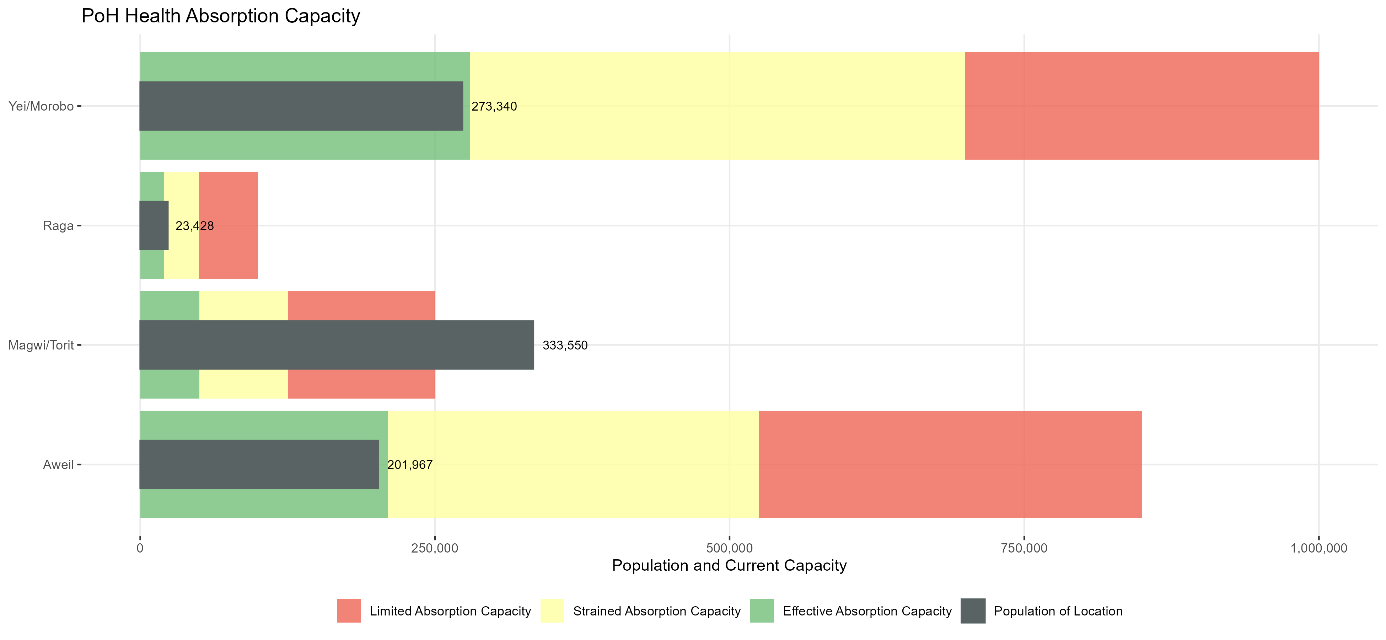
The healthcare systems and capacity vary across the assessed locations, but urgent intervention is needed in many areas of healthcare. Half of the healthcare facilities require critical maintenance, and many lack essential medicines, medical equipment, and trained staff. Most healthcare facilities struggle to provide inpatient services, with low bed counts and severe staff shortages limiting their ability to serve increasing population demands.
The results show that:
Magwi and Torit are under considerable strain, with current healthcare demand exceeding the available capacity by over 83,000 individuals. This points to an urgent need for intervention, as existing facilities are already overwhelmed and not even meeting current needs.
Yei, Morobo, and Northern Bahr el Ghazal (NBeG) are in a more stable position, currently managing within their effective capacity. However, an increase of just 6,000–8,000 people could push these areas into the strained category.
Improving healthcare capacity in these regions does not necessarily require building new facilities. Rehabilitating existing infrastructure—especially addressing medicine stock shortages and lack of water—could significantly increase service capacity. For example, in Magwi and Torit, rehabilitation efforts could expand the healthcare system's ability to serve an additional 978,000 individuals.
Education
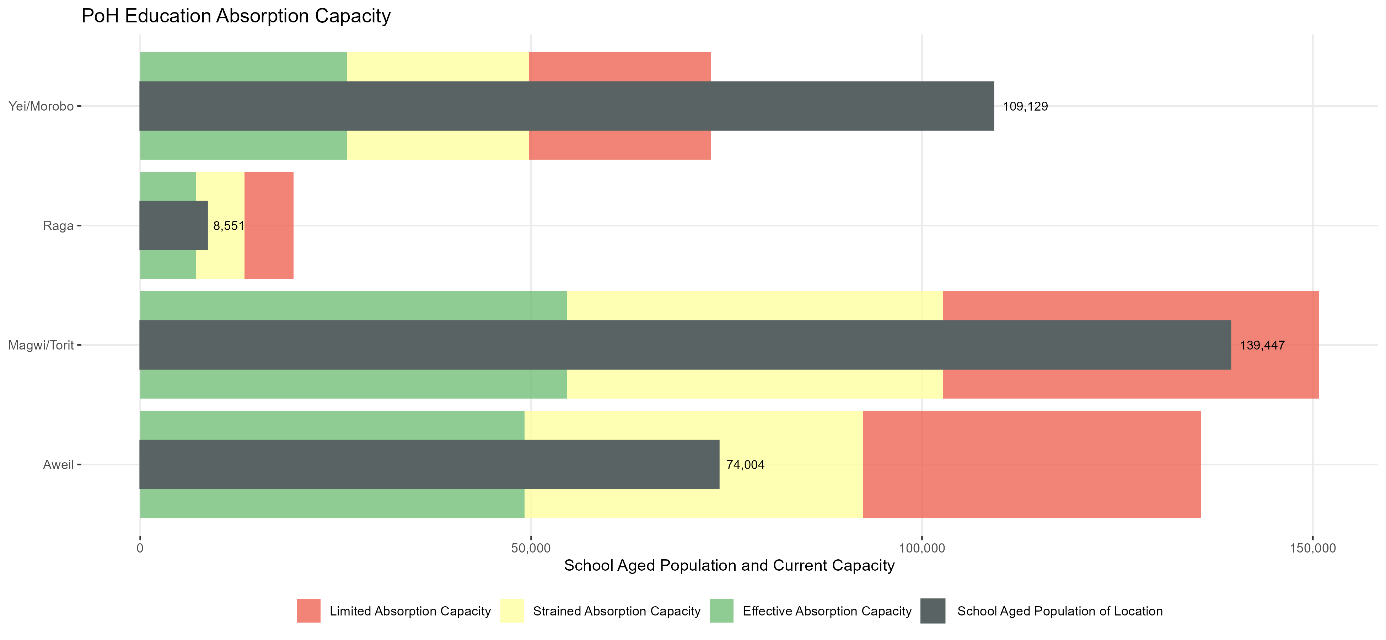
NBeG, Magwi and Torit have the most developed educational networks, while Raja has the most limited infrastructure, offering primarily basic education. Across all regions, 15-20% of schools are rated to be in poor condition. The lack of maintenance of facilities remains an ongoing concern, with only a small percentage of schools having received recent repairs. Many teachers lack formal qualifications, many of whom remain unpaid or untrained, severely impacting learning outcomes.
Schools are at or beyond capacity. The ideal student-to-teacher ratio is set at 1:50 (1 teacher per 50 students), while strained schools operate at 1:94, and those at maximum capacity reach 1:138. By these standards, educational infrastructure in every region is either strained or at maximum capacity. In Magwi and Torit, schools have reached their maximum limits, while in Yei and Morobo, the demand exceeds capacity by over 36,000 school-aged children. None of the assessed locations have the capacity to take in more students while maintaining ideal levels of education standards.
Expanding school capacity could be partially achieved through the rehabilitation of existing facilities, particularly by constructing toilets—identified as the main reason for some schools failing to meet minimum standards. However, facility improvements alone will not be enough. The level of strain suggests that both additional teachers and infrastructure expansion are essential to meet educational needs effectively.
Water Points
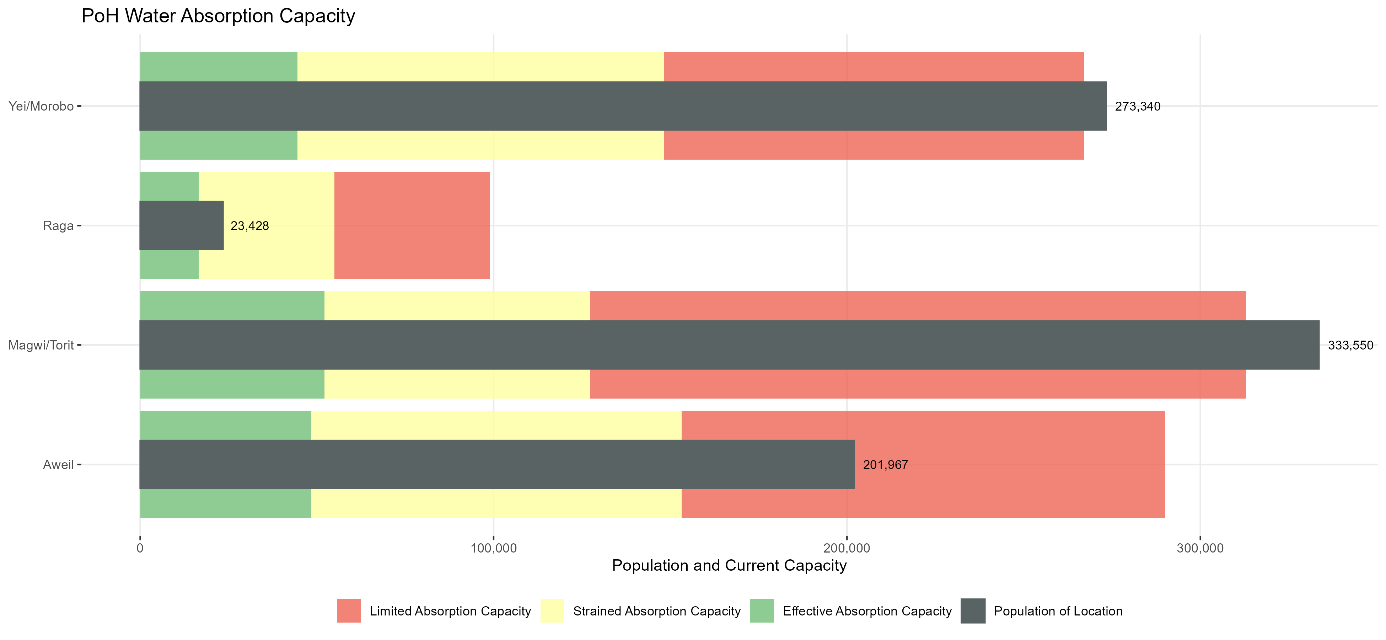
Boreholes and hand pumps are the primary sources of water. Seasonal scarcity and long wait times exacerbate access challenges, especially in Magwi and Torit, where water is described as "almost never available." Only Raja's water infrastructure is close to meeting ideal capacity levels, while Yei, Morobo, Magwi, and Torit are operating beyond survival capacity thresholds, indicating an urgent need for intervention.
Rehabilitating existing water resources could significantly increase capacity—by supporting over 99,000 more people in Yei and Morobo, and by 115,367 people in Magwi and Torit. However, rehabilitation alone is not enough. Additional water points are needed. For example, NBeG would still fall short of maximum capacity even after rehabilitating all existing water points.
Law enforcement and protection
Law enforcement and protection services are a blend of formal structures and traditional community-based systems. While urban areas like Aweil town have some police, judicial, and legal services, other regions depend almost entirely on community leaders and local chiefs for conflict resolution. Many police stations, courthouses, and community security posts are in poor condition and understaffed, limiting their ability to serve the population effectively. Many formal facilities require upgrades, maintenance, and better-trained personnel to enhance their effectiveness.
Protection services, including women's centers, youth centers, and legal aid facilities are also under significant strain due to rising demand from returning displaced populations. Many facilities lack basic amenities, are overcrowded, and require urgent expansion to meet growing needs.
Integration today and tomorrow
Reintegration Sustainability Score (RSS)
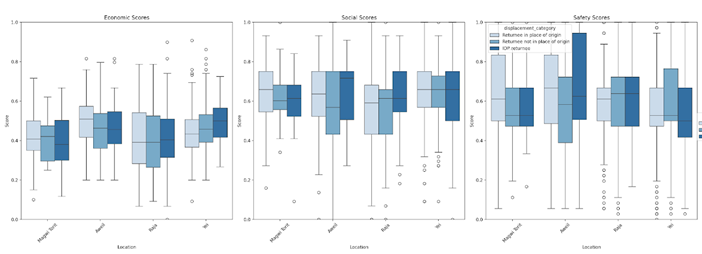
The Reintegration Sustainability Score (RSS), based on economic, social, and safety metrics, reveals significant challenges in the reintegration of returnees. Scores are generally well below optimal levels (1), indicating ongoing issues in all dimensions. The economic dimension is by far the most problematic across the board.
Location has a significant impact on economic, social, and safety scores, with Aweil showing the highest economic scores, Magwi Torit leading in safety and social scores, and Yei having the lowest safety scores. Displacement category has little effect on economic scores but moderately influences social and safety scores. Returnees not in their place of origin report lower social scores, while those in their place of origin report higher safety scores, reflecting the importance of location in reintegration experiences.
Beyond displacement category and location, regression analysis shows that scores are influenced by several key factors across economic, social, and safety dimensions:
Economic Dimension: Women have slightly higher economic scores, while older age and a longer time since return are linked to lower scores. Conversely, spending more time abroad and attaining higher education levels positively influence economic outcomes.
Social Dimension: Women are slightly disadvantaged in this area, with lower social scores. However, individuals who have been back longer and those with higher education levels are more likely to have better social reintegration outcomes.
Safety Dimension: Spending more time abroad is strongly associated with higher safety scores, and education also plays a positive role in improving safety outcomes.
Figure: Reintegration Sustainability Score (RSS) for refugee returnees in assessment locations, across economic, social and safety dimensions
Perceptions of absorption capacity
While the majority of returnees are determined to stay, suggesting some degree of successful reintegration, the question arises: can these communities absorb even more people?
The assessment of each community’s ability to welcome additional returnees reveals mixed perceptions. Locations such as Torit Town and Hiyala Payam show strong confidence in their capacity to support more people, while others, like Baac Payam in Northern Bahr el Ghazal, express significant concerns about resource limitations.
Figure: Perceptions of absorption capacity in assessment locations
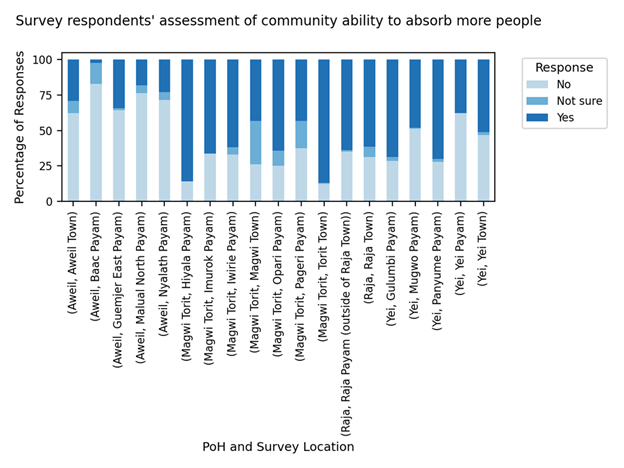
Figure: Perceptions of absorption capacity in assessment locations


