
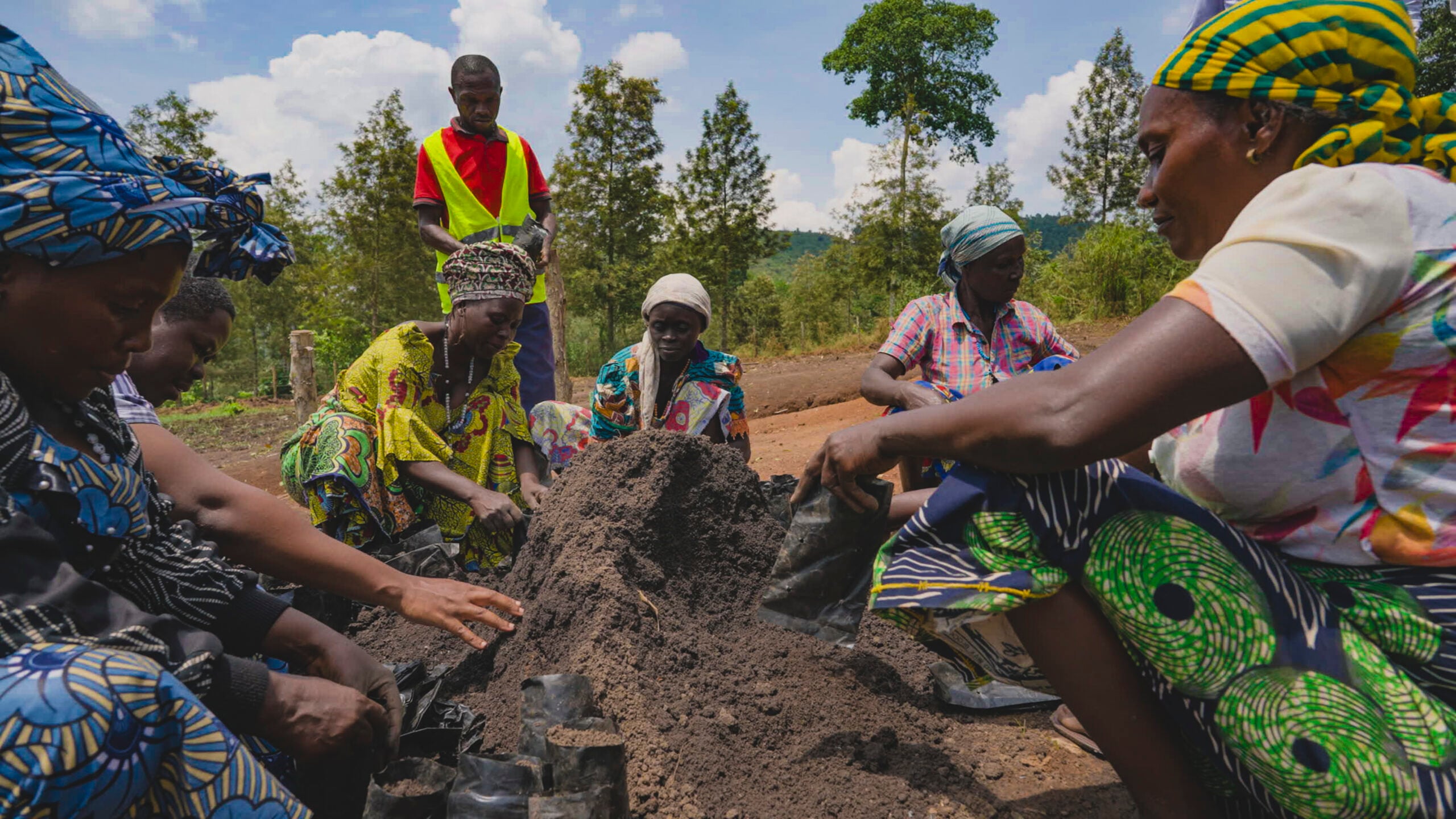
Tree nursery workers near Bugoma forest, Uganda. UNHCR, March 2026
Refugee settlements and camps sit inside some of the world’s most fragile ecological zones, where environmental degradation and human need intersect. Now UNHCR, the UN Refugee Agency, is taking a major step to address both challenges by announcing its first implementing partners for the Refugee Environmental Protection (REP) Fund.
As the world’s first large-scale carbon-financing facility for refugee and host communities, the REP Fund provides a blueprint for how refugee-hosting districts can drive environmental restoration and resilience while moving towards financial self-sufficiency.
Working with two consortia of environmental and development specialists, the REP Fund will launch reforestation and clean cooking programmes across settlements and camps in Uganda and Rwanda.
In this pilot phase, the Fund is expected to restore around 7,000 hectares of degraded land, provide clean cooking access to more than 50,000 households, and begin generating verified carbon credits.
Over the next decade, the scheme aims to restore more than 100,000 hectares – an area bigger than New York City or Berlin – expand clean cooking to over one million refugees and host community members and reduce up to six million tonnes of CO2 annually.
As UNHCR’s flagship innovative finance project, the REP Fund signals that humanitarian settings are not just beneficiaries of climate financing – refugees can be active participants in leading ecological recovery.
Designed to become self-sustaining, the REP Fund reduces reliance on donor funding and marks a structural shift in how environmental and protection responses in displacement settings are financed.
Carbon markets have long struggled to reach the communities and landscapes most in need of investment. The REP Fund is designed to close that gap – by generating the first-ever refugee-driven carbon credits to be registered, verified and traded globally, ensuring benefits flow directly back to refugees and host communities.
Implementation will begin at three sites: Bidibidi and Kyangwali settlements in Uganda, and Kigeme camp in Rwanda. Collectively, they are home to hundreds of thousands of refugees, primarily from South Sudan and the Democratic Republic of the Congo. All three were selected following government engagement and feasibility studies confirming land availability, implementation capacity and carbon certification pathways.
Two consortia will lead the implementation
The BB Energy–Hamerkop–Fairventures consortium will lead activities in Bidibidi settlement in Uganda and will manage the clean cooking component in Kigeme camp in Rwanda. BB Energy’s environmental subsidiary Everpath will oversee carbon asset management and structuring, with Fairventures providing technical expertise on environmental and carbon design. The focus will be on market-based clean cooking solutions designed to reduce fuelwood dependence and associated emissions while improving household air quality.
Farm Africa–Tree Aid–ICRAF will lead activities in Kyangwali settlement in Uganda and co-lead reforestation activities in Kigeme camp in Rwanda. Drawing on long-standing regional experience in community forestry and landscape restoration, the consortium will implement biodiversity-focused restoration, agroforestry systems and long-term carbon sequestration activities.
In Kigeme, both consortia will work under joint governance, ensuring operational coordination between reforestation activities led by the Farm Africa–Tree Aid–ICRAF consortium and clean cooking activities led by the BB Energy–Hamerkop consortium.
All projects will operate under a joint governance framework involving UNHCR, consortium partners and relevant government stakeholders. Monitoring, Reporting and Verification systems will align with internationally recognised voluntary carbon standards and independent third-party validation to ensure environmental integrity and transparency.
The Uganda and Rwanda pilots will shape how the REP Fund is rolled out in other displacement settings. They offer a pathway for how carbon markets can reach new frontiers – financing resilience for the communities that have contributed least to the climate crisis yet have the most at stake.
If you would like to connect with the REP Fund team or learn more about our work, please reach out to [email protected] or visit the Refugee Environmental Protection Fund webpage.