
By Nikolas Pirani, Statistics and Data Analysis Officer; Gina Kosmidou-Bradley, Economist; and Chao Huang, Statistics and Data Analysis Officer
Findings from UNHCR monitoring survey on recovery of families returning to Afghanistan.

Since the start of last year, over 2.4 million Afghans have returned or been forced to return to Afghanistan from neighbouring countries. Thousands of families, many of whom are stepping foot in the country for the very first time, are having to start a whole new life chapter.
But return is only the first step – finding somewhere to live, earning an income, becoming self-reliant, and rebuilding their lives with dignity are further challenges that await.
In December 2024, UNHCR surveyed nearly 3,000 Afghan families who had returned from Pakistan to Afghanistan between January and June of that year to understand how well they were reintegrating and identify any emerging needs. Conducted across 197 districts, the Post-Return Monitoring survey compared responses of those who had been back in the country for less than six months, with those who had been home for up to 11 months.
Using household income as a measure of progress, the survey findings indicate that returnees who have been in the country longer report higher employment rates and earnings.
However, concerningly, deeper structural problems persist – particularly gender disparities and unmet basic needs leading to rising debt, food insecurity – contributing to overall increased vulnerability.
READ THE FULL REPORT: Rebuilding lives: How return duration shapes income generation and reintegration dynamics for Afghan returnees
Some progress towards self-reliance, but not for women
Once back in their chosen community, returnees strive to become self-reliant, shifting from being recipients of humanitarian aid to engaging in wage-earning work.
The survey revealed that those who have been back in the country longer do achieve modest but measurable gains – employment rates increase from 53% to 69% within six months, and wages rise by 7% on average.
When accompanied by formal education, households with more family members – and therefore more potential earners – report higher average income. Families who have reliable access to essential services – such as markets, clean water, and sufficient food – also report higher incomes than those without.
Women, however, are largely excluded from these gains. Over six months, employment rate for women falls from 42% to 39%, and wages drop by 23% on average.
“Within six months of return, wages for women drop by 23%.”
Persistent debt and food insecurity
Nearly 82% of returnee families surveyed are in debt when they arrive back in Afghanistan. This debt can be due to lack of livelihoods opportunities during displacement and loans taken out to cover basic needs, or official and unofficial costs incurred during the journey. It can also be a result of forced or premature return where individuals did not have time to financially prepare before departure.
The survey results indicate that the main sources of income for returnees are employment and remittances from abroad.
Despite improving employment rates and increase in wages over time, most returnee households remain financially unstable, unable to repay debts, meet rising costs, or cover basic needs. More than half of families report not having enough food to eat, with food insecurity worsening over time. This is particularly true for female-headed or vulnerable households.
“More than half of families reported not having enough food.”
Within six months of return, 94% of returnee families report being in debt – a 12 percentage point increase.
Women excluded from sustainable integration
A law enacted by the de facto authorities in August 2024 on the promotion of virtue and prevention of vice extended and codified already severe restrictions on the basic rights of women and girls in Afghanistan. Women face increasing barriers to employment, education, legal rights, and freedom of movement, excluding them from being able to sustainably reintegrate, or effectively function in society at all.
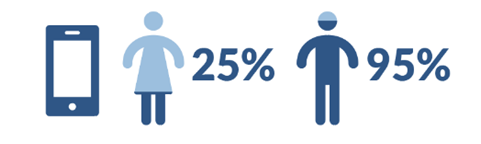
UNHCR’s survey revealed that households in which women have mobile phones report higher income than those without. However, overall, only 25% of women have access to mobile phones, versus 95% of men.
“Households in which women have mobile phones report higher income.”
Over time, women’s access to mobile phones declines further, limiting their access to employment and income-generation, as well as essential services and information.
Within the first year of return, an average of 21% of women did not have national identification documents, versus only 5% of men, which locks them out of the few formal jobs and services still available to them. And in food-insecure households, women are more likely to have to skip meals, affecting their ability to earn and their health and wellbeing.
Sustained investment to facilitate stabilization
For returnees attempting to establish themselves in Afghanistan – especially women – wages are low, jobs are scarce, and food and economic insecurity persists even months after return. Even so, survey findings reveal that over time, families who have reliable access to essential services have stronger economic gains. These contrasting realities show that progress in reintegration is still fragile.
Without international humanitarian and development assistance to help returnees sustainably recover and rebuild their lives, the ongoing mass influx into Afghanistan in 2025 risks driving further onward movement and destabilising the region.
Based on the findings from this survey, UNHCR recommends the international community:
- Substantially increases investment in practical and inclusive livelihoods interventions that support returnees to become economically self-reliant;
- Prioritises support for female-headed households and vulnerable groups, accompanied by efforts to secure documentation and legal identity;
- Strengthens the availability and quality of essential services – such as markets, clean water, and access to sufficient food – in areas of return, benefiting both returnees and host communities.
Regular monitoring of how well returnees are integrating over time remains essential. Tracking socio-economic trends, vulnerabilities, and emerging needs will help ensure humanitarian responses remain timely, evidence-based, and context-appropriate. UNHCR is grateful to the Government of the Kingdom of the Netherlands for funding this 2024 Post-Return Monitoring survey. The next round of UNHCR post-return monitoring will take place in Q3 2025, with expanded geographic scope and including returnees from Islamic Republic of Iran.
The safe and voluntary return of Afghans can contribute to stability, economic growth and regional harmony – but only if met with a humanitarian response rooted in global solidarity and responsibility-sharing. Sustained investments are needed to help Afghan families return with hope, rebuild their lives and prosper.
The safe and voluntary return of Afghans can contribute to stability, economic growth and regional harmony – but only if met with a humanitarian response rooted in global solidarity and responsibility-sharing.