
Digital Tukul
UNHCR Blog on Digital Inclusion
The desert where you call the ambulance by WhatsApp
Internet connectivity can make a huge difference to relief activities and the lives of refugees. For the men, women and children of Sayam Forage camp in Niger, who fled Boko Haram’s violence in Nigeria, the camp is now an oasis of hope surrounded by harsh, unforgiving desert.

How digital identity can enable the Global Compact on Refugees
The Government of Estonia, Kiva and ID2020 make pledges at the first Global Refugee Forum to help ensure that refugees have a good digital identity that protects and empowers them, helping to realise the goals of the Global Compact.

UNHCR launches new Data Transformation Strategy
The Strategy provides UNHCR’s vision, priorities, and key actions in order to enhance strategic and responsible use of timely, quality data to further strengthen UNHCR’s role as a data-driven organization and a center of excellence for refugee, statelessness and forced displacement data.

Including forced displacement in the SDGs: a new refugee indicator
UNHCR joined forces with the Joint IDP Profiling Service (JIPS) to advocate for the inclusion of a new game-changing indicator on refugees in the SDGs, and won!

What is the promise of mobile money for refugees in Jordan?
UNHCR talks with the Government of Jordan and the telecommunications industry to advocate for full inclusion of refugees into mobile wallet opportunities.

Using open data to drive evidence-based responses to support refugees and their hosts
Following the inauguration of the new UNHCR – World Bank Joint Data Center on Forced Displacement, Björn Gillsäter shares some reflections on the importance of data to improve the lives of forcibly displaced and their host communities.

A new tool to facilitate registration and refugee case management in Cameroon
In March 2019, UNHCR staff in Cameroon were trained on how to use proGres v4, the latest iteration of UNHCR’s registration and case management software application, improving their day-to-day work.
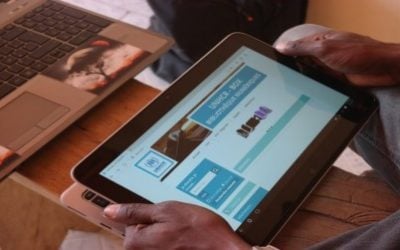
“UNHCR Box”: When access to Culture doesn’t have to depend on Internet Connectivity
A new and innovative offline Digital Library was installed in Sayam Forage refugee camp in Niger, to provide access to numerous cultural resources for the youth.

New off-line tool steps up registration activities in Brazil
In Pintolandia Shelter in Boa Vista, Brazil, UNHCR is testing RApp a new tool to improve the registration process and provide a better protection and assistance to refugees.
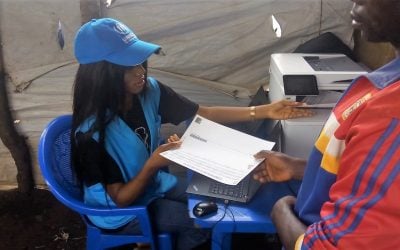
In Angola, PRIMES new anti-fraud features improves the registration process
To face registration challenges in Angola, UNHCR is using the new anti-fraud features offered by its Population Registration and Identity Management EcoSystem (PRIMES).

UNHCR launches the first Global Virtual Summit on Digital Identity for Refugees
In partnership with the Government of Canada, UNHCR has launched the first Global Virtual Summit on Digital Identity for Refugees.
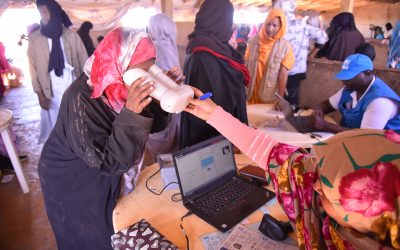
When technology improves the lives of refugees
In Mauritania, in the Sahel region of West Africa, the Global Distribution Tool is changing the life of more than 56,000 Malian refugees registered in Mbera camp.
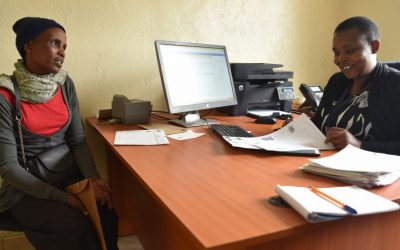
UNHCR upgrades its data management system to improve efficiency
UNHCR Population Registration and Identity Management EcoSystem (PRIMES) has been rolled out in Kenya, in the Government registration centres in Nairobi, Nakuru, Eldoret, Mombasa and Dadaab camp.
About
In an increasingly interconnected world we want to reflect, argue, inform, innovate, and take action: Nobody should be left behind
This blog explores the opportunities the digital age brings to improve the protection and welfare of the people we care for: asylum seekers, refugees, IDPs, stateless and all other forcibly displaced men, women and children
Whilst much of the world’s population benefits from access to digital services and content – many of the most vulnerable do not. They have limited access to the devices and connectivity that many of us take for granted. Digital transformation of the humanitarian system will generate data for effective planning and enable better, identity management. Inclusion into the digital world can provide enhanced access to education, training and livelihoods.