



Ethiopia
Ethiopia
UNHCR operations in Ethiopia focus on emergency response to the different refugee and internally displaced situations, addressing protection needs of refugees and promoting their self-reliance.


Are you a refugee, asylum-seeker or stateless person looking for help? Visit the HELP site to find support and services from UNHCR.
Ethiopia is one of Africa’s largest refugee-hosting countries and has advanced progressive refugee policies in recent years. Building on these reforms, the Government-led Makatet Roadmap, launched in June 2026, sets the course for refugees' gradual inclusion in national systems and services.
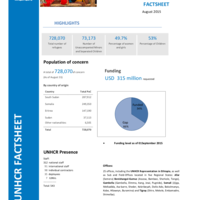
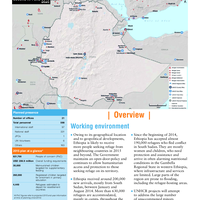
Ethiopia generously shelters over 1 million registered refugees and asylum-seekers, mainly from Sudan, South Sudan, Somalia and Eritrea, with significant new influxes driven by developments in the region in Sudan and South Sudan. Refugees are hosted in 21 camps and seven sites and settlements across the country, with major hosting areas in Gambella, Somali, Benishangul-Gumuz, Afar and Amhara, as well as locations in Tigray and other parts of the country, while Addis Ababa hosts an urban refugee population. Women and children account for 80% of registered refugees and asylum seekers. UNHCR maintains a decentralized operational presence aligned with these major refugee-hosting areas, with ten offices nationwide: a Representation, one Sub-Office, three Field Offices, four Field Units, and a Liaison Office. This field footprint enables UNHCR to remain close to refugees, government counterparts and affected communities.
The country is also responding to significant internal displacement, with some 1.9 million internally displaced persons as of August 2024. Since then, developments in northern Ethiopia in 2026 and other regions have heightened displacement and protection risks, in a fluid context that also includes IDP returns. UNHCR’s field presence, including in Gondar, Semera, Mekelle and Shire in the north and Assosa, supports its continued emergency protection and solutions response to displacement-affected communities, alongside the broader refugee response.
Looking ahead, Ethiopia is advancing a more sustainable and inclusive approach to refugee protection. The Makatet Roadmap provides a framework to progressively include refugees in national and local systems, expanding their opportunities and enabling hosting areas to grow into more integrated and resilient communities. Moving from parallel humanitarian services to nationally owned, development-oriented delivery benefits refugees and host communities alike. To realize this shift, the Roadmap promotes sustained investment in these areas and the services that reach both populations, mobilized through humanitarian, development and private sector partnerships under government leadership. It is also the pathway towards UNHCR's 50 by 35 Vision, supporting refugees in protracted displacement to move beyond aid dependency through greater self-reliance and pathways to solutions.
Population and financial overview
Ethiopia
Use the year selector to access strategy information from previous years.
Latest updates



Office contact details
For information about our operation in Ethiopia, please contact us through our Headquarters in Geneva, Switzerland.


