



Career Fair in Benue Connects Displaced Entrepreneurs with New Clientele and a Renewed Path Forward
Career Fair in Benue Connects Displaced Entrepreneurs with New Clientele and a Renewed Path Forward

When Comfort arrived at the Career Fair for forcibly displaced persons in Makurdi, Benue State, she came with locally sourced food products and a clear purpose: to find new customers, build business connections and recover from a setback that had forced her to start over.
Comfort, 34, is a refugee from Cameroon who fled the Anglophone crisis in 2019. In Nigeria, she trained in baking through a programme run by UNHCR, and with early support started a small business. She expanded into selling palm oil, honey and other locally sourced food items from farmers in Benue State, and eventually opened her own shop, where a POS terminal brought in extra income and made it easier for customers to pay. Then burglars broke into the shop. They took her stock and, with it, her customers. She had to start from scratch, again.
Comfort is one of thousands of Cameroonians who crossed into Nigeria after violence in the country's Anglophone regions. Most of them settled in Benue and neighbouring states, the same communities where she now sources her products and sells to her customers. Nigeria hosts more than 140,000 refugees, mainly from Cameroon.
The Career Fair gave her a way back. Organized by UNHCR in partnership with Jobberman Nigeria and the Benue State Government, it brought forcibly displaced people into the same room as employers, financial institutions, service providers and private sector partners. UNHCR convened the partners and built the day around what displaced people actually need to rebuild a livelihood: customers, contacts, financial services and market access.
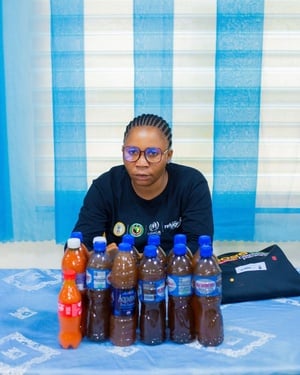
For Comfort, walking in meant putting months of loss behind her and testing whether her business could still find a market.
"I prayed that God would connect me with people who would help me rebuild my business," said Comfort Oyah, a forcibly displaced entrepreneur.
The fair answered that. Her stand drew steady traffic all day. Customers bought her honey and palm oil, praised the quality and the price, and many promised to return. By the close of the event, she had sold almost everything she brought. In the days that followed, more orders came in, and she filled them, giving her business a real boost at a time when she was working to recover.
Comfort was one of more than 500 people at the Benue fair. The event formed part of a wider effort to connect forcibly displaced people with work, entrepreneurship support, financial services and market opportunities. It builds on a pilot held in Lagos in 2025.
That effort sits against a large need. By the end of 2024, 3.5 million people were internally displaced in Nigeria. In states such as Benue, where displacement has strained families, livelihoods and local economies, access to economic opportunity is central to helping people rebuild.
For UNHCR, expanding sustainable livelihoods for people affected by displacement is a core priority, and market-based solutions are central to it. By bringing companies, financial institutions and service providers into the same space as displaced people, the fair turns that priority into practical steps: job pathways, business contacts, bank accounts, financing options, mentorship and market linkages. Jobberman Nigeria brought its experience in career development, employer engagement and skills matching, helping participants reach employability support, entrepreneurship guidance and connections to services.
"Displaced people bring skills, experience and ambition, but they are often left out of formal pathways to work and enterprise," said Oluwaseyi Ibuoyi, Gender and Inclusivity Coordinator at Jobberman Nigeria. "Through this fair, we connected participants with employers, financial institutions and business support services that can help turn their potential into income."
Financial inclusion ran through the day. First City Monument Bank (FCMB) introduced services for displaced entrepreneurs and small business owners, including account opening, business financing guidance and Point-of-Sale terminal opportunities. Through the terminals, eligible entrepreneurs can offer basic banking in their communities, earn commissions on transactions, and open an additional income stream.
The response was immediate. During the fair, FCMB opened 28 new accounts and identified 11 entrepreneurs with existing businesses who met the requirements to move toward financing. The bank is still engaging with them as they take the next steps.
Comfort already ran one POS terminal. At the fair she saw room for a second, along with practical ideas for lifting her revenue.
For Comfort, the fair delivered sales, new customers, and a business connection that outlasted the event. Her next goal is a new shop, where she can serve more of the community she now calls home.
"We are willing to learn and work if only we get the support," Comfort said. "This fair gave me new customers, new ideas and renewed hope."


