



A Safer Start: Rehabilitated Maternity Ward Brings New Hope to Families in Mongoumba
A Safer Start: Rehabilitated Maternity Ward Brings New Hope to Families in Mongoumba

Rebecca’s smile marks an important milestone: the first birth registered at the maternity ward renovated with financial support from the European Union.
With European Union funding, UNHCR and the Central African Government are strengthening maternal and child healthcare for returnees and host communities in southern Central African Republic.
Mongoumba, Central African Republic – When 25-year-old Rebecca walked into the maternity ward of Mongoumba Secondary Hospital that morning, she carried the familiar mix of excitement and apprehension of a mother about to give birth.
Her third child was on the way.
But this time, Rebecca entered a maternity ward that had been transformed. The rooms had been rehabilitated, essential medical equipment was available, and trained health workers stood ready to assist her.
"I feel reassured. The midwife is here to support me, and the environment is much more welcoming and suitable," Rebecca said as she prepared for the delivery.
By her side, Ms Mafouta Lucie, a maternity assistant, works calmly and attentively. Since 2018, she has been supporting the women of Mongoumba through one of the most important moments of their lives. As she guides Rebecca to the delivery room, she reflects on the progress made since the maternity ward's rehabilitation.
An hour later, a baby boy weighing 3.5 kilograms was born.
For Rebecca and her newborn, the improved conditions meant a safer and more dignified childbirth experience. For thousands of other families in Mongoumba, the rehabilitation of the hospital's maternity and paediatric wards is helping strengthen access to essential healthcare in an area where years of displacement and return have placed increasing pressure on basic services.
Safer care for mothers and newborns
With funding from the European Union through its Directorate-General for International Partnerships (INTPA), UNHCR has supported the Central African Government in rehabilitating and equipping the maternity and paediatric services of Mongoumba Secondary Hospital.
The intervention is part of broader efforts to strengthen national services in areas receiving returning refugees and to ensure that investments in return and reintegration also benefit the communities welcoming them home.
At Rebecca's side is Mafouta Lucie, a maternity assistant who has cared for women and newborns in Mongoumba since 2018. She has witnessed first-hand how improved infrastructure and equipment have changed the conditions in which health workers provide care.
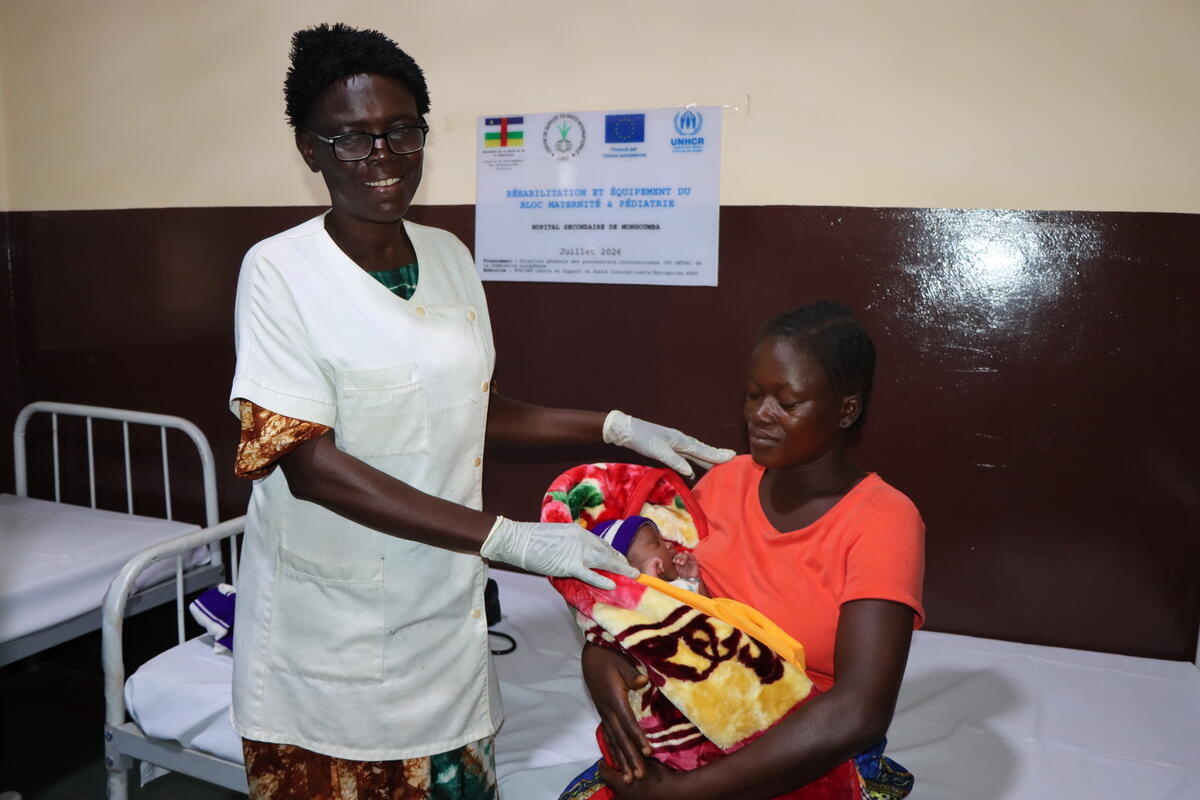
Rebecca is accompanied by the midwifery assistant who helped ensure the safe delivery of her baby.
"For the past eight years, I have been serving women and newborns in this maternity ward. The rehabilitation of this facility, made possible by the European Union's support, has significantly improved our working conditions and the quality of care we provide to women and newborns. We are deeply grateful for this support, which directly benefits the entire community," she said.
The rehabilitated ward now has essential equipment to help health workers respond to the needs of mothers and newborns, including neonatal resuscitation equipment, a mucus suction device, a radiant heat source, a newborn weighing scale and other tools for monitoring newborn health.
Equipment for maternal care, including a delivery chair or stool, privacy screens and a blood pressure monitor, also helps ensure that women can give birth in safer conditions and with greater dignity.
The improvements are particularly important in a community where demand for essential services has grown significantly in recent years.
Supporting communities as people return home
Since 2017, more than 13,440 Central Africans have returned to the Mongoumba sub-prefecture from neighbouring Democratic Republic of the Congo and the Republic of the Congo.
As families return and rebuild their lives, access to functioning health facilities, schools, civil documentation, livelihoods, and other essential services is critical to ensuring their return is sustainable.
In Mongoumba, returnees, internally displaced people and members of the local community rely on the same health facilities. Strengthening these services, therefore, goes beyond responding to the needs of people who have experienced displacement; it is an investment in the entire community.
Dr. Keta Kossi Fidele Vivien, Chief Medical Officer of Mongoumba Secondary Hospital, says the rehabilitation of the maternity and paediatric services and the provision of essential medical equipment have strengthened the hospital's ability to respond to growing needs.
"Each year, more than 360 pregnant women give birth in this maternity ward, averaging 30 deliveries per month," he said.
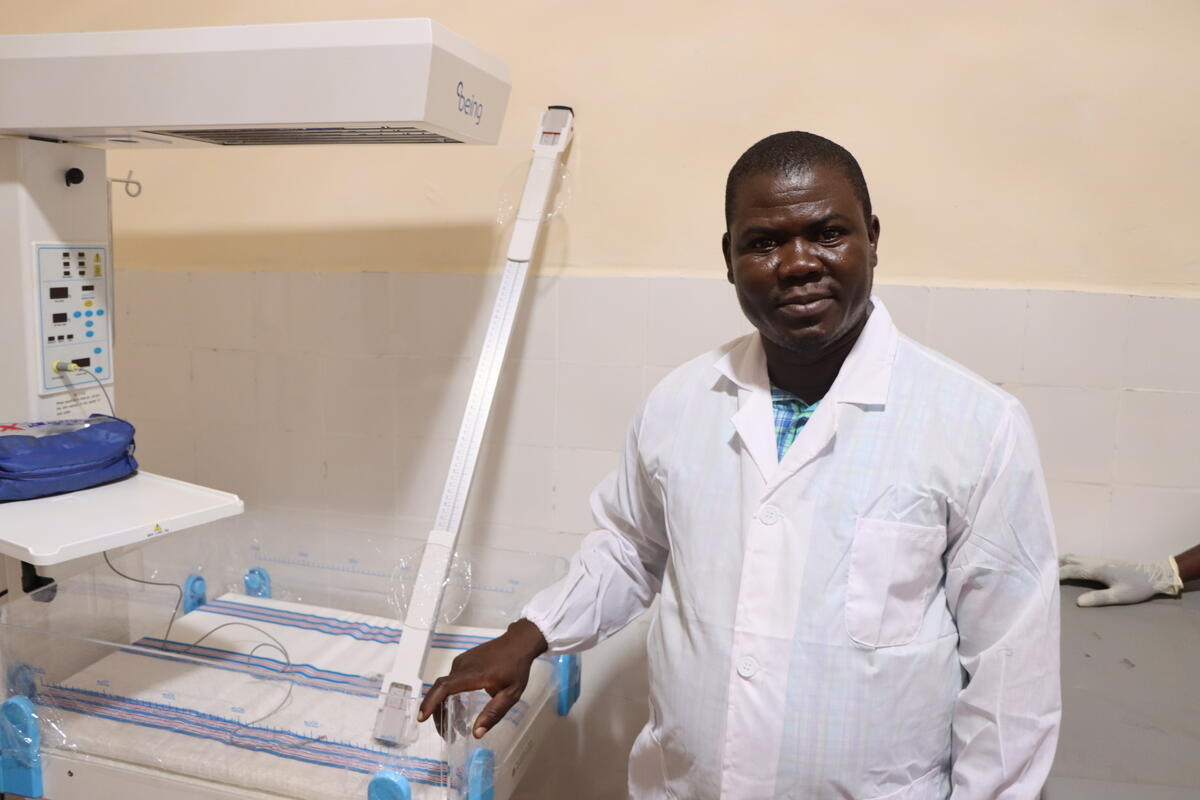
Dr Keta Kossi Fidele Vivien, the hospital’s chief medical officer, in the renovated maternity ward’s delivery room, which provides improved care for mothers and newborns.
Improved facilities and equipment enable health workers to better manage obstetric and neonatal emergencies, improve infection prevention and provide better care for pregnant women, newborns and sick children.
The project also supports human resources. The deployment of a qualified doctor in the Mbaïki Health District, based in Mongoumba, is helping strengthen healthcare for returnees and host communities while providing medical coverage for return convoys.
Investing in communities, not only infrastructure
For UNHCR, supporting sustainable returns means going beyond helping refugees cross the border back home. It also means working with the Government and development partners to strengthen the communities and services people depend on once they return.
In places such as Mongoumba, investments in public infrastructure can help ease pressure on limited services while strengthening peaceful coexistence between returnees, internally displaced people and the communities receiving them.
This approach will continue through the planned construction of a new health centre within the Samba Development Hub, bringing essential services closer to communities while contributing to greater inclusion and social cohesion.
Back at the maternity ward, however, the impact of these investments can be measured much more simply.
For Rebecca, it is the possibility of holding her newborn son after giving birth in a safer and more dignified environment. For Mafouta Lucie, it is having better conditions and equipment to care for mothers and babies. And for families across Mongoumba, it is the reassurance that quality healthcare is becoming more accessible closer to home.
For a community rebuilding after years of displacement, each safe delivery represents more than the arrival of a new life. It is also a sign of a community moving towards a more secure and hopeful future.


