



DAFI Tertiary Scholarship Programme
DAFI Tertiary Scholarship Programme
- Grace, DAFI graduate of public health, Burundi.

Grace, from the Democratic Republic of Congo, is a graduate of Public Health from Université Lumière de Bujumbura in Burundi and led the DAFI Women Power Club.
Higher education is a priority for UNHCR, as outlined in Education 2030: A Strategy for Refugee Education, forming an integral part of UNHCR’s protection and solutions mandate.
Higher education makes it possible for thousands of refugee youth to develop skills and earn qualifications to allow them to become change-makers who can take the lead in identifying solutions to the challenges that affect them and their communities.
The DAFI scholarship programme constitutes one of the five core pillars of the strategy to achieve 15 per cent enrolment of young refugee women and men in higher education by the year 2030 – the 15by30 Roadmap.
Since its founding in 1992, DAFI has supported over 27,200 students in 59 countries. Highlights from the programme in 2024 include:
- DAFI scholarships offered in 58 countries
- 7,890 refugee students from 54 countries of origin
- Women made up 45% of DAFI scholars, the highest female enrolment rate in the history of the programme.
- For the first time since 2020, there was a decrease in the number of scholars supported, reflecting the shift in global funding and subsequent reduction in resources and support for refugees worldwide.
To learn more:

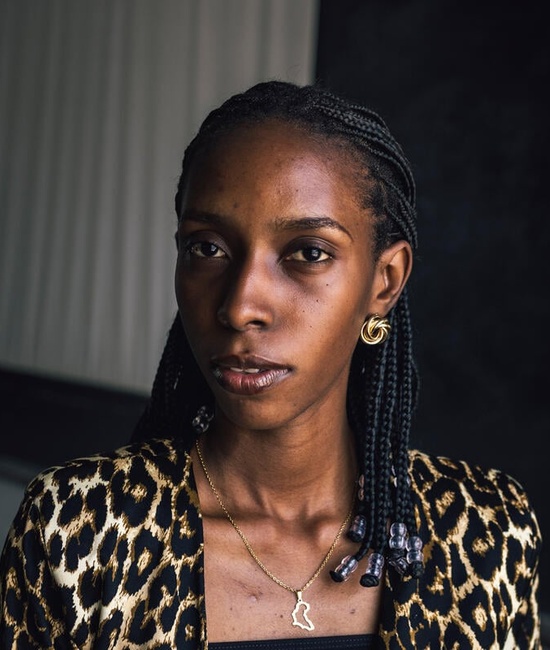
Grace, from the Democratic Republic of Congo, is a graduate of Public Health from Université Lumière de Bujumbura in Burundi.
Grace
Grace completed her public health degree at Université Lumière de Bujumbura. She also served as President of the DAFI Women Power Club, and is determined to empower young refugee women to become leaders.
Born in Burundi to a Congolese family, Grace grew up as the youngest of eight children. “That meant I could focus on my studies,” she says. “That was an opportunity for me but also a responsibility – I had to perform.” And she did. Grace consistently ranked top of her class, driven by a deep passion for healthcare. “I myself went through health issues in my life and have developed a desire to understand diseases and how to prevent or cure them.”
Beyond her studies, Grace is fighting gender stereotypes. “We still have to fight the idea that an educated woman won’t make a good wife. But we keep moving forward and mentoring younger refugee girls and women who come after us so that they can become leaders and have some impact in this world.”
For Grace, being a refugee is not a limitation. “It is all about changing your mindset. As DAFI female scholars, our role is to show that being a refugee doesn’t mean that you should lose hope.” Her message is clear: competence, not refugee status, should define success – and with the right skills and career readiness training, anything is possible.
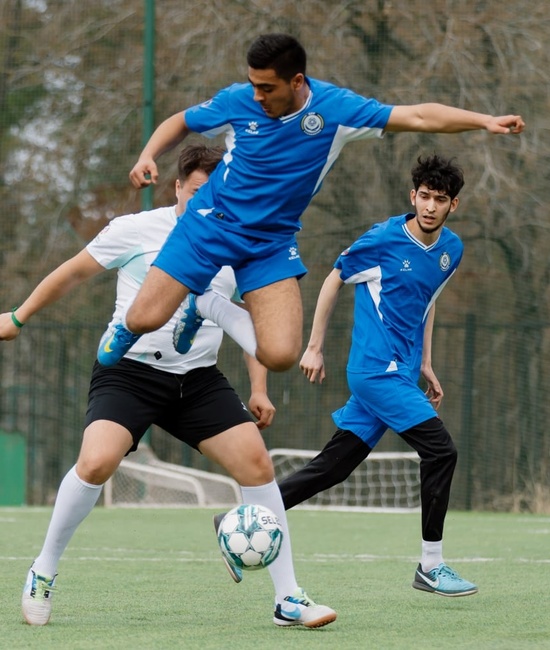
DAFI student of dentistry Farokh, from Afghanistan, at the Higher Medical and Dental College of Professor Ruzuddinov in Almaty, Kazakhstan.
Farokh
Farokh is using every opportunity in and out of the classroom to grow, give back and support others. He and his family fled Afghanistan and arrived in Kazakhstan when he was just one year old.
In 2025, Farokh joined fellow DAFI scholars and refugee youth at the “Games of Peace” football tournament, organized by the Kazakhstan Football Federation and UNHCR. “Football has always been my passion. It helps me connect with others beyond words,” says Farokh. “Being part of the ‘Games of Peace’ was about teamwork, respect, and showing that we – refugees and students – are active members of society.”
In the classroom, inspired by his older sister’s pursuit of medicine, Farokh chose to pursue a career in dentistry. “My goal is to one day open a clinic and offer free care to families in need – especially those who are displaced or can’t afford treatment,” he explains. “Dentistry allows me to help people directly, and the DAFI scholarship is making it possible.”
When asked about the impact of DAFI, Farokh shares “DAFI gave me more than a scholarship – it gave me hope and the chance to be seen. Whether I’m studying, playing football, or helping organize an event, I feel part of this community. I want to show others, especially refugee youth, that it’s possible to dream and achieve.”
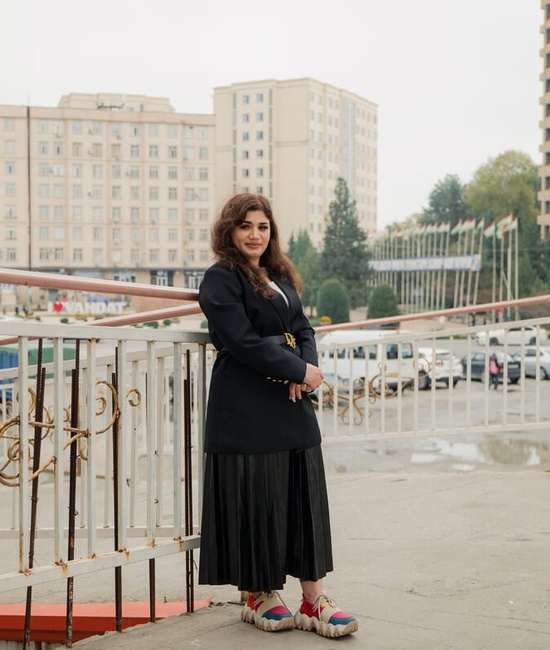
Negara, from Afghanistan, is a graduate of Economics from the National University of Tajikistan and the Asia-Pacific Regional winner of the 2025 Nansen Award.
Negara
"Before the DAFI scholarship, I knew I wanted to attend and finish my university, but I always said I want to work two years then figure it out. My family pushed and poked my brain to really determine what I want to do in a country where you are a refugee with no guaranteed future. They made me realize how hard it is to start working and start a new life. I then figured out that I wanted to get my degree in economics, but I also wanted to start an education system which will serve all Afghans. As I continued to learn about the area of education rights, I was drawn to the social work perspective because of my interest in an “education” approach to aiding women because they don’t have access to education in their own countries.
Now, through experiencing the value of higher education and meeting new people, I have been able to refine my professional plan of creating an education center by the name of ALC (Ariana Learning Center). At ALC we are working for Afghan refugees since 2020 and now we are the leading education center in Vahdat with approximately 1500 students.
[My experience with] DAFI helped me to build the education center and start my work as founder. The experience [of starting ALC] allowed me to observe the public service career path. I learned from DAFI that I can do both and that I want to go into a world where education should be free, and it should be available for all."
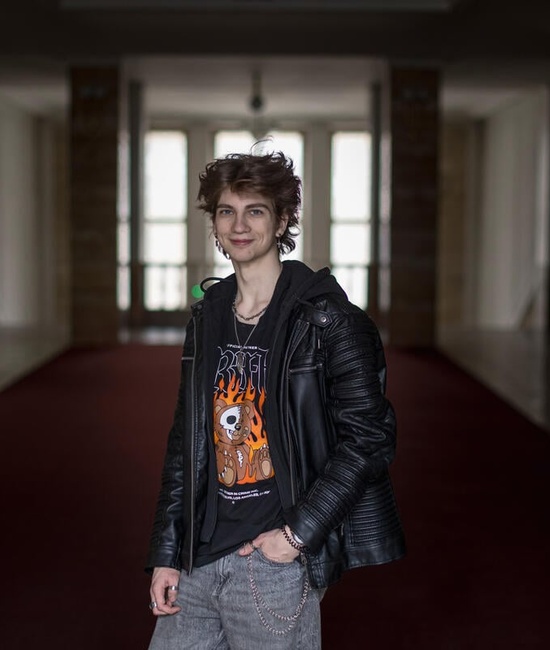
Reidzio, from Ukraine, is a DAFI student of Central European Studies at Comenius University, Slovakia.
Reidzio
Growing up in Pavlohrad, Ukraine, Reidzio always had a passion for studying. He was nine years old when the conflict started in Donbas (Ukraine) in 2014 and it had a great influence on his view of the world, questions about human behaviour and interest in politics. Reidzio reminds us, “History is key. A lot of people use it as a weapon, whereas it should be used as an instrument to learn from the issues that happened and the mistakes that were made, in order not to repeat them”.
When war broke out in Ukraine in 2022, Reidzio was evacuated with his mother and brother to Slovakia. After spending a summer working as a bartender in a hotel to support his family, Reidzio moved to Bratislava on his own to study at university.
During his first semester, he found it difficult to balance a full class schedule with work on the weekends. Since securing a DAFI scholarship, Reidzio can dedicate more time to studying and building a new community of friends in Bratislava. He explains that because of the DAFI scholarship, “My whole life belongs to me now. University has allowed me to progress, to become someone who has more confidence, who is not afraid to speak in public, to express their views, to be more open.”
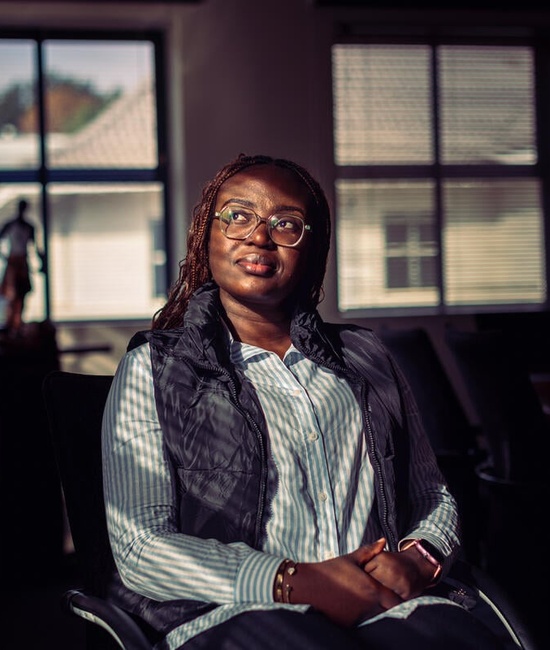
Sarah, from the Democratic Republic of the Congo, is a graduate of Development Studies and Anthropology from the University of Johannesburg and now works at the Mandela Institute for Development Studies.
Sarah
Each day at work, Sarah learns from youth and leaders from different sectors and is inspired by their impact across the African continent. She firmly believes that “Refugees who are granted opportunities grab them and make the best of them.” A DAFI alumna, Sarah is now a Programme Officer in the African Heritage Programme at the Mandela Institute for Development Studies (MINDS).
Sarah left the Democratic Republic of the Congo for South Africa when she was seven years old, along with her mother and six siblings. She was always a strong, driven student and excelled in her education. However, as scholarship opportunities she sought turned her down for being a foreigner, she realized things would not be so simple. University was simply too expensive and she thought high school would be the end of the road.
Nevertheless, she registered at the last minute and, after her first year at university, she was awarded the DAFI scholarship. Even so, she worried about what would happen next, explaining, “I volunteered in so many organizations, mainly impacting underprivileged youth. I also worked on many fundraising projects. That is actually how I landed my first job, by networking and speaking to many different individuals.”
Reflecting on her work and journey to higher education, Sarah explains, “Change starts with one person: you create that change and then you hold the next hand. Through collaboration, there will definitely be more refugees like myself who are going to school and can fly with their own wings, without depending on anyone.”
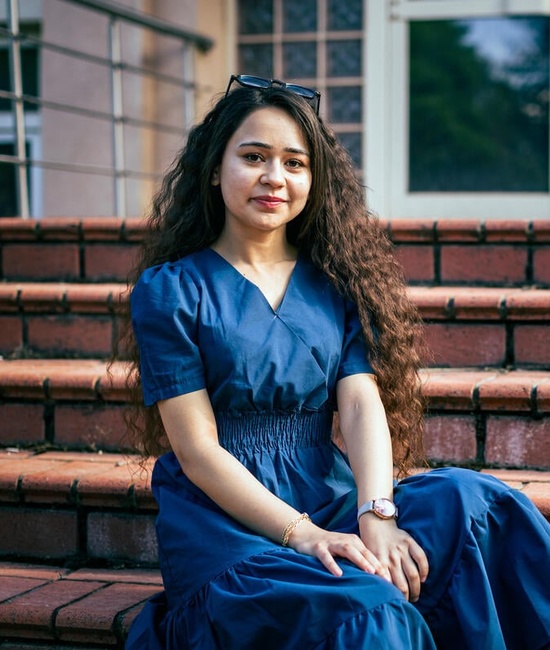
Roshin is a DAFI student from Kobani, Syria, studying nursing at Gaziantep University.
Roshin
When Roshin arrived in Türkiye from Kobani, Syria, in 2015, she faced a world where she didn’t speak the language and felt the weight of discrimination. But she was determined to prove herself.
“I wanted to break down prejudices,” she says. Kurdish is her mother tongue, but she spent two years in an Arabic-speaking school before moving to a Turkish school. She worked tirelessly, asking questions, reading constantly, and earning top marks. By ninth grade, she had the highest score in her school – 98%. “The first five students were Syrians. We proved we could be just as good, if not better.”
Roshin dreamed of becoming a brain surgeon, but medical school was too expensive. Instead, she chose nursing, starting at Gaziantep University in 2021. When she secured a DAFI scholarship, it lifted a huge financial burden. In her words, “With more support, we can have more opportunities.”
She wishes to specialize in psychiatry or psychology. “Mental health is a field that is more and more needed. Only human beings can understand other human beings. In other words, only humanity can heal humanity,” she says.
During the 2023 earthquake, Roshin used her nursing skills to help at a local clinic, realizing how much more there was to learn. Next, she hopes to further her education in the Netherlands and, continuing to demonstrate her ambition and determination to help others, Roshin is already learning Dutch.
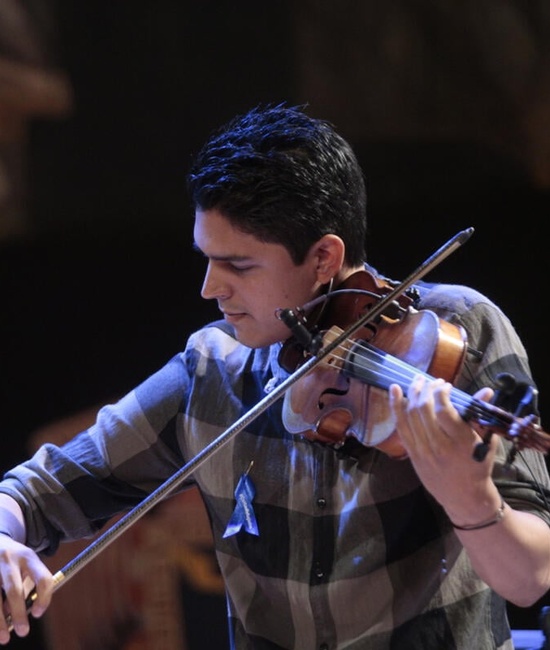
Sayd, a DAFI student from Venezuela studying music at the Universidad Nacional Autónoma de México, plays the violin during the first live concert of 'Palomazo por los Refugiados'.
Sayd
From as early as 12 years old, Sayd studied in ‘El Sistema’, formally known as the ‘Foundation for the National Network of Youth and Children Orchestras of Venezuela.’ The school’s focus was on music as the primary avenue of social and intellectual transformation. The founder, Maestro Anibal Antonio Abreu, was known to say, “Someone who picks up an instrument will never pick up a gun.”
This is where Sayd fell in love with music. “I found it and it found me in a way. I saw so many possibilities, so many opportunities. Music is a universal language.” He eventually achieved semi-professional status and was playing in an orchestra while teaching as well. However, the situation in Venezuela deteriorated rapidly and Sayd had no choice but to leave the country. “It was very unstable. I could not pursue my objectives nor my dreams. In the end, I was just surviving, not really living.”
He arrived in Mexico alone, with only his suitcase and his violin, and almost right away, researched ways to resume his studies. He learned about the Faculty of Music at the Universidad Nacional Autónoma de México (UNAM), spoke with students and met Savarthasiddh Uribe Moreno, who oversees violin studies at UNAM and became a mentor to Sayd. Moreno helped him to prepare for his audition and Sayd was admitted.
Once he started his degree programme, receiving the DAFI scholarship gave him “the support and tranquility I need to be able to concentrate on my studies and dedicate time to my instrument.” Without the support of DAFI, he would not have been able to continue his studies and pursue his dream of becoming a professional musician.
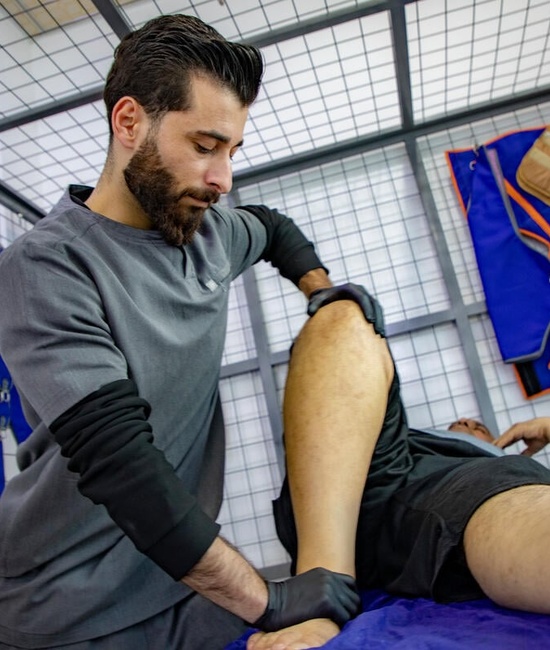
Fawaz is a DAFI alumnus, now running a physiotherapy centre in Erbil, Iraq.
Fawaz
Fawaz, a DAFI alumnus and Syrian refugee in Erbil, runs a busy physiotherapy centre where he and his Iraqi colleagues provide treatments like electrotherapy, acupuncture, and dry needling to help both refugees and locals manage pain.
After fleeing Syria in 2013, Fawaz pursued higher education in Erbil. He earned a bachelor’s degree and overcame financial challenges with the support of a DAFI scholarship. He was determined to integrate into his new community and volunteered as a physiotherapist while studying at university.
Later, Fawaz co-founded his own centre with local graduates. This is more than a job for him; it is a chance to give back and help patients regain mobility and independence. Fawaz explains, “We cannot add days to a patient’s life, but we can add life to their days. I am proud to help people and make a difference in this community.”
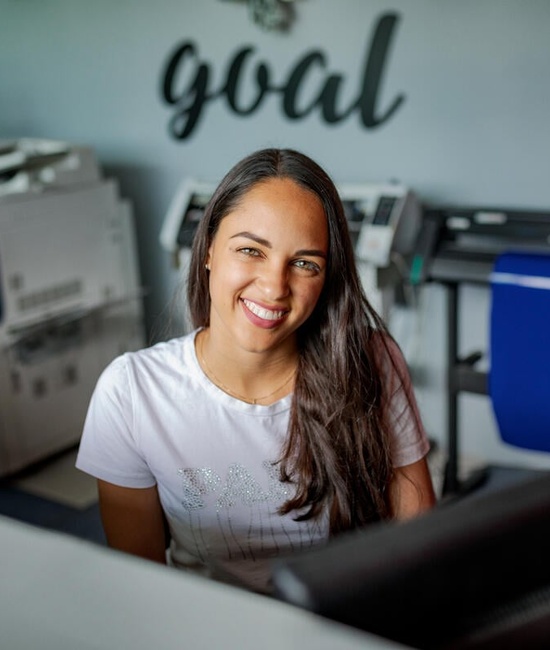
Leidys, from Caracas in Venezuela, a student of Graphic Design at the University of Professional Studies in Science and Arts in León, Mexico on a DAFI scholarship.
Leidys
Leidys has always been a strong student with the determination to continue her education, no matter what. She was accepted to study in a highly competitive architecture programme at the Central University of Venezuela. However, as the country’s economic, social and political situation deteriorated, she spent nearly a semester out of school due to protests and an attack on the university.
When Leidys arrived in Mexico, she struggled to secure a job and told herself, “you have to study, you have to study, you have to study.” She could not believe it when she was awarded the DAFI scholarship. “It is a huge, huge, huge help. Without it, I would be working but not studying, that is certain.”
When the COVID-19 pandemic broke out, she was only able to continue her studies because of the DAFI scholarship. She eventually secured a job in a print shop and explains that in the future, she wishes to start her own business. “That way, I could provide opportunities to others.”
Her message to the world? “When you work hard and you really want something, it eventually materializes. I am very grateful for everything that has happened to me.”
- Total new scholarships: 879
- Total graduates: 1,741
The strategic priorities of the DAFI programme are to:

Promote refugee self-reliance
through increased access to opportunities for employment and entrepreneurship

Empower students to contribute knowledge, skills and leadership
and to facilitate peaceful coexistence with host communities during displacement and upon return

Strengthen the protective impact of education
by encouraging lifelong learning

Provide role models for refugee children and youth
to demonstrate the impact of education on individuals, communities and societies
The scholarship covers a range of costs, including tuition, fees, study materials, food, transportation, accommodation and other expenses.
To amplify academic achievement and skills development, DAFI scholars receive additional support through close monitoring, academic preparatory and language classes based on students’ needs, as well as mentoring and networking opportunities. DAFI student clubs and alumni groups are active in many countries and make valuable contributions in the communities that host them.
Additional information
If you are a refugee looking for a scholarship, please select a country in the dropdown below to find contact details for your nearest UNHCR office.
If you submitted feedback or an enquiry through our contact form from January-April 2026, unfortunately we did not receive it due to a technical issue with our form. Please check back soon for an updated contact form.


