
By: Patricia Sleeman, Archivist (Digital Preservation), Records and Archives (RAS)
History Marches On.
75 Years of History, 10 Years of Digital Preservation: Capturing UNHCR’s Web Past, Present and Future
Ten years ago, UNHCR’s history was already digital. Today, it can feel overwhelmingly so. Websites and social media form part of our institutional memory, documenting how UNHCR communicates, shares information and responds to a changing world.
But the web is not permanent. Websites are redesigned and decommissioned, platforms change, content moves or disappears on an estimated 4-5 year cycle. What is accessible today can be gone tomorrow. UNHCR’s Policy on External Digital Presence recognises this risk, calling for preservation throughout the lifecycle of websites and social media and early engagement with Records and Archives on decommissioning.
Archivists are seen as guardians of the past, but we are also future thinkers. We make decisions today about what tomorrow will be able to remember.
Kim Stanley Robinson’s novel The Ministry for the Future imagines a UN body that speaks for generations to come, yet it never turns to a question archivists face every day: how to future-proof the digital information on which tomorrow’s memory will depend.
That is the work RAS has been doing for a decade through web archiving, capturing and preserving digital information for long term usability before it changes or disappears.
Following a changing Data Portal landscape
On 22 October 2026, UNHCR launched the Refugee Data Portal, providing a timely moment to look back at the changing digital services through which UNHCR has made data available.
RAS has tried to capture this changing landscape through web archiving. Five data platforms were archived between 2015 and 2025: the Operational Data Portal, Refugee Data Finder, Data Visualization platform, Joint Data Centre and Reporting.
Together, the captures show how UNHCR’s digital data landscape, and the way it communicates information, have changed over time. A website that once seemed current can quickly become a historical record.
But capturing a website is not always enough. We also need to preserve it and its meaning.
Why a website is Never just a website
A website is more than what appears on screen. Behind it sit content, metadata, relationships, technologies and workflows. Preserving only the visible surface risks losing the context needed to understand it.
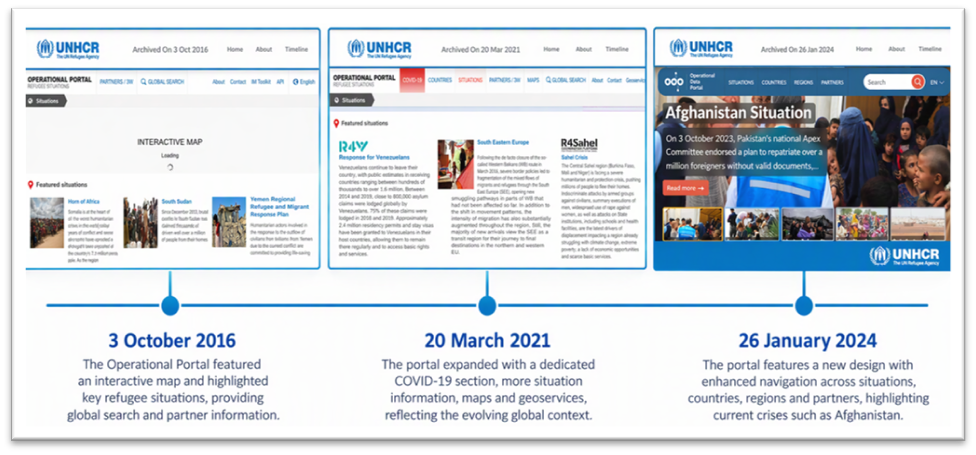
The Operational Data Portal(ODP) provides a good example. Its 2018 Operational Data Portal User Guide shows how population figures, statistics, documents, news and external sources were brought together through Country and Situation Views.
Image: Operational Data Portal web archive timeline. Source: UNHCR Records and Archives Web Archive.
The guide reveals what a web capture alone cannot: how that environment worked. It documents how pages were assembled and information managed, including connections to Power BI and Tableau visualisations, while metadata tags linked content to Country, Situation and sub-location pages.
The guide is therefore part of the archival record too. The web archive preserves what users encountered; documentation and preservation metadata explain the structures, processes and context behind it. A digital object can survive while its meaning is lost, so we need to preserve enough context for it to remain understandable and trustworthy.
Ten years of Digital Preservation
RAS recognised this challenge early. Web archiving was established in 2015, followed by development of the wider digital preservation and digitisation programme from 2016.
In 2020, RAS collectively received a global Digital Preservation Coalition Award for its digital preservation work over 25 years.
But pioneering a programme is only the beginning; it needs maintenance. The web never stops changing, and neither does UNHCR’s wider digital environment. The same principle, intervene before information disappears, applies when entire systems reach the end of their lives.
Whether we are preserving a website, platform documentation or records from a decommissioned system, the objective is not simply to retain data, but to identify what has continuing value and preserve enough context for it to remain findable, understandable and trustworthy.
Requests to capture web and social media content before decommissioning have risen sharply across UNHCR during this time of change. Each asks essentially the same question: if this disappears, what should remain?
A Challenge Beyond UNHCR
The challenge extends beyond our organisation. There is growing awareness of the vulnerability of humanitarian and global-health archives, records and datasets during a period of profound change across the sector.
Ten years and 180 terabytes later, with 170 TB in the digital preservation system and 10 TB in the web archiving solution, the principle remains simple: digital preservation is not about saving everything forever, but about making deliberate choices now so that evidence of continuing value can still be found and understood tomorrow.
History Marches On
History does not stand still, and neither does the web. Pages change, platforms are replaced and systems reach the end of their lives, yet these environments contain evidence of UNHCR’s work, communications and institutional development.
RAS skills evolve alongside the records themselves. We need to understand the platforms, formats, metadata and dependencies on which today’s information relies and recognise when to intervene before it is lost.
Web archiving and digital preservation are not departures from archival practice; they are archival practice carried forward into a digital world that never stands still. We may be guardians of the past, but our work is for the future.
Happy World Digital Preservation Day 2026 everyone!