As the world convenes in Antalya for COP31, UNHCR’s Innovative Financing Delegation will bring together governments, investors, financial institutions, private sector partners and humanitarian actors to explore how new forms of finance can support climate resilience, nature restoration, self-reliance and longer-term solutions for communities affected by displacement.
Humanitarian financing is changing.
Protracted displacement and growing climate and environmental risks are placing pressure on a system that is extremely challenged. At the same time, there is growing recognition that some of the challenges facing displaced and host communities require longer term investment, stronger partnerships and different forms of capital. This makes COP31 an important moment for this conversation. The COP31 Presidency has put implementation at the centre of the conference, with finance, technology and capacity building identified as enabling conditions across its climate priorities.
For UNHCR, these priorities are closely connected to the realities of displacement. Climate change, environmental degradation and displacement increasingly intersect in the same places, putting pressure on land, natural resources, livelihoods, and the services on which communities depend. Yet these settings remain among those least reached by long term climate finance.
For UNHCR, innovative financing is part of that shift.
The aim is not to replace humanitarian funding, but to complement it with financing approaches that can mobilise additional capital, share risk differently and support investments that can generate value over time. The Refugee Environmental Protection (REP) Fund is one example of what this can look like in practice.
Our ambition is making sure refugee hosting areas can become part of the climate investment landscape, and utilize innovative financing to create longer term pathways for environmental recovery, livelihoods and resilience. That means working with governments to create the right enabling conditions, with private sector partners to develop and finance projects, with technical organisations to strengthen implementation and evidence, and with communities to ensure that investments respond to local priorities.
Throughout COP31, the Innovative Financing team will convene partners and participate in a series of discussions on how to make that happen. Our programme also reflects the priorities running through the COP31 Presidency’s agenda, from climate finance and carbon markets to just transition, science and evidence, nature and ecosystem restoration, and access to finance for implementation.
Please see below for an overview of our programming. We hope you can join us.
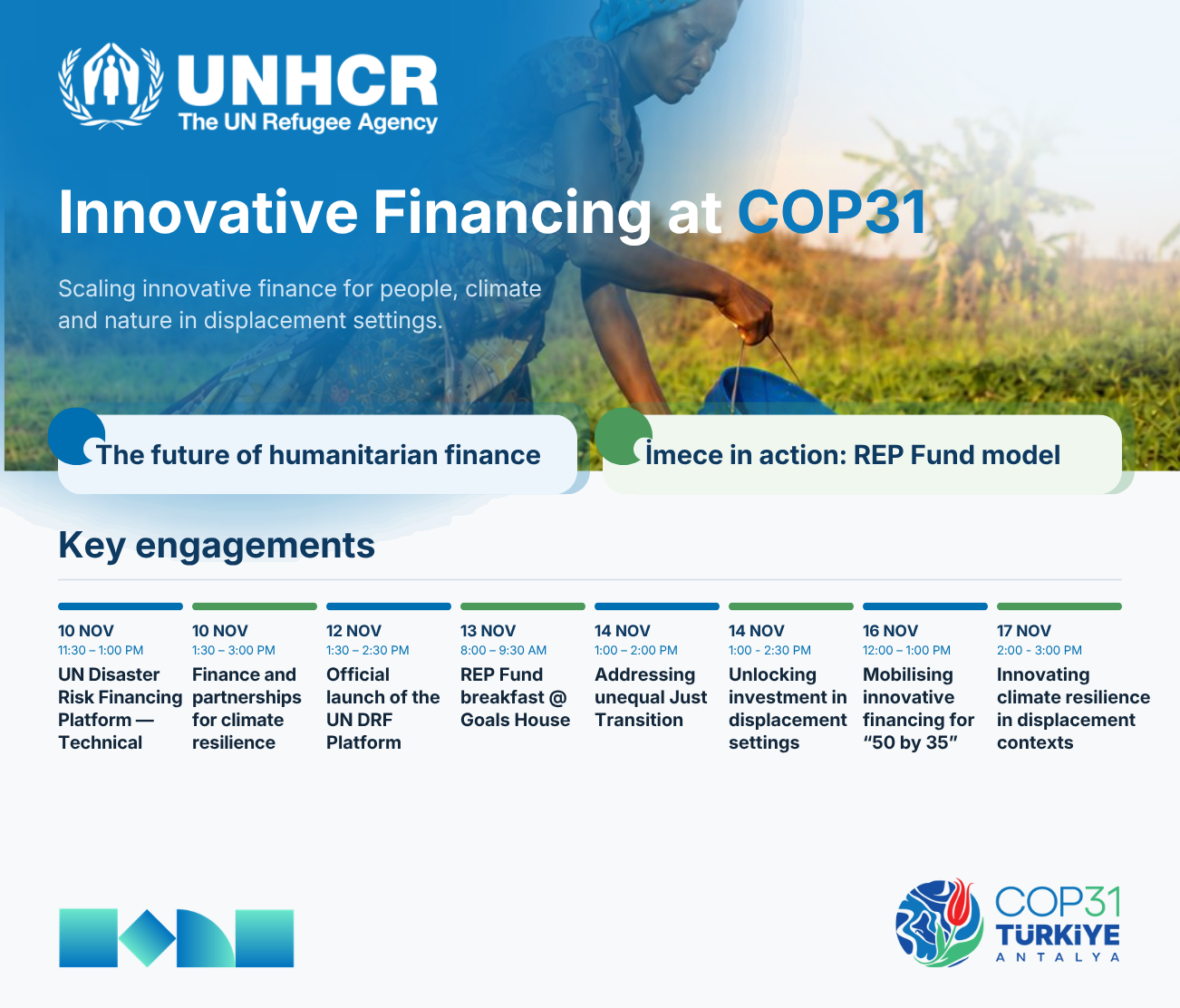
COP31 programme
10 Nov, 11:30 to 13:00 | Side event room 4,
|
UN Disaster Risk Financing Platform: Technical introduction The session will introduce the UN Disaster Risk Financing Platform for Pre Arranged Humanitarian Financing and explore how risk financing, shared analytics and coordinated approaches can strengthen anticipatory action and financial protection for vulnerable populations facing climate and other shocks. The discussion will bring together UN agencies, donors, technical partners and practitioners ahead of the Platform’s formal launch later in the week. |
10 Nov, 13:30 to 15:00 | Italian Pavilion,
|
From commitments to action: finance and partnerships for climate resilience This joint event with Interreg NEXT MED will explore how partnerships and innovative finance can translate climate commitments into concrete action. The session will bring together experience from the Mediterranean and East Africa, including the REP Fund, to examine how cross border cooperation and community led finance can reach people and places that finance too often misses. |
12 Nov, 13:30 to 14:30 | UK Pavilion,
|
UN Disaster Risk Financing Platform: Official Launch The formal launch of the UN Disaster Risk Financing Platform will bring together governments, UN agencies, financial institutions and partners to explore how pre arranged financing can strengthen climate resilience and move humanitarian action from reactive response towards greater preparedness.The Platform will set out its 2030 ambition and invite governments and partners to join a growing effort to strengthen financial protection against climate and disaster risks. |
13 Nov, 08:00 to 09:30 | Goals House, Ruin Adalia Hotel | Invite only |
Financing climate resilience in refugee hosting areas Held on COP31’s Finance and Trade Day, this private breakfast will bring together humanitarian, sustainability and investment leaders to discuss how capital can reach refugee hosting areas and support longer term climate resilience. The conversation will focus on the REP Fund and the role that private sector partners can play in scaling solutions that deliver environmental, social and economic value for refugees and host communities. |
14 Nov, 13:00 to 14:00 | ILO Just Transition Pavilion, Blue Zone |
A just transition that works for all: addressing unequal impacts Climate and economic transitions do not affect everyone equally. UNHCR, KOBiZE, Lahore Smog Collective, The Ministry of Agrarian Development of Brazil and UN ESCAP will bring perspectives from coal dependent regions, South Asia, Asia Pacific, family farming and refugee hosting areas to explore how data, social protection, clean air policies and innovative finance can help identify and address unequal impacts. |
14 Nov, 13:00 to 14:30 | ICC Pavilion,
|
Unlocking investment in displacement settings Climate finance is not reaching many of the communities most exposed to climate and environmental risks. Displacement affected settings face particular barriers to investment, including perceived risk, limited project pipelines, complex operating environments and insufficient financial and legal infrastructure. Drawing on the experience of the REP Fund, this session will bring together investors, corporates, advisers, legal experts and humanitarian actors to explore what makes investment in these contexts credible, investable and scalable, and what different actors can do to help unlock more capital. |
16 Nov, 12:00 to 13:00 | SDG Pavilion,
|
Mobilizing Innovative Financing for 50 by 35 UNHCR’s 50 by 35 vision aims to help millions of refugees in long term displacement move towards greater self reliance and pathways to solutions by 2035. Achieving that ambition will require more than humanitarian funding. It will require new sources of capital, stronger partnerships and new ways of sharing risk. Inspired by the Turkish concept of İmece, this session will bring together governments, financial institutions, private sector actors and refugee representatives to explore how climate and innovative finance can contribute to longer term investment in refugee hosting areas. |
17 Nov, 14:00 to 15:00 | CGIAR Pavilion,
|
From land rights to finance: innovating climate resilience in displacement contexts Climate resilience in displacement contexts is not simply a question of technology or capital. It also depends on whether people have the legal conditions to act, whether finance can reach the context and whether evidence can demonstrate what works. This session will bring together perspectives from law, finance, science and humanitarian practice to explore how these pieces can work together.The session will also mark the launch of a five year partnership between UNHCR and WFP, bringing together innovative climate finance with satellite based environmental monitoring and geospatial analysis. |