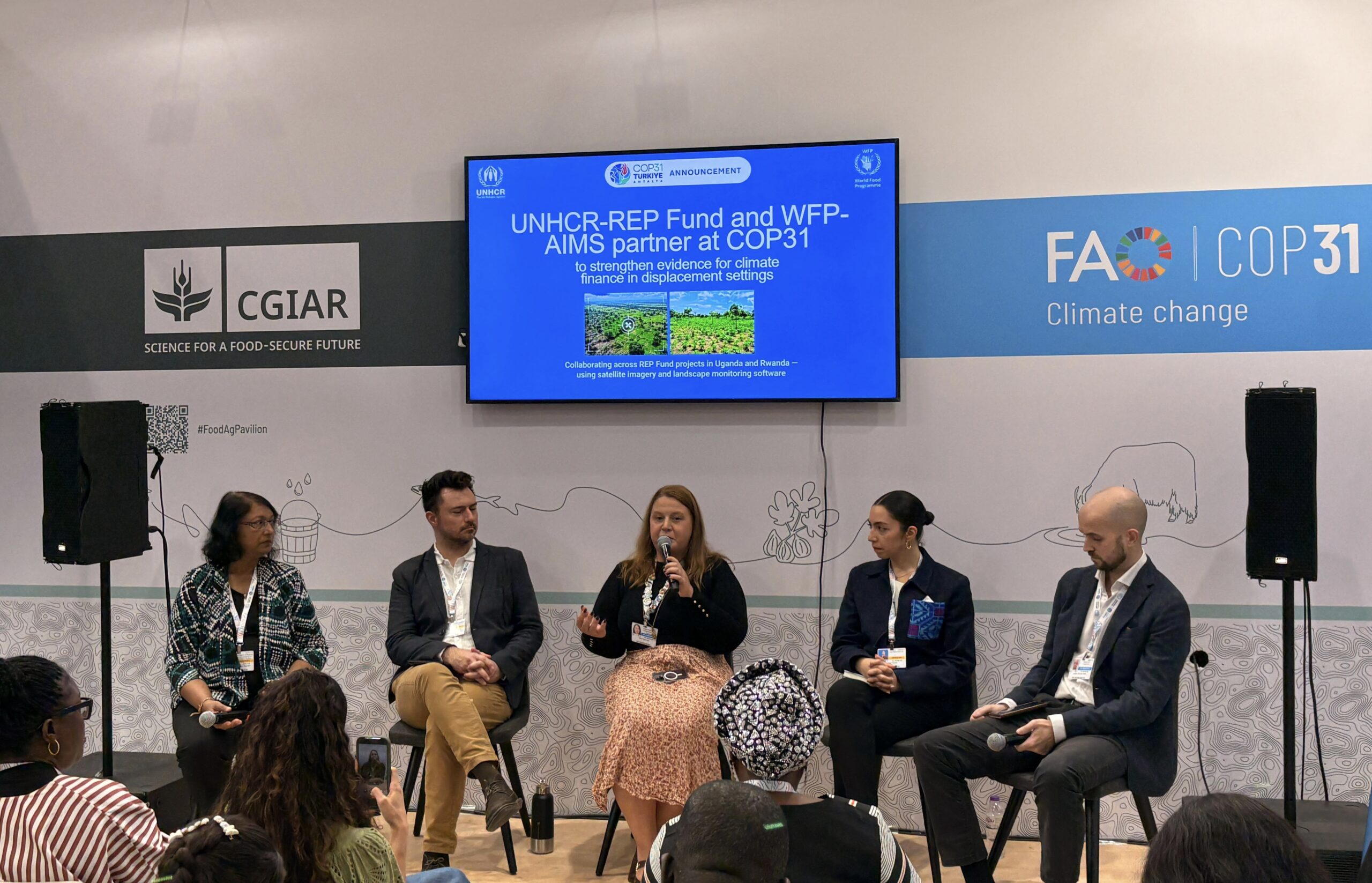
Refugee hosting areas are among the places most exposed to climate and environmental risks, yet they remain difficult to reach with long term climate finance. One of the challenges is being able to demonstrate whether investments are delivering lasting results. At COP31, UNHCR and the UN World Food Programme are taking a step towards addressing that challenge.
The two agencies have announced a five-year partnership bringing together UNHCR’s Refugee Environmental Protection (REP) Fund and WFP’s Asset Impact Monitoring from Space, or AIMS. The partnership will combine the REP Fund’s work on innovative climate finance with WFP’s expertise in satellite based environmental monitoring and geospatial analysis.
Making climate finance more measurable
The REP Fund is UNHCR’s flagship innovative finance initiative and the world’s first large scale carbon financing facility for refugee and host communities. It combines donor funding with carbon finance to support ecosystem restoration and clean cooking in refugee hosting areas, while creating opportunities for refugees and host communities to participate in and benefit from environmental investments.
AIMS brings a complementary capability. Using satellite imagery and landscape monitoring, it tracks changes in land condition, vegetation and water systems, including in remote areas. The technology can help verify whether physical interventions are in place and monitor changes in environmental conditions over time. WFP describes AIMS as a way of turning satellite data into objective evidence that can strengthen accountability and support better decision making.
For the REP Fund, this provides an important additional layer of evidence. Satellite monitoring will complement field-based monitoring and other sources of data, helping to build a more consistent picture of environmental outcomes across projects and countries.
“By bringing AIMS into the REP Fund, we are helping UNHCR strengthen how environmental outcomes are measured across its projects. Satellite data provides an additional, independent view of changes on the ground, complementing field monitoring and helping build the evidence needed to understand what is working, improve implementation and support future investment.”
A commitment to radical transparency
For UNHCR, the partnership is also about strengthening transparency around what climate finance delivers in some of the most complex operating environments.
The REP Fund’s first phase in Uganda and Rwanda is expected to restore around 7,000 hectares of degraded land, provide clean cooking access to more than 50,000 households and begin generating verified carbon credits. The Fund is also developing expansion pathways in other displacement settings, including Bangladesh and Brazil.
As the portfolio grows, the ability to consistently monitor environmental outcomes across different landscapes will become increasingly important. It can help identify where interventions are delivering results, where approaches need to be adapted and where further investment can have the greatest impact.
“For us, this is about radical transparency. If we are asking donors and investors to put capital into places that have historically been overlooked, we also need to be prepared to show clearly what that funding is achieving. That means being transparent not only about what is working, but also about what is not working so that we can course correct right away and what we can also share what we are learning along the way.”
Building the foundations for scale
The partnership builds on the progress made since the REP Fund projects were launched at COP30 in Belém, where UNHCR set out a new approach to bringing carbon finance into refugee hosting areas. In 2026, the Fund moved into implementation with the announcement of its first partners in Uganda and Rwanda. Bringing AIMS onboard is the next step in building the systems and evidence needed to support that growth.
As the Fund expands, this evidence will become increasingly important. Consistent environmental data can help projects learn and adapt, strengthen accountability to communities and funders, and provide investors with greater confidence that capital is translating into measurable results.
If the first phase of the REP Fund was about demonstrating that climate finance can reach refugee hosting areas, the next phase is about demonstrating what that finance can achieve. That means building projects that can deliver, evidence that can withstand scrutiny, and a model that can learn and improve as it scales. The partnership with WFP AIMS is an important part of building that foundation.