



From statelessness to belonging: Amida’s story and North Macedonia’s landmark victory
From statelessness to belonging: Amida’s story and North Macedonia’s landmark victory

Amina smiles proudly, holding her new ID card. After living stateless for more than five decades, Amida Demiri (55) finally received Macedonian nationality in 2025, with support from UNHCR, the UN Refugee Agency, and the Macedonian Young Lawyers Association (MYLA) — a moment she describes as being ‘born again.’
It is a warm summer day in the small village of Gradsko, North Macedonia. Amida Demiri is busy in the small kitchen of her home. Her lively grandchildren playfully run in and out of rooms and into the yard, where their own homes are just steps away. For Amida, the tight-knit family is her greatest source of happiness. At 55 years old, she recently received her official ID card and citizenship – a milestone for a country she’s called home her entire life. Holding her new documents, Amida’s face lights up with a bright smile, she cannot contain her happiness.
“I spent the largest part of my life without a nationality,” she recalls. “Without an ID, a nationality, or a passport, I felt as if I was locked away, imprisoned. I couldn’t travel even to nearby towns. Everyone else was moving, but I was standing still.”
For decades, Amida lived as though she didn’t exist. Her parents, who came from Kosovo* for work, crossed the borders of what was then Yugoslavia. The journey toward citizenship was long and filled with hardship. At one point she was fined for presenting an outdated Yugoslav ID card to the authorities. After undergoing heart bypass surgery, she faced the impossible task of paying for life-saving medication because she had no health coverage. But the deepest pain came when she was unable to visit her sister in Sweden during a family emergency. “I felt alone, as if I never had parents,” she recalls, her voice heavy with sorrow.
For decades, thousands of people in North Macedonia lived in the shadows of statelessness, caught in the cracks left by the breakup of the Socialist Federal Republic of Yugoslavia in 1991. People had to become formally registered in one of the six successor countries – a complex process for many who had spent their lives moving across the federation’s internal borders for work, marriage, or family reasons. Others came from mixed marriages, or were born in the territory of one country but had long resided in another. Suddenly, their long-settled lives no longer aligned with the new citizenship laws.
But thanks to persistent advocacy from UNHCR, the UN Refugee Agency, and its local partner, the Macedonian Young Lawyers Association (MYLA), as well as decisive legal reforms by the Government and the Parliament of North Macedonia, the country emerged in 2025 as the first in the region to resolve all cases of statelessness linked to the dissolution of former Yugoslavia.
For Amida, this positive outcome followed years of perseverance. In 2012, she met Aleksandra Efremova, a lawyer from MYLA, who took on her case and tried all options to help Amida achieve her fundamental human right – the right to a nationality. “I had cried and begged in institutions, but nothing happened,” Amida remembers. Following years of efforts, it was only with the 2021 amendments to the Law on Citizenship that resolving all Yugoslav-era cases finally became possible. Then one phone call changed her life. “Aleksandra called me: ‘You are going to become a citizen.’ I cried from happiness. She prolonged my life.”
The day she finally received nationality (in November 2023), Amida was trembling. “I felt as if I was born again. For the first time, I could dream of traveling, of seeing my sister. I felt the sky open above me.”
Since 2001, almost 20,000 stateless people have been granted citizenship in North Macedonia. In 2021, amendments to the Law on Citizenship provided a legal solution for those living without a nationality since the dissolution of Yugoslavia. During the summer of 2025, authorities confirmed that no person in the country remains stateless as a result of Yugoslavia’s breakup. For the last 317 individuals who had lived in legal limbo since independence, citizenship has now brought dignity and security. Still, some challenges remain. Statelessness has not been fully eradicated - 147 people, most of them children, still lack citizenship due to missing birth registrations. The progress made is remarkable, but prevention and the creation of a robust statelessness determination procedure are essential.
“Statelessness reduction in North Macedonia is the result of years of close cooperation between state institutions, UNHCR, international organizations, civil society, media and academia, ensuring no one is left behind. By resolving all Yugoslav-era cases, the country has set the benchmark for the Western Balkans and is now a global example to others.”
- Gabriel Gualano de Godoy, Representative of UNHCR in North Macedonia.
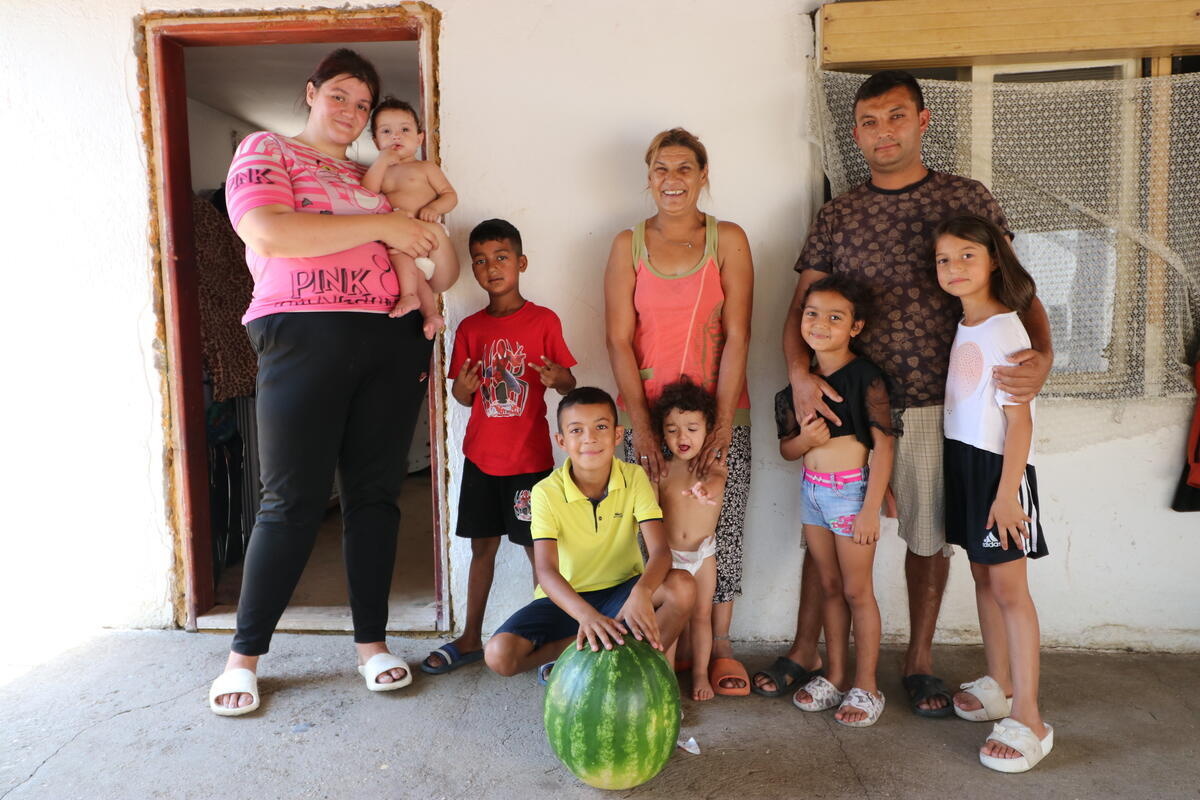
Amida together with her family. For more than 50 years, she lived without a nationality, unable to travel, visit doctors freely, or even hold an ID card. “I felt imprisoned, as if locked away, while everyone else was free to travel.”
For Amida, the moment she received her citizenship was life-changing and more than just a legal status. With access to social security, she could finally afford the medication that keeps her health. She could apply for a passport, and for the first time in her life, visit her sister abroad. “I am over the moon,” she says with a wide smile. “I am the happiest woman. I feel like I am floating in the sky.”
Her happiness is rooted in her family. At 55, she is a proud grandmother surrounded by children and grandchildren who no longer face the legal uncertainty she endured. Now, with her new identity card in hand, Amida can celebrate things that others may take for granted: visiting relatives, receiving care, and being surprised with a birthday party trip by her daughter-in-law. These are joys she once thought forever out of reach.
“To others who don’t have nationality, I would say: never lose hope. I was reborn when I became a citizen.”
For Amida, nationality is far more than a piece of paper – it’s a gateway to dignity, belonging, and the freedom she always dreamed of. Her journey reflects her personal triumph, but also the resilience of thousands of other stateless people in the world, who continue to fight for recognition and inclusion.
ENDS
* All references to Kosovo shall be understood in the context of United Nations Security Council Resolution 1244 (1999).


