



Women’s Race: the challenge that became a tradition

Women’s Race: the challenge that became a tradition
Viktoriia, after crossing the finish line of the Women's Race in A Coruña on 27 September 2026.
Rain threatens on the last Sunday of September in A Coruña, in north-west Spain. Clouds drift slowly over the Orzán cove, above a cobalt-blue sea. Another kind of wave, this one pink, rolls towards the seafront from inland. It is more than 7,000 women taking part in the Women’s Race (Carrera de la Mujer), cheerful despite the uncertain weather. Viktoriia is one of them.
She came to Galicia in late May 2022, just three months after a full-scale invasion of her country displaced millions of people within weeks. Nearly five years on, more than 5.6 million Ukrainians still live outside Ukraine and over 3.6 million are displaced inside it, according to UNHCR.
The pain of that moment, and the need to feel useful and help others, took Viktoriia to Santiago de Compostela, where she began volunteering with children. She went on to study for a master’s degree and continue her career, and Galicia has become her new home.

Viktoriia poses in A Coruña, the city she goes to every year from Santiago de Compostela to run the Women's Race.
Being part of something bigger
Viktoriia first ran in A Coruña in 2023. She had read about the Women’s Race and wanted to “be part of something bigger”, joining other women to celebrate health and women’s participation in sport.
That year, UNHCR, the UN Refugee Agency, and the Women’s Race began a partnership that continues today. It promotes access to sport for refugee women and girls in all nine races of the circuit, held in nine cities across Spain, with free bibs to help them take part, and it aims to raise their visibility. Many of them fled conflict and violence in which a race like this would have been unthinkable.
Viktoriia remembers that first race fondly. She recalls her nerves on the train from Santiago, about 70 kilometres away, and her surprise at the crowd of women in the race’s pink T-shirt: mothers with daughters, grandmothers with granddaughters, groups of friends, solo runners, babies in strollers. That year she heard about a runner who was almost 90. Viktoriia had arrived alone, but she found she was part of the crowd.
“That day, every year, I never feel alone, because every woman is here to share, to chat, to show her ability and her strength,” she says.
That sense of solidarity is the hallmark of the race, which began in 2004 and passed 1.6 million cumulative participants in 2025, making it the largest women’s sporting event in Europe.
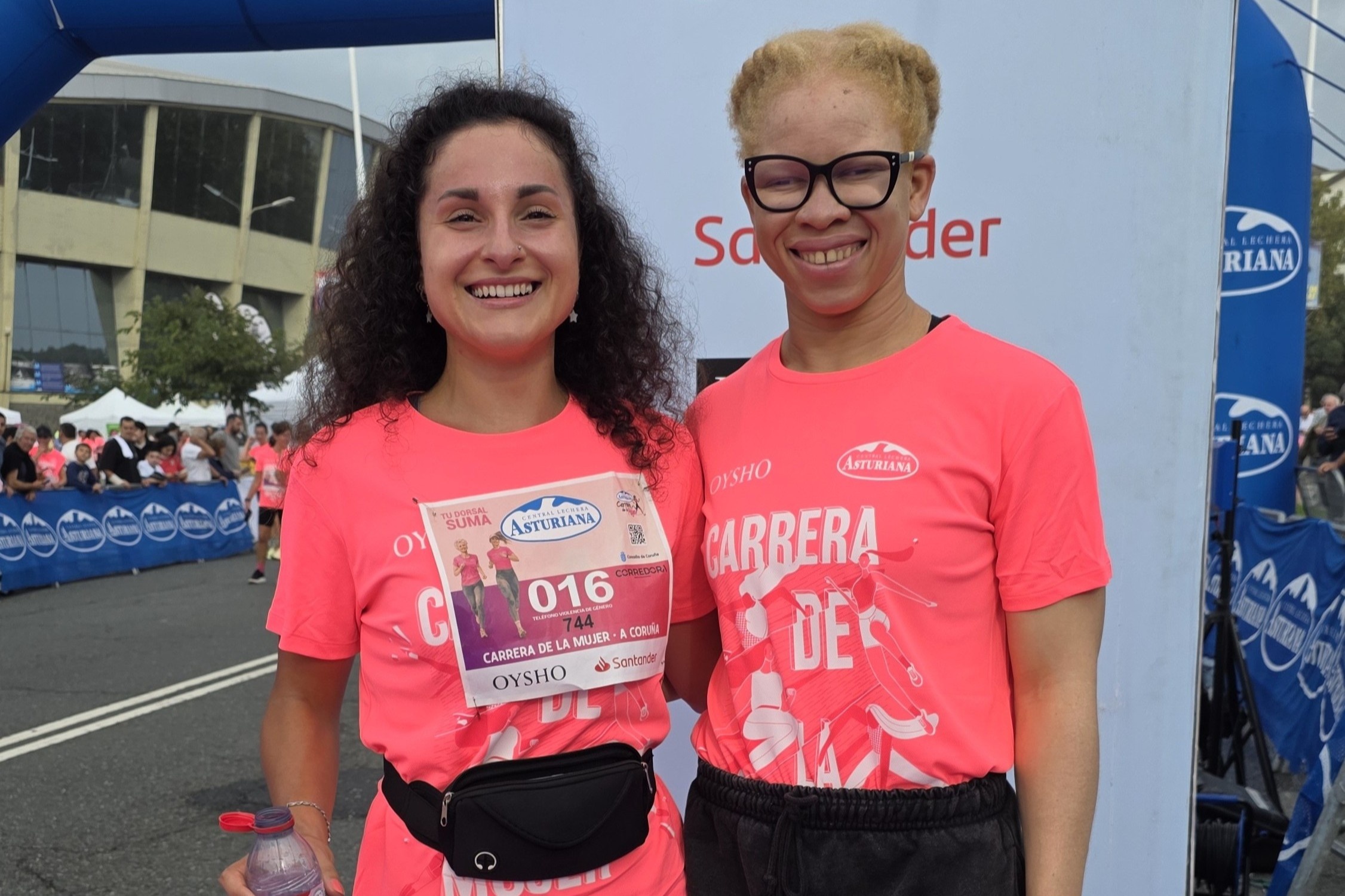
Viktoriia and UNHCR paralympic athlete Adi Iglesias at the Women's Race in A Coruña on 27 September. It was Viktoriia's fourth participation.
The race aims to promote sport and health among women and to raise the visibility of the fight against gender-based violence and inequality. In 2026 it also showed solidarity with people forced to flee, coinciding with the 75th anniversary of UNHCR and the 1951 Refugee Convention. As well as encouraging refugee women to take part, organizers symbolically dedicated one kilometre of the route to people forced to flee, for whom running is sometimes not a choice but a way to save their lives.
Around thirty refugee women and asylum-seekers took part alongside Viktoriia, from countries including Ukraine, Venezuela, Mauritania and Côte d’Ivoire. Paralympic athlete and UNHCR High-Profile Supporter Adi Iglesias fired the starting pistol. Adi also arrived in Spain fleeing persecution she faced because of her albinism. Today she is one of Galicia’s best-known athletes and the subject of the short documentary Adi, filla da luz.
Sport as a tool for inclusion
For UNHCR, sport is much more than physical activity. It can support psychological well-being after very difficult experiences, and it builds bonds that help overcome barriers such as language, background and culture. In 2022, the agency published its first sport strategy, More Than a Game, to expand the use of sport for the benefit of displaced and stateless people.
Viktoriia knows this from her own experience. When the news overwhelms, saddens or angers her, running helps her manage those emotions. “Before I run, I can feel unable to do anything, and afterwards I feel much more confident,” she says.
Her relationship with the race has changed too. In her first race, finishing was what mattered. Now she trains every week and sets her own goals. Even so, she says taking part is what counts, and she tells the people around her that it is not that hard, or that important, to run the whole course.
For refugee women and girls, safe and inclusive places to play sport are especially important. They are where bonds form with other women, with the community and with the place they now live, bonds that are essential to rebuilding a life after displacement.
To other refugee women who are unsure about signing up, Viktoriia says: “Take a step forward and you will surely find people who support you. Sharing something together helps a lot in getting through difficult times.”
The Women’s Race in Spain. The circuit takes place annually in nine cities: Las Palmas de Gran Canaria, Valencia, Madrid, Vitoria-Gasteiz, Gijón, A Coruña, Zaragoza, Seville and Barcelona. The partnership with UNHCR offers free bibs to refugee and asylum-seeking women and girls in all of them. In 2026 alone, more than 100 women have benefited from the initiative.
Related news and stories


