



Returning with hope: Muhammed and Hussein’s journey back to rebuild Syria
Returning with hope: Muhammed and Hussein’s journey back to rebuild Syria

Syrian refugees wait at Derabon Centre to process return applications.
At the Derabon Return Centre in Zakho, the air is filled with warm conversations of hope and memories of home. Among those waiting, 29-year-old Muhammed sits beside his mother, clutching their documents tightly in his hands. After years of displacement, they are just one step away from returning home to Syria through the Peshkhabour border crossing.

Syrian refugees wait at Derabon Centre to process return applications.
“If we do not return and rebuild our country, then who will?” Muhammed says, his voice steady with conviction.
Muhammed fled Syria in 2013, carrying little more than his skills as a carpenter. He sought refuge in Erbil, Iraq, where he registered with UNHCR and obtained government-issued documentation which allowed him to rebuild his life through establishing a small sofa-making business. “This was my profession before the war forced me to leave,” he explains.
After more than a decade living in refuge, Muhammed has now made the voluntary choice to return to Syria. Though the choice is bittersweet, he speaks fondly of the life he built in Iraq. “We lived with the people of Erbil like a family. They welcomed us and treated us with kindness,” he recalls.
But his heart has always remained in Syria. “Syria is the home we belong. We have been waiting a long time for this moment” he says.

A UNHCR protection staff counsels Muhammed and his mother before their voluntary return to Syria.
The Syrian conflict, which started in 2011, devastated the country, leaving over 6.8 million Syrians, like Muhammed and his mother, displaced and uncertain. Yet, Muhammed’s determination to return is fuelled by hope. “I will visit my sister in Hassakah. I have not seen her in 10 years,” Muhammed shares.
Located just 10 kilometres from the Peshkhabour border crossing, at the Derabon Return Centre UNHCR staff provide counselling, carry out de-registration and record the return. This process is important as it will also enable UNHCR in Syria to have information about their return.
35-year-old Hussein Walid from Aleppo has also come to the centre on his journey to return to Syria with his wife and three children. He fled in 2013 and similarly built a life in Erbil, running a small business selling home decorations. Despite this he faced challenges with his documentation.
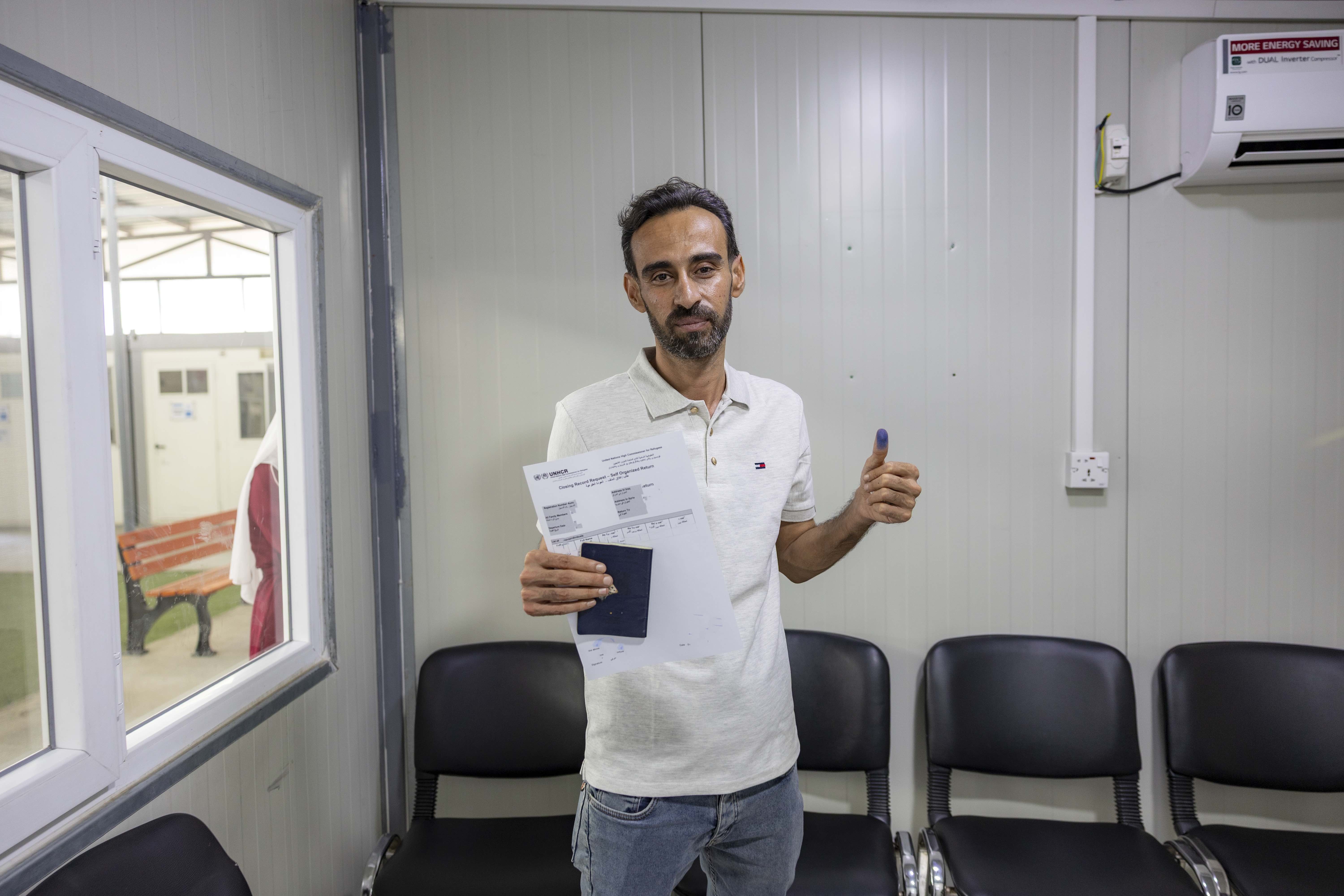
Hussein flashes an ‘okay’ sign after completing his return application to Syria.
“My residency expired over four years ago. I could not afford the fines to renew it or return home,” Hussein says. “I felt lost.”
Recently, however, a decision of the Kurdistan Regional Government to grant a 60-day grace period, effective from 15 June, to allow Syrians – including refugees and asylum seekers – to regularize their stay or return home without incurring penalties has provided an opportunity for families like Hussein’s. “I was very relieved. This decision removed a major obstacle for many of us,” he adds.
Now ready to return to Aleppo, Hussein plans to open a printing shop and rebuild his life.
Iraq currently hosts over 340,000 Syrian refugees, approximately 90 per cent of whom live in the Kurdistan Region. A survey carried out by UNHCR in early 2025 revealed that 12 per cent of refugees in Iraq plan to return in the next year. Between January and June 2025 alone, over 2,500 Syrians registered with UNHCR have voluntarily chosen to permanently return home.
“We should never lose hope. Life is about working hard and not giving up. I want to rebuild my life, support my family, and help my country.” Muhammed concludes.
Still, many remain hesitant. While 63 per cent say they hope to return one day, ongoing insecurity – particularly in northeast Syria – remains a major barrier.
UNHCR is dedicated to ensuring that refugee and asylum seekers returns are voluntary, informed, and conducted with dignity.
Lilly Carlisle contributed reporting to this story.