



In Biringi, a South Sudanese mother works to rebuild her family’s future
In Biringi, a South Sudanese mother works to rebuild her family’s future

''Thanks to a small business, I sell farm produce, fish, and other items at the Biringi market to provide for my children.'' Vicky Apuku, South Sudanese refugee in the Democratic Republic of Congo.
In Biringi, Ituri province, eastern Democratic Republic of the Congo, Vicky walks through the market stalls with the same determination that helped her survive the war. At 39, a mother of five, this South Sudanese refugee now sells salted fish and farm produce to support her family, after fleeing violence that changed her life forever.
“From my village of Yei, on the border between South Sudan and the DRC, we fled for two days. Day and night, we were exposed to heavy gunfire without knowing why. My husband was killed on the road. By God’s grace, my children and I reached the DRC. Since then, I have had to be both father and mother,” Vicky said.
Like thousands of other South Sudanese, Vicky fled a conflict that continues to uproot families. Fighting between Dinka and Nuer communities has already displaced more than 4 million people. In 2026, over 33,000 South Sudanese refugees are hosted in the DRC, alongside hundreds of thousands in neighboring countries such as Uganda and Sudan.
Before the war, Vicky lived a stable life with her family. Today, she is trying to rebuild her future in Biringi camp, which shelters more than 7,000 people.
“The life I knew ended abruptlyended abruptly. I was a homemaker and farmer, I ran a small business, raised goats and poultry, and practiced manual trades. We lived with dignity: our children went to school; my husband worked in transport. Today, we have lost everything and don’t know where to start again,” she says.
In Biringi, UNHCR organizes reception and accommodation for refugees, while supporting activities that help displaced families regain autonomy and use their skills. Thanks to the partnership between UNHCR and the Mastercard Foundation, interventions increasingly focus on education, livelihoods, and economic empowerment. Between 2025 and 2030, this partnership will support more than 25,000 refugee children in school and create over 37,000 jobs through income‑generating activities.
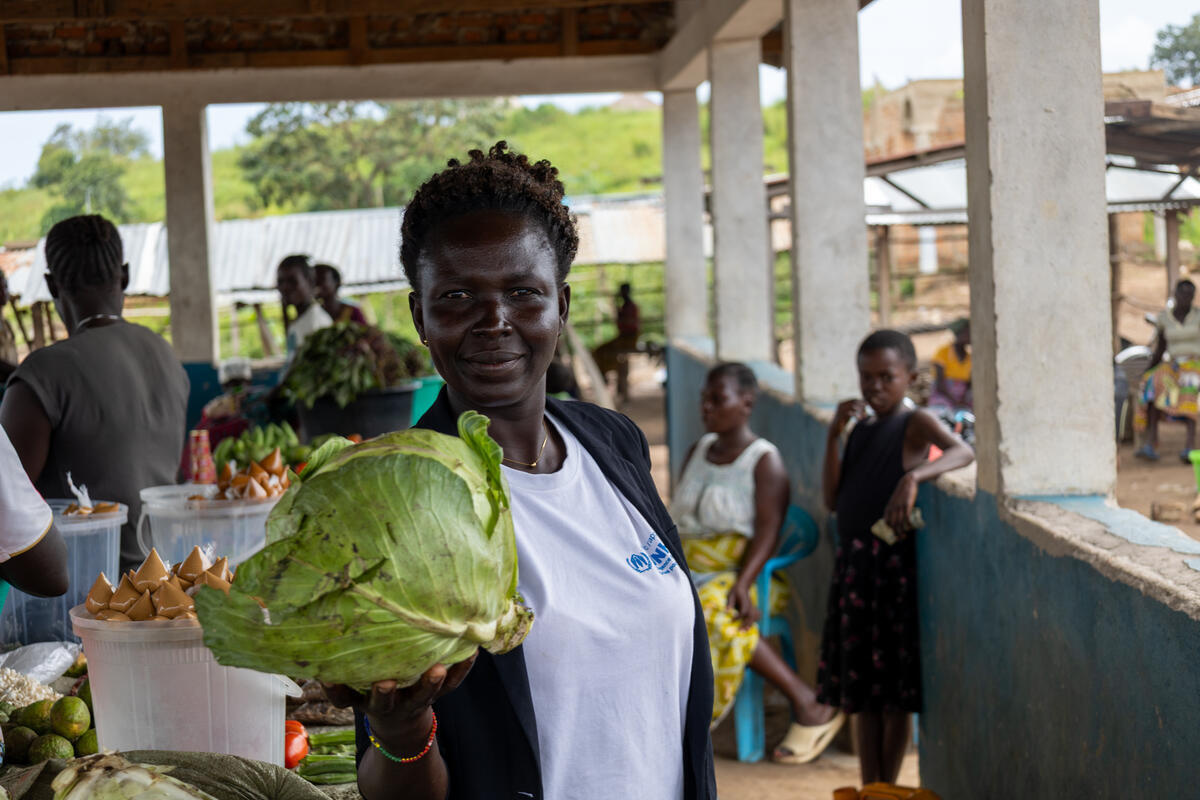
With support from UNHCR and partners, refugees like Vicky Apuku, a widow and mother of five, can earn an income, support their families, and build greater self-reliance.
For Vicky, resuming small trade has been a first step toward rebuilding.
“To survive, I sell salted fish and farm produce at the market. Each sale allows me to meet my family’s basic needs,” she explains.
Yet despite this resilience, needs remain immense—especially for access to secondary education. Refugees in the camp can attend free primary education in the public system, but secondary schooling must be self‑funded, which many families cannot afford. The UNHCR–Mastercard Foundation partnership directly addresses this gap by supporting continuation of secondary studies.
“If our children study, our future will change. It will save our generation, because many of us never had that chance,” Vicky emphasizes.
For UNHCR, investing in refugee skills and potential is essential, particularly in the context of shrinking humanitarian funding.
“With reduced funding, it is crucial to rely on refugees’ skills, trust them, and enable them to reach their full potential. This prevents them from depending entirely on humanitarian assistance,” explains Dr. Pierre Atchom, UNHCR Representative in the DRC.
As violence continues in South Sudan, UNHCR calls on the international community to strengthen support for refugees and host countries. Beyond emergency aid, investments in education, livelihoods, and empowerment remain vital to help displaced families rebuild their lives with dignity and contribute to stronger, more inclusive communities.


