



Education is a light that cannot be extinguished by conflict
Education is a light that cannot be extinguished by conflict

Tarek, a Sudanese refugee, is learning French to strengthen his integration while ensuring his children have access to education. They are enrolled in the Central African education system at the primary level.
In Korsi, a neighbourhood on the outskirts of Birao, Tarick Abdallah is rebuilding his life far from Sudan, balancing work at the market, learning and the hope of a better future for his children."Education is a light that conflict cannot extinguish. As it shines in our children, the future is still possible," he says.
Under a blazing sun, in the middle of makeshift shelters made of worn tarpaulins and bamboo sticks, Tarick lives with his wife, Awadi, and their four children: Tawasol, 9, Ossama, 6, Mnahil, 4, and Intessar, born in Korsi a year and a half ago.
Originally from Nyala, Sudan, Tarick fled with his family in 2023 when shelling made it impossible to survive.
"We left Nyala by vehicle to Am-Dafock, then continued to Birao on three-wheeled motorcycles. I left everything behind, including my house and my belongings," he says.
Before the war, Tarick was a teacher. An identity that exile has not taken away from him.
Sitting on a mat in front of their shelter, he now corrects his children's French, encourages them as they learn, and shares lessons he is learning himself.
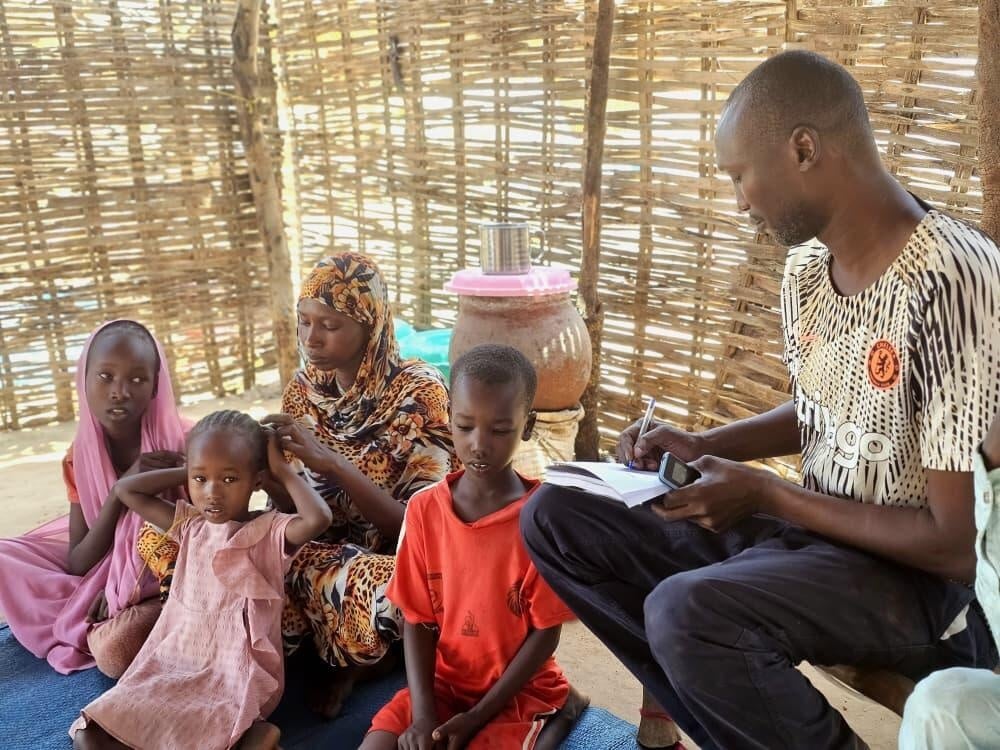
Tarek, a Sudanese refugee, is learning French to strengthen his integration while ensuring his children have access to education. They are enrolled in the Central African education system at the primary level.
For Tarick, education is much more than learning; it is a survival strategy and an integration gateway.
"The main difficulty for our children here is access to education, especially because of the language. In Sudan, we mostly use Arabic and English. Here, it's French. I started learning it myself to help my children integrate and communicate with the local community," he explains.
Every week, he takes French classes in Birao as part of a project supported by the Mastercard Foundation.
Despite the distance, the heat and the demands of daily life, Tarick keeps going to his French classes. He believes language is one of the keys to building a future in Central African Republic. Sitting among other refugees, he is learning again, asking questions and gaining confidence step by step.
In Korsi, in the heart of Vakaga, knowledge continues to pass from one generation to the next. It is carried by a father determined that conflict will not define his children’s future.
Tarick is rebuilding that future through more than education.
With cash assistance from the World Food Programme, he has started a small business in the Korsi market. Every morning, he sets up his stall and sells basic goods bought from local traders. His sense of organisation, shaped by years as a teacher, and his honesty have earned him the respect of other traders and the trust of his customers.
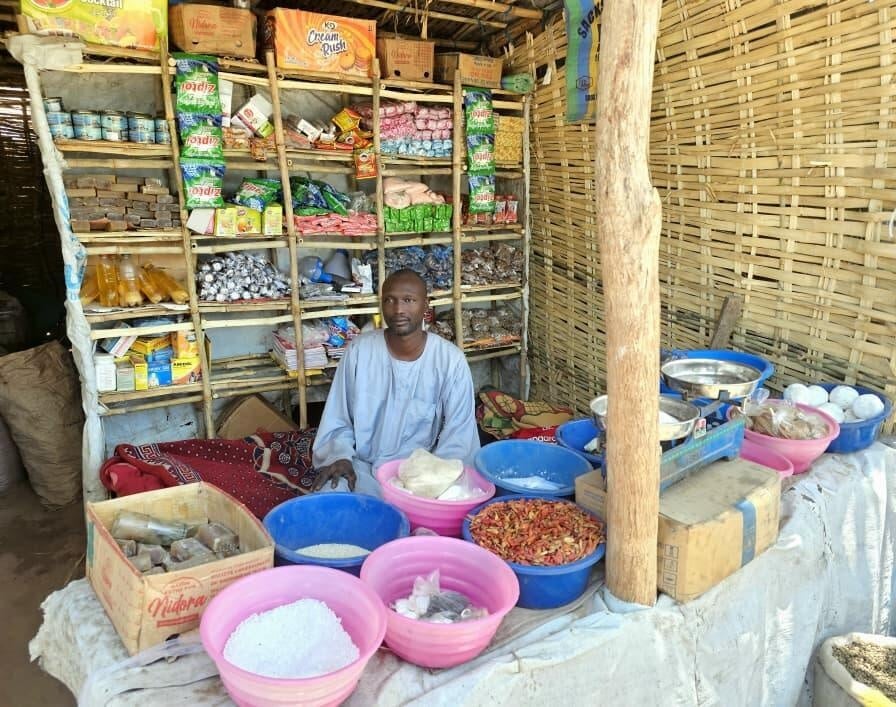
Tarick Abadallha, Sudanese refugee, trader at Korsi market in Birao in Vakaga in CAR.
The business provides income for his family. It also gives him a place in the life of the community. For Tarick, work is another lesson for his children: courage, discipline and dignity.
Between French classes, helping his children study and working at the market, Tarick has found a fragile but determined rhythm.
At the market, he teaches by example, through work and honesty. At home, he teaches through language, patience and education. In both places, he remains a teacher.
His children see him as a father, a respected shopkeeper and a patient teacher. They are also learning that education and work can move together.
Nine-year-old Tawasol, his eldest daughter, learned French through the lessons her father gives at home.
“My wish is to learn French to communicate better and have the chance to continue my schooling,” she says.
Tawasol and her younger brother attend Nguerendomo public school, less than a kilometre from Korsi, where they learn French alongside Central African classmates. The school is among those welcoming Sudanese refugee children in Birao, where around 1,200 Sudanese refugees are now attending school.
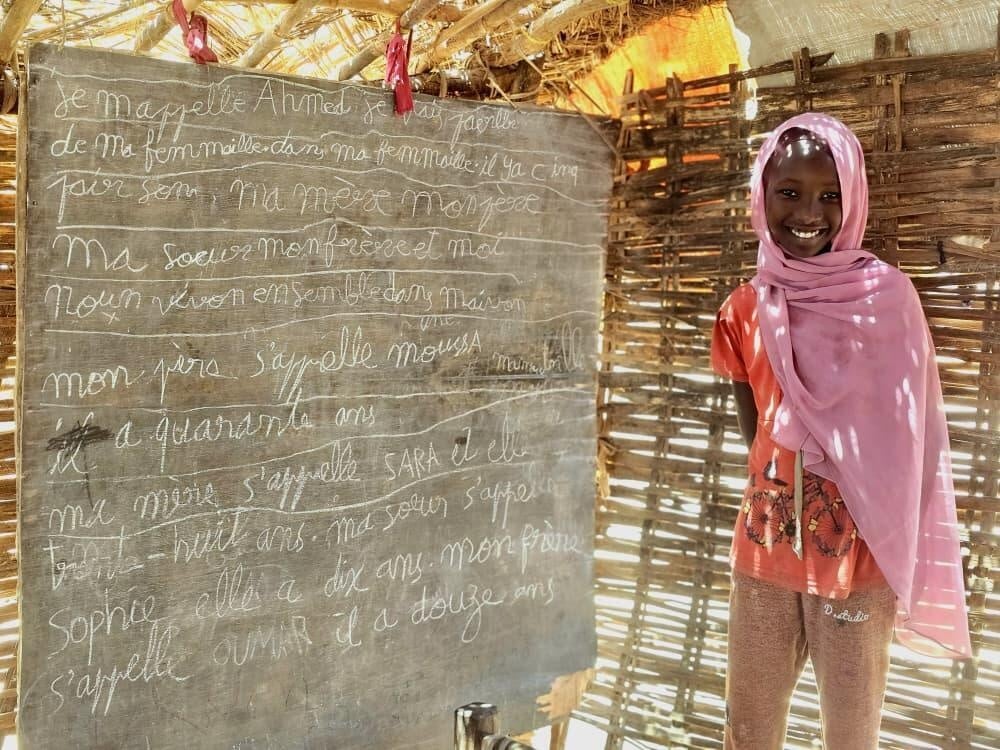
Tawasol, Tarik's eldest daughter, repeats French class at home with her father's support in Korsi (Birao), CAR.
For Tarick, rebuilding has meant holding together work, learning and family. Through trade, he feeds his family and earns the trust of his community. Through education, he helps his children imagine a future beyond displacement.
“I am grateful to the Central African government and the local authorities for the welcome and solidarity we receive here. Sudan and the Central African Republic are two brotherly countries,” he says.
“In Korsi, the government, through the Commission Nationale pour les Réfugiés, is working to ensure that refugees have access to protection, education and essential services. The aim is to support their self-reliance and their contribution to the socio-economic development of host communities in Birao,” says Achley Kolea, protection assistant at the Commission Nationale pour les Réfugiés, in charge of the Birao office.
Since the beginning of the crisis in Sudan, UNHCR has supported the construction of classrooms and latrines, teacher training, and efforts by the Central African government to strengthen administrative infrastructure.
The Central African Republic hosts more than 36,300 Sudanese refugees, 85 per cent of whom are women and children. More than 22,300 live in Korsi, near Birao, while more than 14,000 have found refuge in other areas, many of them difficult to access. UNHCR, in close collaboration with the Commission Nationale pour les Réfugiés and partners, is coordinating the response. This includes access to asylum, registration and civil documentation, protection monitoring, and support for water, food, essential household items, shelter, health, livelihoods and education.
Tarick’s story reflects the lives of many Sudanese refugees who have found safety in the Central African Republic since the conflict in Sudan began in April 2023. In Korsi, he is rebuilding one day at a time, through work, learning and the steady belief that his children can have a future.


