



Fields of hope in Chad: how Amne is rebuilding her life after fleeing Sudan
Fields of hope in Chad: how Amne is rebuilding her life after fleeing Sudan

Amna in her field, delighted to see the fruits of her labor. She holds in her hands the ears of wheat that bring hope to her country of asylum.
After fleeing the war in Sudan with her six children, Amne found refuge in Zabout, in eastern Chad. Thanks to a project run by UNHCR and the Mastercard Foundation with the Chadian NGO OHDEL, she has been able to return to farming, regain a source of income and begin rebuilding her life.
Under the sun of Zabout, in Sila province in eastern Chad, golden sorghum stalks sway in the wind. To many, this field looks like any seasonal crop. But for Amne Hassan Haroun, every stalk tells of a victory over exile, loneliness and the hardships of war. Standing in the middle of her field, the 28-year-old woman gazes at the result of several months of effort.
“As you can see, the harvest is ready. I will start harvesting this week. Part of it will be kept to feed my family and the rest will be sold. With that money, I will be able to restart a small business,” she says with a smile.
Before the conflict ravaging Sudan, Amne lived in Simbil, a village near Kabkabya in the Darfur region, where she divided her time between rain-fed farming and small-scale trading. But in April 2023, clashes between the Sudanese Armed Forces and the Rapid Support Forces plunged Darfur into violence. The night Simbil was attacked, Amne, her husband and their six children hurriedly left their home, leaving behind their house, their belongings and their livelihood.
To reach the Chadian border, Amne and her children avoided the main roads, deemed too dangerous, making their way through ravines and over hills.
“The children were exhausted. We walked all night. The adults could keep going, but for the little ones, every step was an effort,” she recalls. “I had lost everything. I had to find the strength to keep going for my children.” After more than seven hours on foot, the family reached Moudeina, on the Chadian border. In July 2023, they were relocated to the Zabout site in Sila province, with the support of UNHCR, the UN Refugee Agency, the Chadian government and their partners. On arrival, like all relocated people, she received hot meals, a basic kit of mats, blankets and jerrycans, and an emergency shelter.
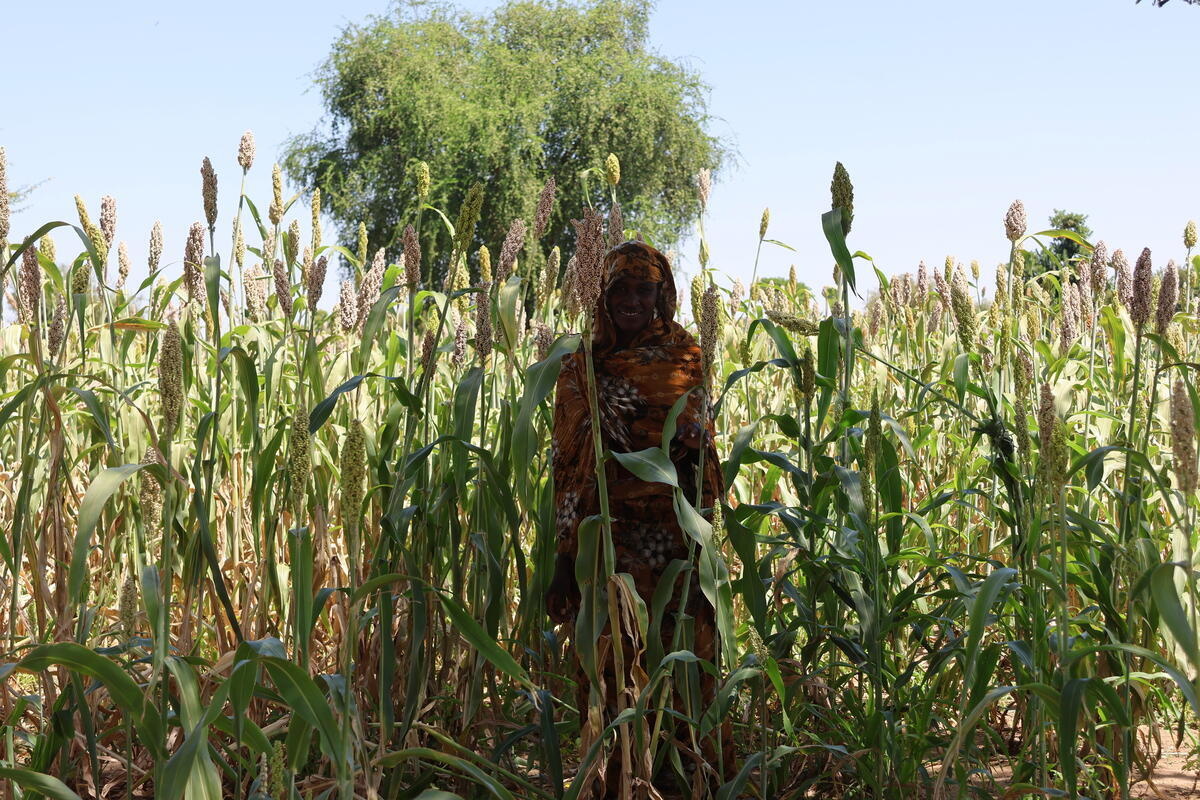
A partial view of Amna's field. She is inspecting it to prepare for and begin the harvest.
Sometime after their arrival in Zabout, Amne and her husband separated. Now alone in caring for their six children, she sought to resume the activity she knows best: farming. But without access to land, regaining a measure of independence remained difficult.
Access to land to rebuild her life
An opportunity arose through a partnership between UNHCR and the Mastercard Foundation aimed at strengthening the self-reliance and future prospects of refugees and host communities in Chad. Named the “African Initiative Pathways,” the initiative operates in the east, the south and the Lac region, as well as in N’Djamena. It promotes access to education, employment and entrepreneurship, while strengthening community organizations. It also aims to support 35,000 refugee and host-community youth and women in developing their livelihoods, notably through farming and livestock.
In Zabout, this support notably takes the form of access to land. UNHCR and its partner, the Chadian NGO Organisation Humanitaire pour le Développement Local (OHDEL), work with local communities to make agricultural plots available to refugees and host populations. Thanks to the land agreements reached, each producer can cultivate at least one hectare, or more depending on their capacity. In total, 421 households, including 211 refugee families and 210 from host communities, are receiving support to develop their farming activities.
“Many refugees who arrived from Sudan lived off farming before the war. By giving them access to land and the means to cultivate it, we enable them to resume an activity they know, feed their families and gradually regain their independence,” explains Georges Dagbelou, Head of the UNHCR Office in Goz Beïda, who oversees the agency’s operations in the region, including in Zabout. “It is also an investment in host communities, which receive the same support, and in peaceful coexistence between the two communities.”
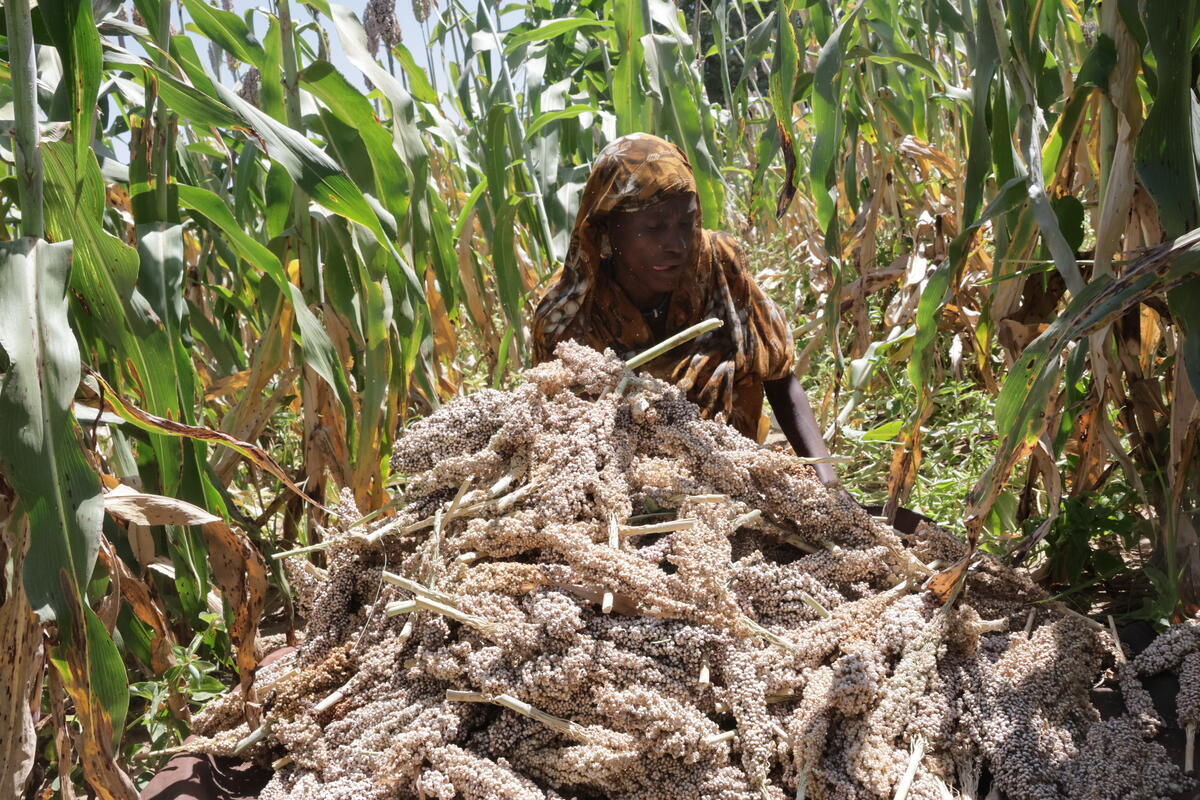
First harvests: Amna is packing up the ears of corn to transport them, to keep her belongings safe at home.
Like the other households taking part in the project, Amne received 40,000 CFA francs (about US$68) to buy seeds and farming tools. She also benefits from training in farming techniques to improve her practices.
This year, the rains have been less abundant than hoped. But the proximity of Amne’s field to a spreading weir, built by UNHCR with the support of various financial partners to retain and better distribute runoff water, is helping her crops develop well. Despite the low rainfall, these facilities make a real difference: at sites that benefit from them, average yields reach 900 kilograms (kg) per hectare for legumes and 1,100 kg for cereals, compared with 550 kg and 800 kg respectively at other sites.
Over the months, the young green shoots turned into a vast expanse of golden sorghum, ready to be harvested. For Amne, this harvest is much more than a source of food: it marks the beginning of a new chapter.
“My goal is to get back the way of life I had before the war. I want to farm during the rainy season, then trade for the rest of the year. That will allow me to take better care of my children and prepare their future,” she says.
Despite the hardships of forced displacement, Amne does not want her refugee status to define her future. She prefers to see herself as a mother, a farmer and an entrepreneur in the making. As she watches the first bags of sorghum about to leave her field, one certainty stands out: after losing everything because of the war, she is taking her life back into her own hands.


