



How farming cooperative is helping returnees rebuild their lives in South Sudan
How farming cooperative is helping returnees rebuild their lives in South Sudan

Oyuoh Dak Awang, 46, a father of eight, fled Malakal in 2013, spent over a decade in Sudan, then returned and learned vegetable farming from neighbours before being selected for UNHCR training and support in March 2025.
In South Sudan's Upper Nile State, years of armed conflict have displaced hundreds of thousands of people and disrupted livelihoods across the region. For many families who have returned after years living as refugees in Sudan, starting over with little or no resources remains an overwhelming challenge. But in the farmlands of South Payam, in Malakal, a group of returnees is demonstrating that recovery is possible with the right support.
Through the Strengthening Community Adaptability and Resilience (SCAR) Project funded by the European Union, UNHCR, the UN Refugee Agency, is supporting returnees, refugees and host community members in Malakal to rebuild their lives through farming. The initiative provided hands-on agricultural training, quality seeds and solar-powered water pumps to 60 members of the Malakal Farmer Cooperative Group. Participants also received ongoing coaching from technical staff at the Ministry of Agriculture and Forestry, equipping them with improved farming techniques and the confidence to scale up production.
Oyuoh Dak Awang, 46, a father of eight, fled Malakal for Khartoum when conflict broke out in 2013. He remained in Sudan for over a decade before the 2023 conflict in Sudan forced him to return. In 2024, with few options and no steady income, he began learning vegetable farming from neighbours. When a UNHCR team visited and assessed the farms in March 2025, Oyuoh was among those selected for training and support.
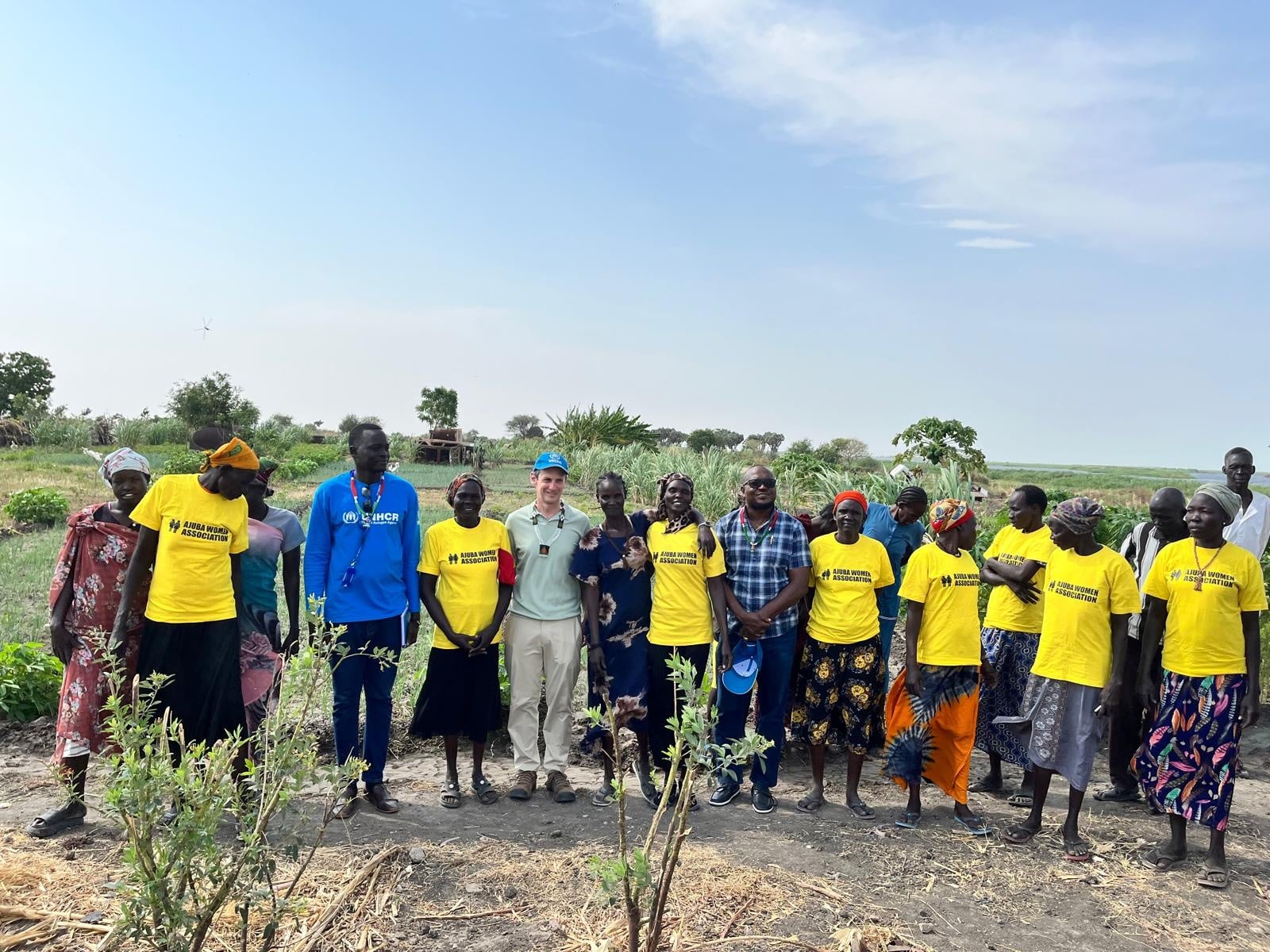
UNHCR South Sudan Representative Matthew Brook visits farming cooperatives in Malakal, where displaced farmers are cultivating vegetables with training and support from UNHCR.
“Before receiving this support, I did not know how to plant beans, potatoes or carrots, nor did I understand how to plan and organize my garden,” he says. Since completing the training, Oyuoh has expanded his farm from half a feddan (about half an acre) to 12 feddans (about 12 acres) and now employs 35 labourers. Local businesspeople visit his farmland to purchase vegetables in bulk, and he also supplies vegetables directly to local markets in Malakal. “My life has transformed completely. I can now pay my workers, feed my family, send my children to school and afford medical care when needed.”
Fellow cooperative member Achol Arop Manykuany, 55, a mother of nine, has experienced a similar transformation.
Achol fled to Juba and later to Khartoum after the 2013 conflict before returning to Malakal in 2016. She began learning vegetable farming from a colleague who had gained skills while in Sudan and gradually built up a small plot of land. After receiving training and inputs from UNHCR, she now produces large quantities of vegetables that supply Malakal Town and has created employment for over 40 people from both returnee and refugee backgrounds. “This is the first time I have experienced an agency investing genuinely in farmer development,” Achol says.“I have been given not just the tools to farm, but the hope and ability to create a sustainable future for myself and my family.”
The cooperative's impact extends well beyond its members. In the past, fresh vegetables had to be transported from Juba by cargo planes at very high prices, putting them out of reach for many families. Now, with local production growing steadily, communities in Malakal can access fresh produce at more affordable rates. “We are proud to stand with families who chose to return and rebuild here in Malakal, and we will continue working with our partners so that their hard work on these fields translates into lasting stability and hope for the whole community,” says Dmytro Charskykh, UNHCR Head of Field Office in Malakal.
Members of the cooperative plan to expand their farmland in the coming seasons and dream of supplying enough vegetables to meet the needs of the entire Upper Nile State. Through shared farms, the initiative is helping displaced families strengthen the local economy.


