



From Exile to the Land, Marie's Fresh Start
From Exile to the Land, Marie's Fresh Start

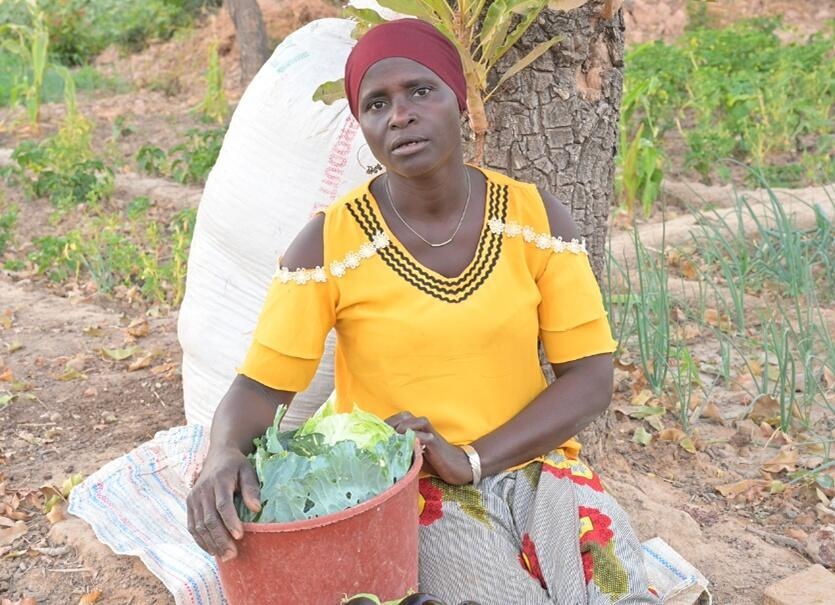
Marie Dabini, an internally displaced person (IDP) and beneficiary of the AICS project, holding part of her eggplant harvest.
Seated in the shade of a tree, her hands still bearing the marks of the morning's harvest, Marie gazes at her plot of eggplants, cabbage, and onions. In that silence, the violence of the past meets the determination to keep going. Having lost everything, she has found in the land a path toward rebuilding her life. At 35, Marie single-handedly shoulders the responsibility of 12 children: her three biological children and nine others entrusted to her care after her husband's death. Before the crisis, she worked as a cashier at a microfinance institution, while already nurturing a deep passion for livestock farming. "My husband was a livestock expert. He was the one who trained me. Thanks to him, I had gained real experience in a field I loved deeply," she recalls.
Before everything fell apart, Marie had already built a promising livestock business. Then in 2020, in a single night, that horizon collapsed. Her village was attacked while she was nine months pregnant. The family compound was destroyed, and her husband and brothers-in-law were killed. Shortly after, she gave birth under precarious conditions, then fled with her children and sisters-in-law to Fada N'Gourma, where the family became internally displaced.
After a brief stay with a relative, Marie rented a small tin-roofed house in a remote neighborhood of Fada N'Gourma, where she lived with her children, including a newborn. On top of the precariousness came deep physical and psychological wounds. Upon their arrival, Marie and her family received emergency assistance, food, medical care, and psychosocial support, with the backing of the authorities, UNHCR, and local partners. "Mentally, I was no longer well. There were times I would go out with my baby and forget where I had left him. I lived in constant fear and depression."
Little by little, however, Marie began reaching beyond mere survival — seeking to reclaim her autonomy and carve out a place for herself and her children.
From Aid to Self-Reliance: An Opportunity That Changes Everything
A pivotal opportunity then opened up for Marie, holding the promise of lasting recovery through agriculture. Under the project "Promoting Empowerment, Sustainable Socio-Economic Integration and Cohesion for Forcibly Displaced Persons and Host Communities in Burkina Faso" , funded by the Directorate General for Development Cooperation of the Ministry of Foreign Affairs and International Cooperation through the Italian Agency for Development Cooperation (AICS), forcibly displaced persons and vulnerable members of host communities receive support toward economic self-reliance.
Implemented by UNHCR together with the Environmental and Agricultural Research Institute (INERA), FAO, and local authorities, the project provides training, equipment, and technical assistance. It was through this framework that Marie was selected to take part in an agricultural training and empowerment programme.
At the heart of the initiative is a market gardening site developed within INERA's premises. There, a plot was made available for beneficiaries to learn, produce, and earn an income. INERA's role is central. Beyond immediate support, the Institute imparts lasting skills and roots the project within national institutions. For Dr. POUYA B. Mathias, INERA's Regional Director in Fada, this partnership represents far more than agricultural assistance. "Through this cooperation with UNHCR and its partners, our ambition is to help forcibly displaced persons regain their autonomy and dignity through sustainable agricultural skills. Beyond production, we want to restore hope to families who have lost everything," he stated.
Marie is one of 42 project beneficiaries, 25 of whom are women. Through the programme, she learned market gardening techniques and crop health monitoring. Upon completing the training, each beneficiary received prepared plots, seeds, fertilizer, and farming equipment. Today, Marie grows cabbages, eggplants, and onions, which she sells at the market to cover her family's essential needs. "Thanks to this activity, I can feed my children, pay for their schooling and healthcare. We are living with dignity today," she shares.
More Than an Income: A Rebirth
On the market gardening site, displaced women are not only growing vegetables, but they are also gradually rebuilding their lives. Between the rows of onions, cabbages, and eggplants, they share their pain, support one another, and slowly regain a sense of balance after the trauma of exile and violence. This place has become at once a space for production, solidarity, and psychological recovery.
For Marie, this activity means far more than an income. It allows her to protect her children and offer them a more dignified life. "This market garden allows us to raise our children with dignity, without begging, without exposing our daughters to prostitution or our children to theft just to survive."
Today, Marie is beginning to look ahead again. She is saving money with the aim of returning to her first passion: livestock farming. Her ambition is to establish a pig and improved local poultry farm, and in turn, to help other vulnerable women reclaim their independence.
Despite wounds that are still deep, Marie now moves forward with renewed hope. Her journey speaks to the tangible impact of this project, funded by Italian Cooperation (DGCS/AICS), on the lives of women and the most vulnerable.
"Thanks to this project, we have found hope again. We were able to get back on our feet and move forward."


