



When violence forces families to flee, climate shocks can uproot them again
When violence forces families to flee, climate shocks can uproot them again

IDPs in Far North region receive dignity kits and household essentials to support life in displacement.
In Cameroon’s Far North Region, the road to safety is often shaped by more than one crisis. Families who flee violence may later face floods. People who escape kidnappings may lose their household items to heavy rains. Communities hosting displaced neighbours endure the same climate shocks, fragile roads and rising uncertainty.
In places like Godji-Godji, in Tokombere, these crises overlap quietly.
Boukarou Umati and his family fled their home village in the border town of Kolofata for Tokombere, joining other Cameroonians escaping worsening insecurity, including threats and kidnappings, with only what they could carry.
“You cannot sleep when you know someone can come in the night,” Boukarou says. “You think of your children, and you leave.”
This is why basic household assistance matters.
In Tokombere, as well as in parts of Cameroon’s North-West and South-West regions, including Boyo division, UNHCR has provided essential dignity items to more than 23,000 displaced households. The items include buckets, blankets and other basic household and kitchen materials, delivered thanks to support from the King Salman Humanitarian Aid and Relief Centre.
These items may appear simple, but in settings where people have fled violence and continue to face climate shocks, they help families regain order, privacy and a measure of control over daily life.
At a distribution site, people wait in line under a bright sky that can change quickly during the rainy season. Some hold documents. Others carry children. Community members help organize movement. UNHCR and partners verify names, explain the process and support families as they receive the items. Assistance is prioritized for households facing the greatest risks, including women-headed households, older people and people with disabilities or specific protection needs.
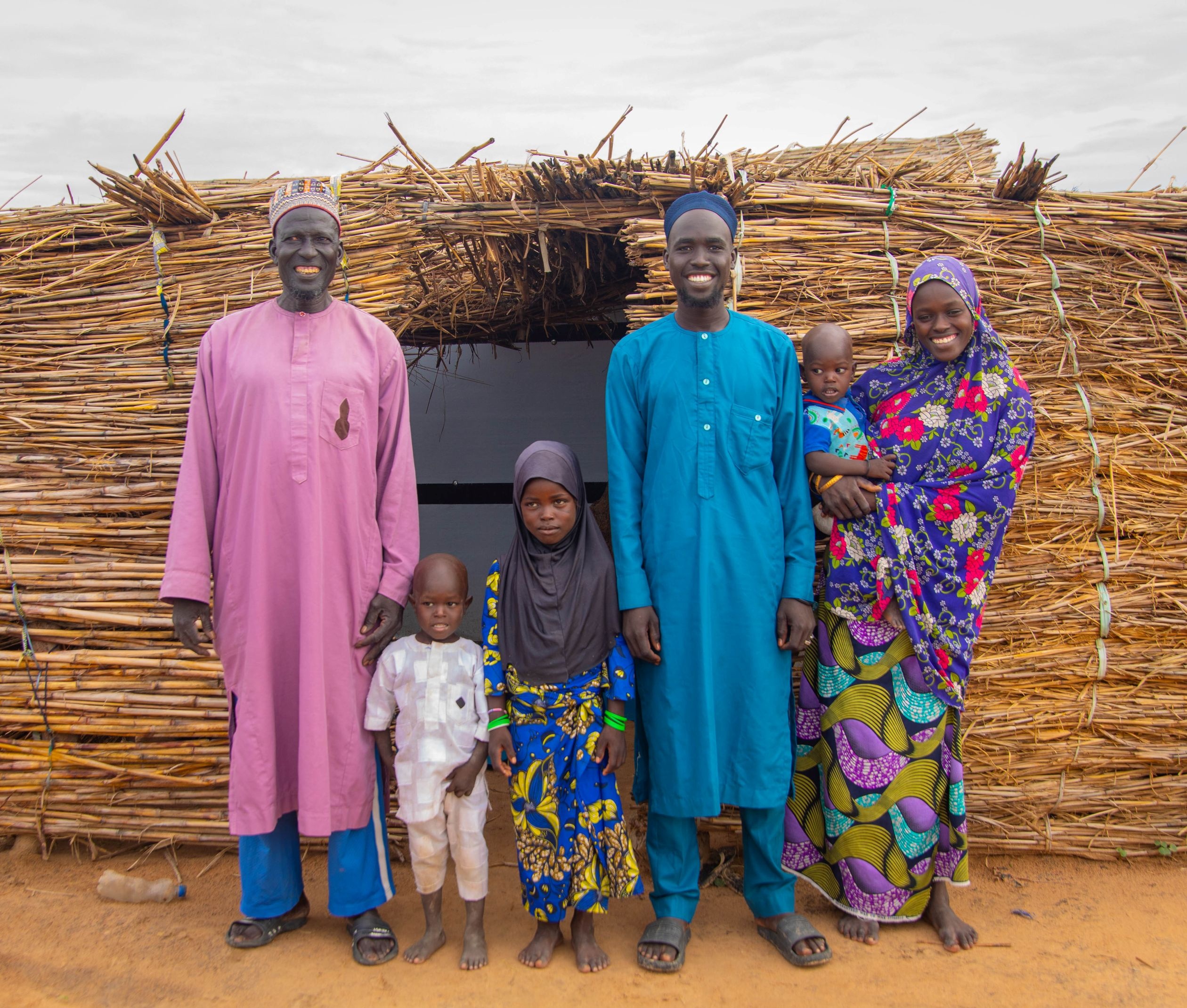
Boukarou Umati and family posing outside a temporary constructed shelter following their displacement due to conflict near the Border town of Kolofata, Far North region.
For Boukarou, the distribution is not only about receiving practical items. It is about being able to function again, with dignity, as a household.
“When you arrive with almost nothing, even a bucket is important,” Boukarou says. “A blanket is important. Things for the kitchen are important. They help the family continue.”
Across the Far North, one of Cameroon’s most densely populated regions, displaced families have moved into rural communities where host families share limited resources, land, water points and services.
Yet resilience is visible everywhere. Women start small businesses, while men search for daily labour. Children return to learning when schools are accessible. Neighbours share shade, water, information and space. Families repair shelters with whatever materials they can find. Community leaders help identify those most in need.
Humanitarian assistance supports that resilience. When it arrives at the right time, it can reduce pressure on families, help prevent harmful coping strategies and restore dignity. For host communities, assistance can also help ease pressure when displaced neighbours arrive with few resources.
“We want to live without fear,” Boukarou says. “We want our children to grow in peace.”
In Cameroon’s Far North, where conflict and climate shocks continue to test families who have already lost so much, protection must be practical. It must reach people where they are. It must help families recover not only from the violence they fled, but also from the storms that followed.


