



The Power of Opportunity: How Education Shaped Danu and TJ’s journey
The Power of Opportunity: How Education Shaped Danu and TJ’s journey

Danu (right) and TJ (left) Danu and TJ, Sri Lankan refugee students, stand at Siam University in Bangkok, where they completed their studies through DAFI scholarship programme supported by the German Government.
After years of disrupted schooling, two refugee siblings found opportunities to continue their studies in Thailand – opening a path to university and later starting a new chapter nearly 13,000 kilometers away, better prepared for what lies ahead.
Danushiga (“Danu”) and Wisethujaan (“TJ”), refugees from Sri Lanka, arrived in Thailand as children with their family after fleeing their country in search of safety. Much of their early life was shaped by uncertainty. Without legal documentation, their movements were restricted, and the risk of detention was constant.
“For most of our lives, ‘refugee’ was not just a word,” Danu says. “It shaped how we lived, what we could do, and who we could become. If you have no paper documents, you are no one.”
After registering with UNHCR, the Refugee Agency, the family was later officially recognized as refugees. This recognition, along with their UNHCR documentation allowed them to access healthcare and opened pathways to further opportunities.
However, education remained out of reach at first. For five years, Danu and TJ were unable to attend formal school and instead relied on informal learning through church groups and volunteer teachers within the refugee community.
“People in the community taught us for free,” Danu recalls. “That’s how we kept learning.”
Their parents encouraged them to continue studying despite difficult conditions. The family of six shared a single room, where studying often meant everyone staying awake late into the night.
A turning point came when a Thai private school headmaster welcomed refugee students to enroll and covered their tuition. After taking placement tests, Danu and TJ were admitted at the level expected for their age, despite having spent five years outside the formal school system. Their placement reflected the years of informal learning and determination to stay on track academically.
Teachers supported them closely, sometimes providing photocopied textbooks when the originals were too expensive. That opportunity allowed them to continue their education, even as uncertainty about the future remained.
As they completed high school, a new challenge emerged. Without clear pathways to higher education, both found themselves unsure what would come next.
“I kept asking myself, what is the point of studying if there is no future?” TJ says.
During this time, they continued learning through online courses and supported other refugee students, determined not to lose momentum despite the lack of opportunities.
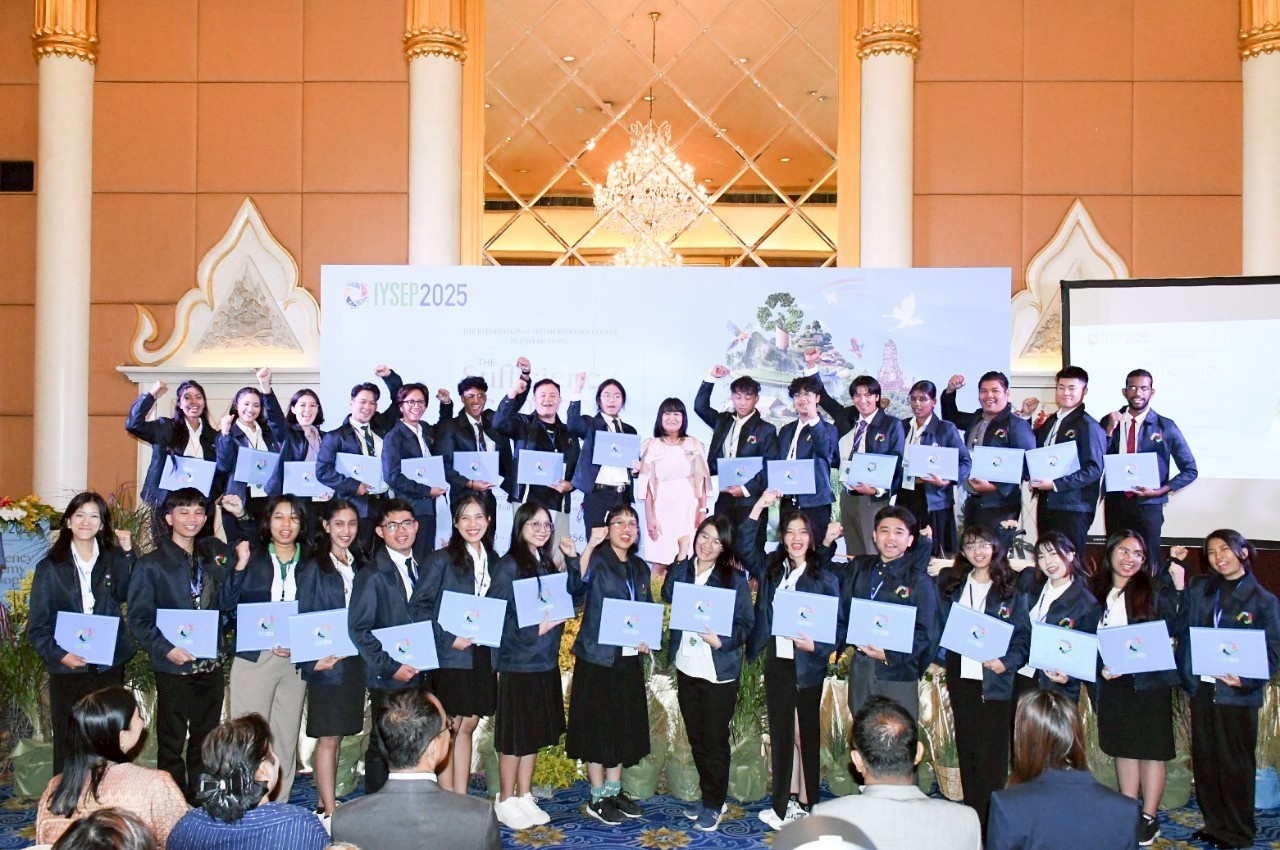
Participants pose for a group photo after completing the IYSEP programme in Thailand. Danu (top row, fourth from right) and TJ (top row, far right) took part as university representatives, an experience they describe as one of the most meaningful of their lives.
Through UNHCR, they learned about the Albert Einstein German Academic Refugee Initiative Fund (DAFI), a scholarship programme funded by the German Government that supports refugees to access higher education and build professional futures. With recognized refugee status, they were able to apply for this opportunity.
In 2023, both were admitted to Siam University, where Danu studied information technology and TJ studied civil engineering. Becoming university students brought a shift that went far beyond academics.
“It’s just a piece of plastic,” TJ says of his student ID card. “But it made a huge difference.”
“For the first time, people saw us as students,” Danu adds. “It changed the way people look at us.”
Wearing a university uniform and carrying a student card gave them a sense of safety and belonging that had long been missing. At university, they quickly distinguished themselves, becoming active in student life and community initiatives while maintaining strong academic performance.
Danu’s achievements were recognized with the International College’s Best Student Award, reflecting her leadership and commitment both inside and outside the classroom.
They were also selected to represent their university and the Sri Lankan refugee community in the Experiencing the Sufficiency Economy Philosophy programme organized by the Royal Thai Government. During the programme, they travelled across Thailand, met young people from different countries and engaged with local communities.

TJ takes part in a coastal activity during the IYSEP programme in Thailand, which brought together young people from different backgrounds for learning and cultural exchange

Danu takes part in a rice planting activity during the Experiencing the Sufficiency Economy Philosophy (IYSEP) programme in Thailand. The programme brought together young people from different backgrounds to learn about sustainable living and local practices.
"We did not feel we were refugees at all during that time,” they say.
Alongside their studies, a separate opportunity emerged. Through a private sponsorship pathway to Canada, Danu and TJ have recently arrived in Winnipeg, where they plan to continue their studies and build independent lives. Danu hopes to pursue nursing, while TJ intends to continue in engineering and explore his interest in astronomy.
“It will be life-changing,” Danu says. “I will finally feel free and maybe start building a life where I truly belong.”
The transition brings both hope and concern. Their parents, who supported their education through years of uncertainty, remain in Thailand. While this is not easy, they share a sense of pride in what Danu and TJ have achieved.
“I just wanted to have a home,” Danu says. “A place where I belong.”
Their journey reflects how access to education, combined with opportunity, can create lasting change. From a school that opened its doors to a scholarship that made university possible, education became a foundation for what comes next.
Now in Canada, Danu and TJ carry forward not only what they have achieved, but the belief that opportunity can change the course of a life.


