



Mission to Chios: "How does one go on when one's entire family has been lost?"
Mission to Chios: "How does one go on when one's entire family has been lost?"

The UNHCR Representative in Greece, Laura Lo Castro, visited Chios on Friday, February 20, accompanied by a team of colleagues. A few weeks after the deadly tragedy that claimed 15 lives and left 24 people seriously injured, most of them children, Ms. Lo Castro met with survivors at the Chios Hospital and the Vial facility, as well as with representatives of local authorities and other actors.
In an interview with ERT Aegean and journalist Thodoris Pylotis, Ms. Lo Castro referred, among other things, to the harrowing experiences shared by survivors, while also highlighting the exceptional work of the medical staff at Chios Hospital, who provided care and psychological support to the injured from the very first moment. She also addressed the critical question of what drives a person to risk their life and the lives of their children on such dangerous journeys.
"Mothers lost their children, children lost their parents."
At Vial, the UNHCR Representative met three women and two men who survived the shipwreck. The scars—both physical and emotional—were evident in all of them. One woman lost five children and her husband. Another lost her husband and their 17-year-old child. The youngest, just 24 years old, was pregnant and lost her unborn baby and her husband, a few days before their second wedding anniversary. She is now in the shelter with her other child, not even two years old. The two men did not speak, only cried silently.
"We wanted to be close to them, to express our solidarity and our deep sorrow for this tragedy," said Ms. Lo Castro.
"Mothers lost their children, children lost their parents... How will we go on with our lives?" were among the first words the refugees said to Ms. Lo Castro. Despite their unbearable pain, the women spoke of the strength they draw from their surviving children. "We must be even stronger than before. For the sake of our children who are alive," said one survivor.
Their common request is to be reunited with the bodies of their loved ones as soon as possible and for the burial procedures to be completed quickly. They are seeking "closure" – some sense of peace in their mourning. They are also seeking justice: "What we want is for the investigation that has begun to bring justice, for those responsible to be held accountable."
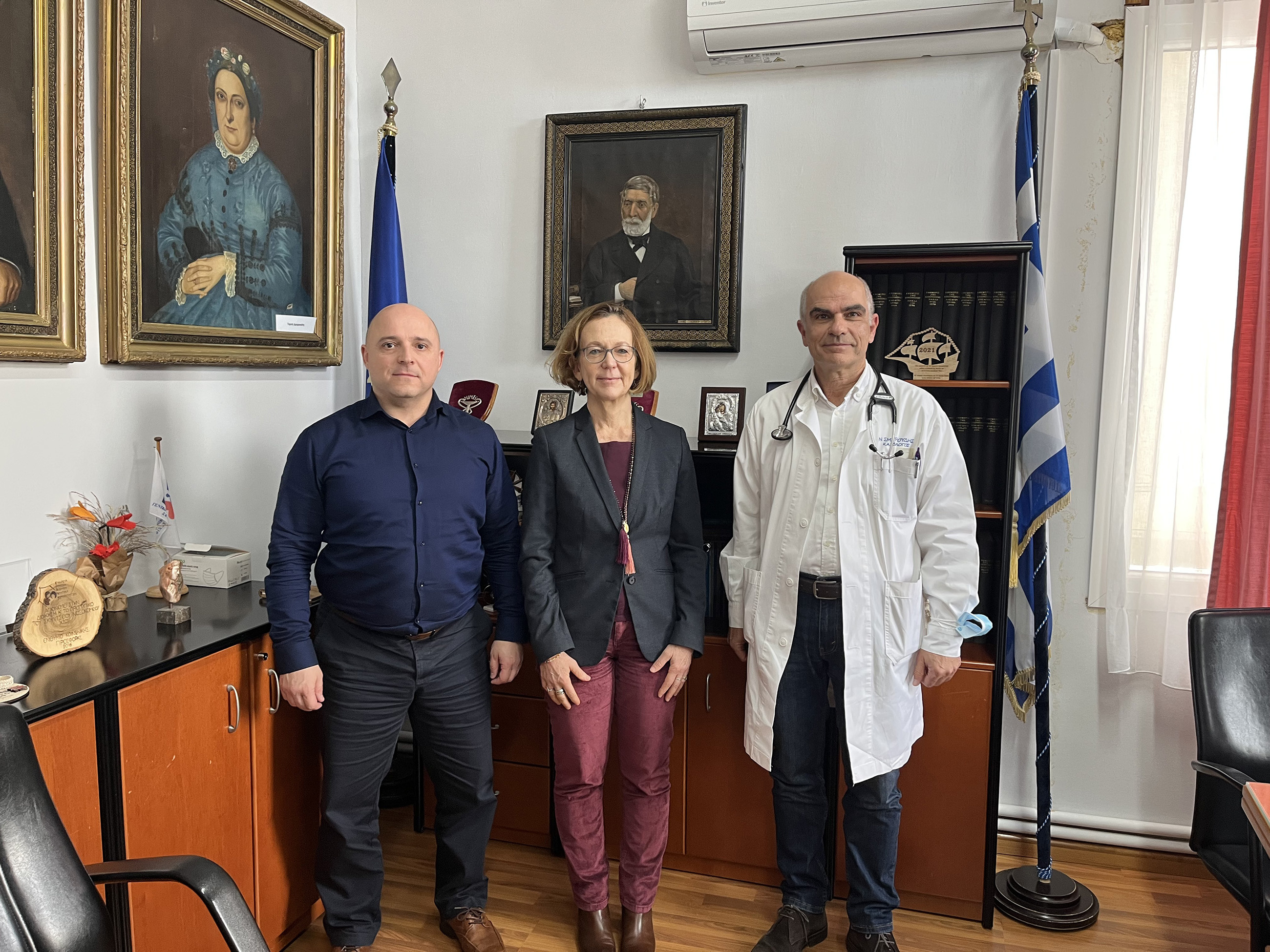
The Representative of UNHCR with the Governor and the Director of Medical Services at Chios Hospital.
Solidarity in action
Ms. Lo Castro visited the medical, nursing, and psychosocial staff of Chios Hospital, expressing her gratitude for their immediate response to a truly extraordinary and unprecedented incident, both in its tragedy and its severity.
"Despite limited resources and working under extremely stressful conditions, the staff made remarkable efforts to care for the injured," she noted. Faced with the shock of the tragedy themselves, they mobilized swiftly to provide care and relief to those rescued from the sea. Amidst the loss and grief, their attitude was a shining example of professionalism and practical solidarity.
A life-or-death decision
Although refugee and migrant arrivals decreased overall in 2025 compared to 2024, and with the vast majority of refugees remaining in neighbouring countries in the hope of returning when conditions allow, people will continue to move in search of safety or simply a better life, as long as wars, persecution, hunger, and inequality continue. The decision to get on a boat is a painful dilemma, a decision of life or death. “As long as the root causes of displacement are not addressed, as long as humanitarian aid to countries of first reception is reduced, and as long as legal pathways—such as family reunification – remain limited, desperate people will continue to have no choice but to seek safety and survival through dangerous and irregular routes," Ms. Lo Castro stressed.
You can read the full interview (in Greek) to ERT Aegean here.