Chad flag

Chad Chad RSS Feed

2013 UNHCR country operations profile - Chad

Working environment

The context

In September 2012 Chad hosted some 288,700 refugees from Sudan, 56,700 from the Central African Republic (CAR), 90,000 internally displaced persons (IDPs), 91,000 returned IDPs and 550 urban refugees and asylum-seekers. The political and security situation in the country is stable thanks to improvements in relations with Sudan and the work of the joint Chadian-Sudanese border-monitoring force.

Nevertheless, the majority of the Sudanese refugees in Chad are reluctant to return home due to ongoing instability in Darfur.

In June 2012, there was an influx of 1,550 refugees from the CAR into southern Chad as a result of violent clashes in northern CAR. As the situation in this area remains tense, there is a possibility of a further influx of refugees to Chad.

Some 90,000 people remain internally displaced in Chad. Since the Government announced a "Year of Return" for IDPs in 2011, UNHCR has been assisting them to return home, escorting them to their villages of origin and providing shelter and reintegration packages. It is expected that most IDPs will have returned in 2012. Consequently, in 2013, UNHCR's interventions will be limited to monitoring the 88,000 individuals who have opted for local integration in their areas of displacement.

The needs

The presence of a large population of refugees from Sudan and CAR weighs heavily on Chad in Chad weighs heavily on the country's resources. Measures to reduce the pressure on host communities and the environment are therefore indispensable.

In eastern Chad, where the climate is semi-arid, the large number of Sudanese refugees puts a strain on already scarce natural resources and leads to tensions with host communities. In southern Chad, where the climate is tropical, flooding regularly destroys refugees' homes and crops. This has hampered UNHCR's efforts to improve the self-reliance of CAR refugees and made them more vulnerable to malnutrition.

Given the volatile conditions in neighbouring Sudan and CAR, large-scale voluntary returns are unlikely. Basic life-saving activities such as the provision of water, food, shelter, health services and sanitation remain imperative. Providing education is equally important in order to protect boys from forced recruitment and discourage early marriage for girls.

Returning IDPs will continue to require support in terms of basic services and infrastructure in villages of return. Indeed, there is a need for development activities in Chad as the refugee and IDP operations are moving from crisis mode to a stage of transitional development.

Assuring the security of refugees, IDPs and humanitarian workers will remain at the forefront of UNHCR's work in 2013. The Chadian security force, or Détachement Intégré de Sécurité (DIS), has provided vital support in and around the refugee camps and IDP sites, and in escorting humanitarian workers in the operational areas. As attacks on humanitarian compounds remain frequent, the DIS has been essential in ensuring security and following up on acts of criminality to generate respect for the rule of law.

Unfortunately, very little funding was received in 2012 to support the DIS. For this reason, UNHCR will draw up a cost-sharing strategy with other UN agencies operating in the Field.

UNHCR 2013 planning figures for Chad
TYPE OF POPULATION ORIGIN JAN 2013 DEC 2013
TOTAL IN COUNTRY OF WHOM ASSISTED
BY UNHCR
TOTAL IN COUNTRY OF WHOM ASSISTED
BY UNHCR
Total 505,450 500,450 496,550 491,550
Refugees CAR 79,000 74,000 83,000 78,000
Sudan 281,000 281,000 253,000 253,000
Various 400 400 500 500
Asylum-seekers Various 50 50 50 50
Returnees (refugees) Chad 20,000 20,000 40,000 40,000
IDPs Chad 120,000 120,000 1,500 1,500
Returnees (IDPs) Chad 5,000 5,000 118,500 118,500

Main objectives and targets for 2013

Favourable protection environment

Laws and policies are developed or strengthened.

  • Laws and policies relating to refugees are consistent with international standards.

Fair protection processes and documentation

The quality of registration and profiling is improved or maintained.

  • All persons of concern are registered on an individual basis.

Security from violence and exploitation

The risk of sexual and gender-based violence (SGBV) is reduced and quality of the response to it improved.

  • More than a third of refugees who are survivors of gender-based violence receive support.

The protection of children is strengthened.

  • Some 30-40 per cent of out-of-school adolescents participate in targeted programmes.

  • A best interest determination (BID) process is initiated or completed for 40 per cent of unaccompanied and separated refugee children from CAR.

Basic needs and essential services

The nutritional well-being of the population is improved.

  • The prevalence of global acute malnutrition among refugee children aged 6-59 months remains at or below 5 per cent.

The health status of the population is improved.

  • The under-5 mortality rate is reduced.

The supply of potable water is increased or maintained.

  • An average of 22 litres of potable water per person per day is available for CAR refugees and 19 litres per person per day for Sudanese refugees.

Refugees have optimal access to education.

  • Some 80 per cent of CAR refugees and 90 per cent of Sudanese refugees aged 6-11 are enrolled in primary school.

Durable solutions

The potential for resettlement is realized.

  • More than 20 per cent of CAR refugees submitted for resettlement depart for third countries.

Strategy and activities in 2013

In 2013 UNHCR will assist and protect Sudanese refugees in eastern Chad, promoting self-reliance and mitigating the impact of large groups of refugees on the environment by providing cooking fuel.

UNHCR will also provide basic assistance to CAR refugees. It will focus on improving livelihoods and pursue resettlement for the most vulnerable individuals. UNHCR hopes to be able to move CAR refugees who have continued to suffer from severe flooding to dryer sites with the aid of the Government.

Refugees in urban areas will receive cash grants to develop livelihoods and will benefit from integration into national health and social services. Urban refugee children will be able to attend national schools. Voluntary repatriation and resettlement will also be pursued for urban refugees where appropriate.

Constraints

The security situation in the region remains unstable, making large-scale voluntary returns of CAR and Sudanese refugees unlikely. Meanwhile, group resettlement of Sudanese refugees remains on hold by order of the Chadian Government. IDP areas of origin continue to lack basic infrastructure and social services, while the challenging natural environment and location of camps in remote areas make providing assistance to refugees logistically challenging.

Organization and implementation

Coordination

UNHCR will work with UN agencies, especially WFP, UNICEF, UNDP and UNFPA, to reinforce joint programmes. It will also strengthen its relationship with government ministries, particularly those dealing with health, water, the environment, social action and education. Partnership agreements with national and international NGOs will be renewed and cooperation with development agencies, the European Union and the Swiss Agency for Development and Cooperation will be reinforced.

Financial information

UNHCR's budget for Chad rose steadily between 2008 and 2011 owing to the rise in the number of Sudanese and CAR refugees. The increase was the result of small influxes and the natural birth rate. Since 2011 the budget has been more or less stable. The 2013 needs have been estimated at USD 171.7 million, of which USD 158.9 million is for refugees and USD 12.8 million to cover IDP protection and assistance.

Source: UNHCR Global Appeal 2013 Update

• DONATE NOW •


• GET INVOLVED • • STAY INFORMED •
Statistical Snapshot*
* As at January 2012
  1. Country or territory of asylum or residence. In the absence of Government estimates, UNHCR has estimated the refugee population in most industrialized countries based on 10 years of asylum-seekers recognition.
  2. Persons recognized as refugees under the 1951 UN Convention/1967 Protocol, the 1969 OAU Convention, in accordance with the UNHCR Statute, persons granted a complementary form of protection and those granted temporary protection. It also includes persons in a refugee-like situation whose status has not yet been verified.
  3. Persons whose application for asylum or refugee status is pending at any stage in the procedure.
  4. Refugees who have returned to their place of origin during the calendar year. Source: Country of origin and asylum.
  5. Persons who are displaced within their country and to whom UNHCR extends protection and/or assistance. It also includes persons who are in an IDP-like situation.
  6. IDPs protected/assisted by UNHCR who have returned to their place of origin during the calendar year.
  7. Refers to persons who are not considered nationals by any country under the operation of its laws.
  8. Persons of concern to UNHCR not included in the previous columns but to whom UNHCR extends protection and/or assistance.
  9. The category of people in a refugee-like situation is descriptive in nature and includes groups of people who are outside their country of origin and who face protection risks similar to those of refugees, but for whom refugee status has, for practical or other reasons, not been ascertained.
The data are generally provided by Governments, based on their own definitions and methods of data collection.
A dash (-) indicates that the value is zero, not available or not applicable.

Source: UNHCR/Governments.
Compiled by: UNHCR, FICSS.
Residing in Chad [1]
Refugees [2] 366,494
Asylum Seekers [3] 165
Returned Refugees [4] 76
Internally Displaced Persons (IDPS) [5] 124,000
Returned IDPs [6] 7,000
Stateless Persons [7] 0
Various [8] 0
Total Population of Concern 497,735
Originating from Chad [1]
Refugees [2] 42,640
Asylum Seekers [3] 3,133
Returned Refugees [4] 76
Internally Displaced Persons (IDPS) [5] 124,000
Returned IDPs [6] 7,000
Various [8] 0
Total Population of Concern 176,849

Chad UNHCR Fundraising Reports Rss FeedUNHCR Fundraising Reports

more documents
2013 UNHCR partners in Chad
Implementing partners
Government agencies: Commission Nationale pour l'Accueil et la Réinsertion des Réfugiés et des Rapatriés (CNARRR)
NGOs: African Initiative for Relief and Development; Africare; Association pour la promotion des libertés fondamentales au Tchad; Association pour le Développement Economique et Social de Kobe; Association Tchadienne pour le Développement; Associazione di Cooperazione Rurale in Africa e America Latina; Bureau d'Appui Santé et Environnement; Centre de Support en Santé Internationale; Christian Outreach Relief and Development; Cooperative for Assistance and Relief Everywhere; Cooperazione Internationale; Croix Rouge du Tchad; Hebrew Immigrant Aid Society; International Medical Corps; International Rescue Committee; Jesuit Refugee Service; Lutheran World Federation-Action by Churches; OXFAM Intermon; Secours Catholique pour le Développement; Tchad Solaire; Together
Others: Deutsche Gesellschaft für Technische Zusammenarbeit (BMZ-GIZ)
Operational partners
Government agencies: The Ministry of Territorial Administration, through the Commission Nationale d'Accueil et de Réinsertion des Réfugiés et des Rapatriés (CNARR); Ministry of Agriculture; Ministry of National Education; Ministry of Public Health; Ministry of Planning; Ministry of Water Resources
NGOs: Action contre la Faim; Agence Française de Développement; Christian Children Fund; LWF; Médecins Sans Frontières (Netherlands, France, Spain, Switzerland, Luxembourg)
Others: ICRC; FAO; ILO; IOM; OCHA; UNAIDS; UNDP; UNFPA; UNICEF; UNV; WFP; WHO

Crisis in the Central African Republic

Little has been reported about the humanitarian crisis in the northern part of the Central African Republic (CAR), where at least 295,000 people have been forced out of their homes since mid-2005. An estimated 197,000 are internally displaced, while 98,000 have fled to Chad, Cameroon or Sudan. They are the victims of fighting between rebel groups and government forces.

Many of the internally displaced live in the bush close to their villages. They build shelters from hay, grow vegetables and even start bush schools for their children. But access to clean water and health care remains a huge problem. Many children suffer from diarrhoea and malaria but their parents are too scared to take them to hospitals or clinics for treatment.

Cattle herders in northern CAR are menaced by the zaraguina, bandits who kidnap children for ransom. The villagers must sell off their livestock to pay.

Posted on 21 February 2008

Crisis in the Central African Republic

Battling the Elements in Chad

More than 180,000 Sudanese refugees have fled violence in Sudan's Darfur region, crossing the border to the remote desert of eastern Chad.

It is one of the most inhospitable environments UNHCR has ever had to work in. Vast distances, extremely poor road conditions, scorching daytime temperatures, sandstorms, the scarcity of vegetation and firewood, and severe shortages of drinkable water have been major challenges since the beginning of the operation. Now, heavy seasonal rains are falling, cutting off the few usable roads, flooding areas where refugees had set up makeshift shelters, and delaying the delivery of relief supplies.

Despite the enormous environmental challenges, UNHCR has so far managed to establish nine camps and relocate the vast majority of the refugees who are willing to move from the volatile border.

Battling the Elements in Chad

Chad: Relocation from the Border to Refugee Camps

Since fighting broke out in Sudan's western region of Darfur last year, more than 110,000 Sudanese refugees have fled into Chad. They are scattered along a 600-km stretch of desert borderland under a scorching sun during the day and freezing temperatures during the night.

Access to these refugees in this inhospitable region is difficult. Staff of the UN refugee agency drive for days to locate them. Bombing in the border zone and cross-border raids by militia from Sudan put the refugees at risk and underscore the urgent need to move them to camps in the interior. In addition, the approach of the rainy season in May will make the sandy roads impassable. Aid workers are racing against time in an attempt bring emergency relief to these refugees.

Chad: Relocation from the Border to Refugee Camps

Portraits of Darfur's Refugees

Nearly 200,000 refugees, the majority of them women and children, have fled across the border from Sudan into Chad since the outbreak of conflict in Sudan's Darfur region in March 2003. The refugees have left behind their homes and often loved ones in Darfur, where militias have reportedly killed and raped villagers, looted and burned houses and possessions and driven people from their homes.

Most of the refugees in eastern Chad are sheltered in 11 camps established by the United Nations High Commissioner for Refugees, where they receive humanitarian aid, shelter, water and basic services.

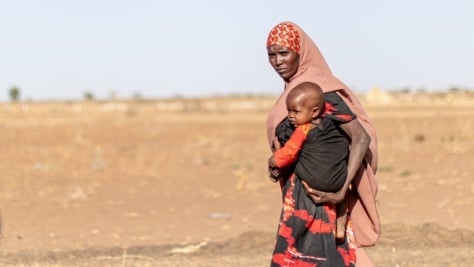
Life in the camps is not easy in the desert environment of eastern Chad, where water and firewood are extremely scarce. Sandstorms are a regular feature during the dry months and torrential rains flood the landscape in the wet season.

Yet in the faces of the refugees, dignity and hope remain in spite of the hardships and the violence they have suffered.

Portraits of Darfur's Refugees

Camp Life in Eastern Chad

Faced with nearly 200,000 Sudanese refugees from Darfur fleeing into the barren desert of eastern Chad, the UN refugee agency has essentially had to build small villages – including shelter, latrines, water supply and basic services – to accommodate the refugees and help them survive in a hostile natural environment with scarce local resources. The 11 camps set up so far shelter more than 166,000 refugees from Darfur.

While much work still needs to be done, especially to find sufficient water in the arid region, life in the camps has reached a certain level of normalcy, with schools and activities starting up and humanitarian aid regularly distributed to the residents. Meanwhile, UNHCR continues to improve services and living conditions in the existing camps and is working to set up new camps to take in more refugees from the ongoing violence in Darfur.

Camp Life in Eastern Chad

Internally Displaced in Chad

In scenes of devastation similar to the carnage across the border in Darfur, some 20 villages in eastern Chad have been attacked, looted, burned and emptied by roving armed groups since 4 November. Hundreds of people have been killed, many more wounded and at least 15,000 displaced from their homes.

Some 7,000 people have gathered near Goz Beida town, seeking shelter under trees or wherever they can find it. As soon as security permits, UNHCR will distribute relief items. The UN refugee agency has already provided newly arrived IDPs at Habila camp with plastic sheeting, mats, blankets and medicine. The agency is scouting for a temporary site for the new arrivals and in the meantime will increase the number of water points in Habila camp.

The deteriorating security situation in the region and the effect it might have on UNHCR's operation to help the refugees and displaced people, is of extreme concern. There are 90,000 displaced people in Chad, as well as 218,000 refugees from Darfur in 12 camps in eastern Chad.

Posted on 30 November 2006

Internally Displaced in Chad

Chad: Education in Exile

UNHCR joins forces with the Ministry of Education and NGO partners to improve education for Sudanese refugees in Chad.

The ongoing violence in Sudan's western Darfur region has uprooted two million Sudanese inside the country and driven some 230,000 more over the border into 12 refugee camps in eastern Chad.

Although enrolment in the camp schools in Chad is high, attendance is inconsistent. A shortage of qualified teachers and lack of school supplies and furniture make it difficult to keep schools running. In addition, many children are overwhelmed by household chores, while others leave school to work for local Chadian families. Girls' attendance is less regular, especially after marriage, which usually occurs by the age of 12 or 13. For boys and young men, attending school decreases the possibility of recruitment by various armed groups operating in the area.

UNHCR and its partners continue to provide training and salaries for teachers in all 12 refugee camps, ensuring a quality education for refugee children. NGO partners maintain schools and supply uniforms to needy students. And UNICEF is providing books, note pads and stationary. In August 2007 UNHCR, UNICEF and Chad's Ministry of Education joined forces to access and improve the state of education for Sudanese uprooted by conflict in Darfur.

UNHCR's ninemillion campaign aims to provide a healthy and safe learning environment for nine million refugee children by 2010.

Chad: Education in Exile

Chad Mission Photo Gallery

Chad Mission Photo Gallery

Darfuri Refugees in Chad: No end in Sight

More than six years after the beginning of the conflict in Sudan's Darfur region, more than a quarter-of-a-million refugees remain displaced in neighbouring Chad. Most of the refugees are women and children and many are still traumatized after fleeing across the border after losing almost everything in land and air raids on their villages.

Families saw their villages being burned, their relatives being killed and their livestock being stolen. Women and girls have been victims of rape, abuse and humiliation, and many have been ostracized by their own communities as a result.

The bulk of the refugees live in 12 camps run by UNHCR in the arid reaches of eastern Chad, where natural resources such as water and firewood are scarce. They have been able to resume their lives in relative peace, but all hope one day to return to Darfur, where hundreds of thousands of their compatriots are internally displaced.

In eastern Chad, UNHCR and other agencies are helping to take care of 180,000 internally displaced Chadians, who fled inter-ethnic clashes in 2006-2007. Some families are starting to return to their villages of origin only now.

Darfuri Refugees in Chad: No end in Sight

Chad's other refugee crisis

While attention focuses on the Darfuris in eastern Chad, another refugee crisis unfolds in southern Chad.

A second refugee crisis has been quietly unfolding in the south of Chad for the past few years, getting little attention from the media and the international community. Some 60,000 refugees from the Central African Republic (CAR) are hosted there in five camps and receive regular assistance from UNHCR. But funding for aid and reintegration projects remains low. Refugees have been fleeing fighting between rebel groups and governmental forces in northern CAR. 17,000 new refugees have arrived from northern CAR to south-eastern Chad since the beginning of 2009.

Chad's other refugee crisis

Goodwill Ambassador Angelina Jolie Returns to Eastern ChadPlay video

Goodwill Ambassador Angelina Jolie Returns to Eastern Chad

Angelina Jolie braved a violent sandstorm to visit refugees in eastern Chad. There, she was able to see how the security situation has deteriorated in the region since she last visited about three years ago.
Violence In Eastern ChadPlay video

Violence In Eastern Chad

In eastern Chad, continued violence threatens the UN refugee agency's fragile humanitarian lifeline to hundreds of thousands of Sudanese refugees and tens of thousands of displaced Chadians.
Chad: Influx from Central African RepublicPlay video

Chad: Influx from Central African Republic

The conflict in Central African Republic (CAR) receives far less media attention than that in Darfur, but the effects are much the same. More than 17,000 people have crossed into Chad since January, bringing the total number of CAR refugees to almost 70,000.
Chad: Environmental ChallengesPlay video

Chad: Environmental Challenges

The search for water and firewood is a daily trial for the 250,000 Sudanese refugees from Darfur in eastern Chad. The UN has found ways to alleviate the problems.
Life in ChadPlay video

Life in Chad

Photographer Frederic Noy looks at the lives of Sudanese refugees living in protracted exile in Chad.
Chad: Class ActPlay video

Chad: Class Act

Funding from the European Union helps refugee children in southern Chad's Camp Amboko go to school.
Chad: Changing LivesPlay video

Chad: Changing Lives

Refugees in southern Chad's Amboko Camp grow vegetables under an income-generation programme funded by the European Union.
Chad: Health for allPlay video

Chad: Health for all

Refugees in southern Chad receive health care under a European Union-funded programme. A new clinic tackles malaria, malnutrition, respiratory infections and more.