



From Safety to Support: Sudanese refugee sets up organization to support displaced women in South Sudan
From Safety to Support: Sudanese refugee sets up organization to support displaced women in South Sudan

A Sudanese woman who fled to South Sudan in 2023 has built one of the most active women-led organizations in South Sudan's Gorom refugee settlement, from the ground up. Through a partnership between UNHCR, the UN Refugee Agency, and the Mastercard Foundation, her organization is among a growing number of refugee-led organizations receiving funding.
Samia Abdulrahman Mohammed knows what it means to arrive with nothing. In May 2023, she fled the violence in El Geneina, in Sudan’s West Darfur State, and crossed into South Sudan. She eventually found safety in Gorom Refugee Settlement, outside Juba. It was there, in the community she now calls home, that she chose to build a foundation of support for the women around her.
“The Darfur Women Action Group (DWAG) specializes in women’s affairs and economic empowerment, and from there we provide them with small projects ranging from sewing, English language classes, and agriculture,” she says.
DWAG’s roots reach back to 2009, when it was established by a woman from Darfur to support women affected by the conflict. Arriving in Gorom 14 years later, Samia established its presence in South Sudan, carrying the mission into a new displacement crisis.
She did not start alone. Alongside a small group of women, they began by distributing Ramadan food packages and modest assistance to families in Gorom, work that quickly grew to include support for survivors of gender-based violence. “We started independently, to assist the community here in the Gorom Settlement,” she recalls.
“When we fund an organization like DWAG directly, we are not just funding a project; we are recognizing that Samia and women like her already have what international organizations often take years to build: the trust of their community,” says Gloria Fabian Nyaki, Assistant Representative for Protection, UNHCR South Sudan. “That is exactly what this partnership with the Mastercard Foundation is designed to do, get resources to the people closest to the people in need.”
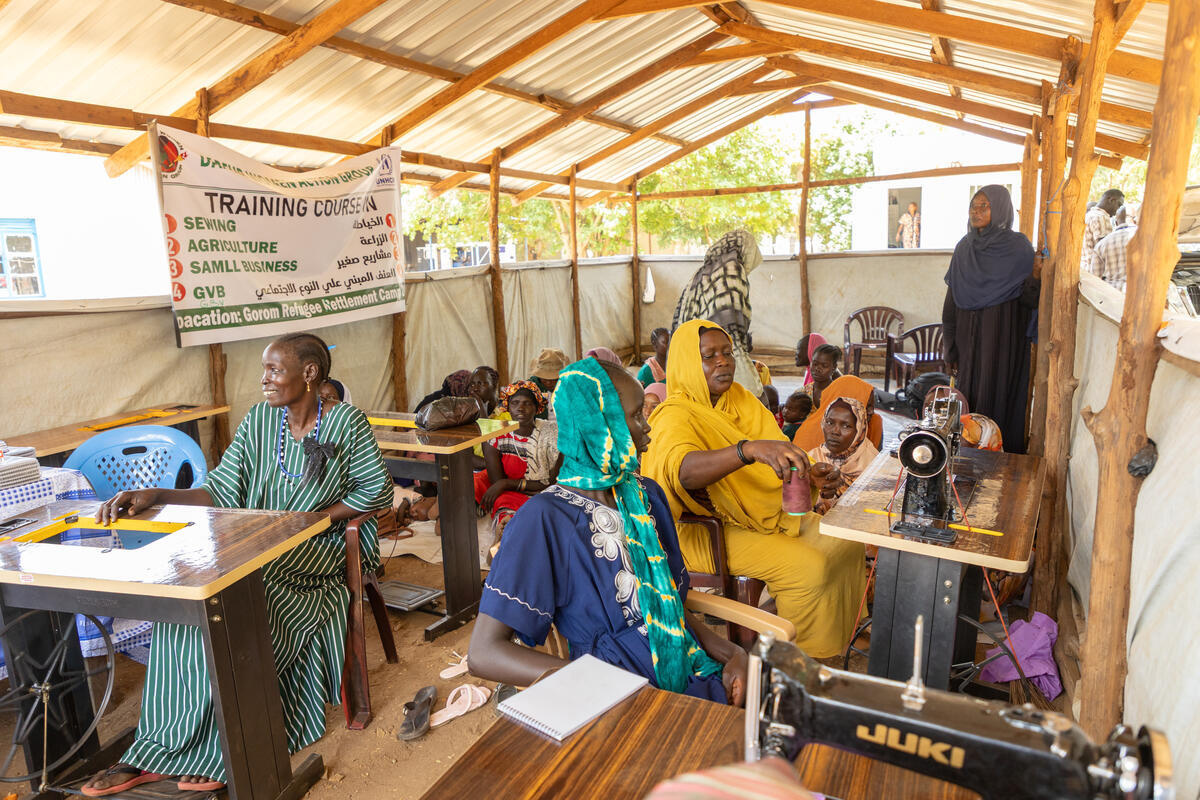
Through Samia’s organization, in Gorom, the shift toward localized funding is already bearing fruit. Over 70 women are now training on newly procured sewing machines, learning a trade that can generate income long after a project cycle ends. Alongside the tailoring workshop, DWAG runs a small agricultural project built around collective farming, continues its GBV response work, and offers targeted business assistance to a select number of women ready to start their own enterprises.
The timing could not be more critical. More than 650,000 refugees and asylum-seekers in South Sudan risk losing access to assistance amid declining humanitarian funding, and food and nutrition support for the country’s most vulnerable is running out. Against that backdrop, women-led, community-rooted programmes offer a vital path toward self-reliance that does not depend on the next emergency appeal.
For Samia, the work is far from finished. “We hope organizations stand with us and support us further, because the camp truly needs all organizations to join hands,” she says.
It is that same conviction, forged in her own experience of displacement, that drives DWAG’s work today. Given the tools, the trust, and the direct investment to lead, women who have lost almost everything can build something lasting for themselves and their communities.


