



Under one roof again, Aisha and Falmata stitch a new beginning in Minawao
Under one roof again, Aisha and Falmata stitch a new beginning in Minawao

Aisha Mohammed’s family gathers beneath its repaired shelter roof in Minawao.
In the densely populated Minawao refugee camp, in Cameroon’s Far North region, life moves with the rhythm of survival and routine. Children run through narrow, muddy paths after the rain. Traders call out to customers from small market stalls. Men repair shelters, and the smell of wood smoke rises from cooking fires. Home to nearly 80,000 Nigerian refugees, but initially designed for 15,000 people, Minawao is a place where people have rebuilt their lives from fragments, one mat, one meal, one roof at a time.
Outside one shelter, just as dark rain clouds gather over the camp, Aisha and her daughter Falmata sit close together on a mat under the shade of a newly extended roof. A sewing machine is set before them. They wear matching clothes, laugh easily, and often appear less like mother and daughter and more like sisters, or friends who have known each other all their lives.
Aisha is 40 years old. Falmata, her eldest daughter, is 21 and has two children of her own. Together, their family home is full of voices, movement, children, work and some worry. But on this afternoon, there is also relief. For the first time in months, when the rain begins to fall, the family does not rush to gather bags, lift mats or send children to neighbours.
They stay where they are.
“It is not easy,” Aisha says, watching the first drops soften the ground. “But even though we struggle for food, the fact that we can stay together as a family because of this shelter is a reason to be grateful.”
A few weeks earlier, that was not possible.
When heavy rains tore through their shelter last year, the roof gave way. Since then, every storm brought a familiar scramble. The children would be sent to one house, the adults to another. Sometimes relatives took them in. Sometimes friends made space. Sometimes the family split up because no single shelter could hold everyone.
“Imagine not having food,” Aisha says, “and also wondering whether your smallest child is crying in another person’s house.”
For families already living with uncertainty, a roof is more than shelter. It is where children sleep close enough to be counted. It is where a mother can hear a baby cough at night. It is where a family can remain together, even when everything else is difficult.
Falmata knows what it means to lose safety more than once.
She was still a teenager when she arrived in Minawao with her parents. The family had fled Banki, in north-eastern Nigeria, after clashes between Boko Haram and government security forces forced them to leave. Before Minawao, they had tried to find safety elsewhere in Nigeria, including in Lagos, but insecurity followed them in different forms. Her father, Mohammed Ali, now 48, lost his sight. The family’s options narrowed. As a teenager, Falmata entered a marriage she says was tied more to survival than choice. Two years later, she left and fled with her parents to Cameroon.
“When we arrived here, it felt like peace,” she says.
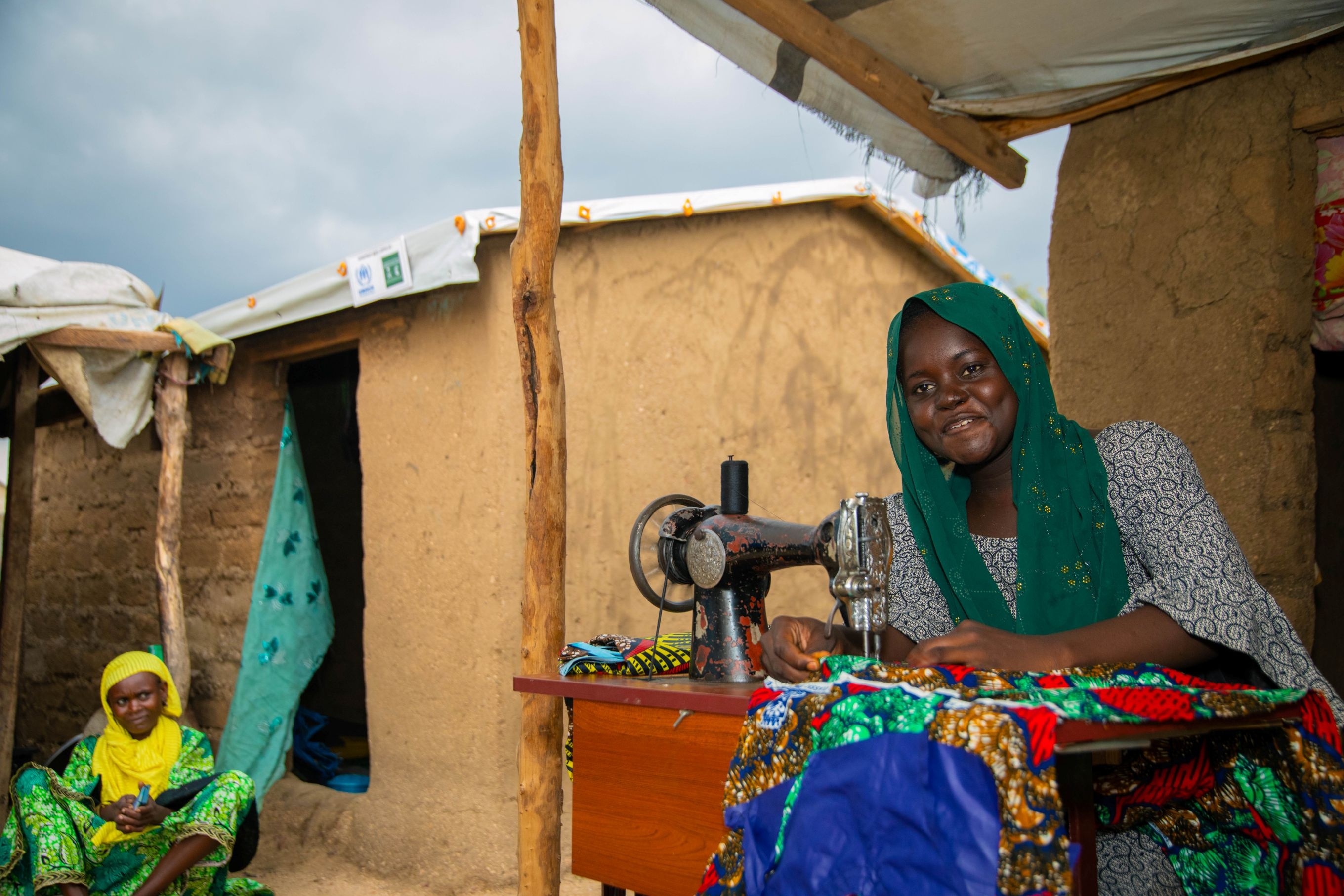
Nigerian refugee, Falmata Mohammed sews outside their house with a new roof in Minawao.
In Cameroon, she fell in love and married. Today, she is a mother, a seamstress, a daughter, and part of the daily life that keeps the family going. Her father often travels to Garoua, the main town of the North region, with two of his sons to look for work and send support back to the camp. At home, Aisha and Falmata sew clothes when they can. Their work is modest, but every small income matters.
They sew in matching outfits under the roof they rebuilt with support from UNHCR and the King Salman Humanitarian Aid and Relief Centre. The kit included tarpaulin to cover the roof, wood, nails and other items that helped them repair and better protect their home.
The materials did not solve every challenge. Food remains a daily concern, especially after food assistance stopped last year. Work is uncertain. The household is large. But the shelter support returned something essential: the ability to face the rain together.
Around Aisha and Falmata, children move in and out of the shade. One child leans against the shelter wall. Another watches the sewing machine. Rainwater begins to thread along the edge of the roof and fall to the ground outside the mat, not onto the family’s bedding.
Falmata looks up at the sky and then back at her mother’s work.
“When the rain came before, we had to run,” she says. “Now we can sit here.”
In Minawao, that simple sentence carries weight. It means the children can sleep at home. It means the smallest ones are no longer sent away when clouds gather. It means Aisha can keep her family in one place, even when other struggles remain.
The camp around them continues its daily rhythm. The market stays busy. Children continue playing after the rain slows. Families keep repairing, cooking, sewing, rebuilding.
For Aisha and Falmata, recovery is not a dramatic moment. It is a roof that holds when the sky grows heavy. It is a sewing machine under shade. It is a mother and daughter working side by side, their children close by, their family together.
“Now, when it rains,” Aisha says, “we can remain here.”


