
By Laura Argibay, UNHCR Reporting Officer.
On World Environment Day, the global community reflects on the urgent need to protect our planet. For UNHCR, the UN Refugee Agency, this responsibility is closely linked to how we deliver our mandate—supporting displaced people in some of the world’s most remote and fragile environments.
Across more than 130 countries, UNHCR relies on energy, infrastructure, and transport services to reach communities in need. Yet these essential support services—powering offices, running facilities, and enabling transport—have traditionally depended on energy- and fuel-intensive systems. That is now changing.
Through a series of integrated initiatives, the Global Mobility and Infrastructure Service (GMIS), within the Division of Resource Management (DRM), is advancing the sustainable transformation of UNHCR’s mobility and infrastructure services—strengthening resilience, improving efficiency, and reducing costs while supporting more responsible humanitarian operations.
1. Shifting operations to cleaner energy
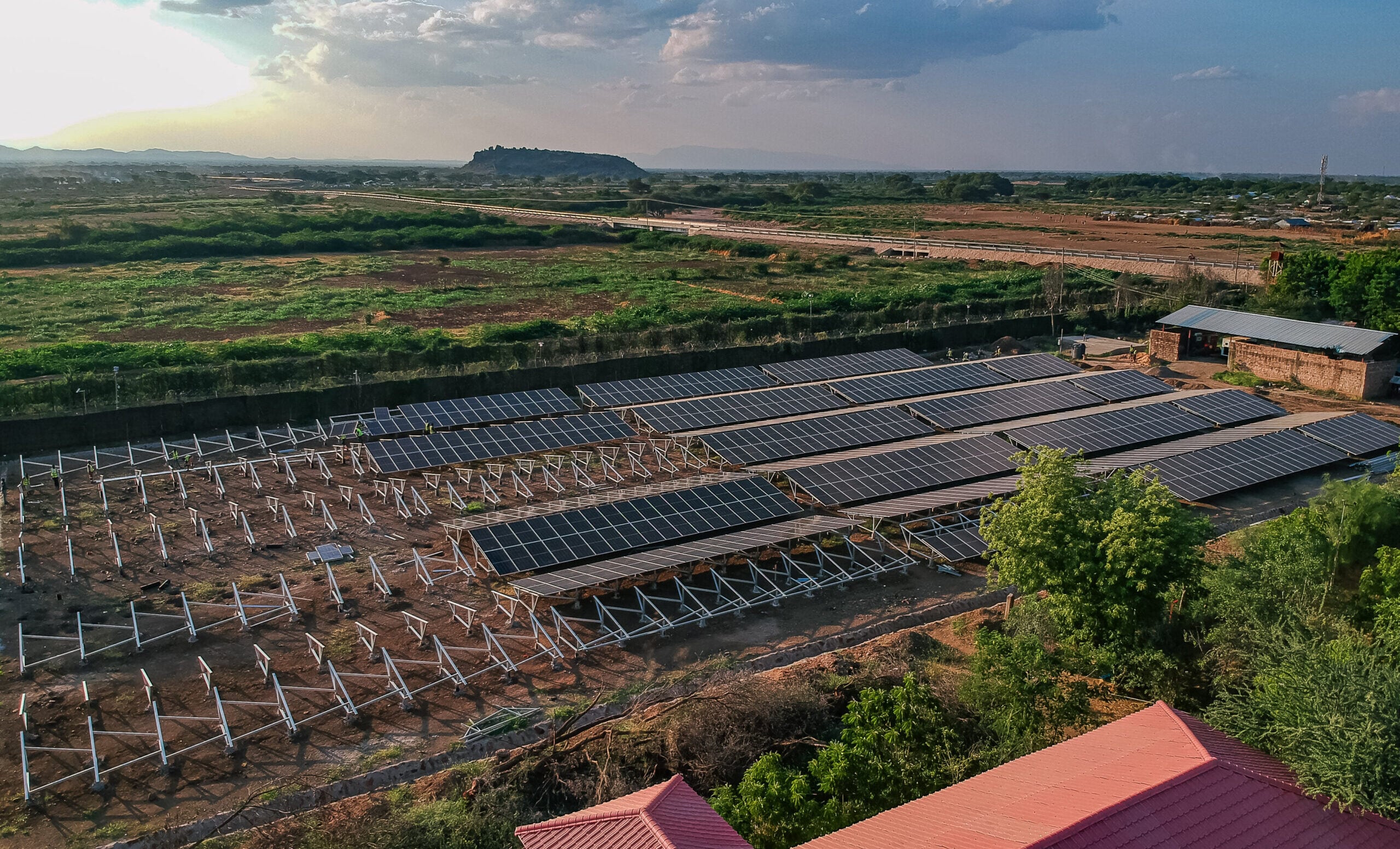
Solar panels are installed at the UNHCR Kakuma sub-office, Kenya, in 2023. © German Corporation for International Cooperation (GIZ)
Reliable energy is essential to humanitarian operations. Within GMIS, Sustainable Energy Services (SES) is leading UNHCR’s shift to cleaner energy solutions, especially in remote and crisis-affected environments.
At the centre of this effort is the Green Financing Facility (GFF), developed with support from the Swedish International Development Cooperation Agency (Sida), the German Federal Ministry for Economic Cooperation and Development (BMZ), and the IKEA Foundation. The GFF helps operations transition to clean, reliable solar power through an integrated technical and financing model. Winner of the 2025 AidEx Sustainable Initiative of the Year Award, it provides end-to-end financial support for the installation and operation of solar energy solutions. This centrally managed approach uses a revolving fund to cover up-front costs, which offices repay over time. Because capital is recycled as loans are repaid, a fixed pool of donor funding can reach far more sites than a conventional grant model, where each dollar is spent once and cannot be redeployed.
2. Driving more sustainable fleet services
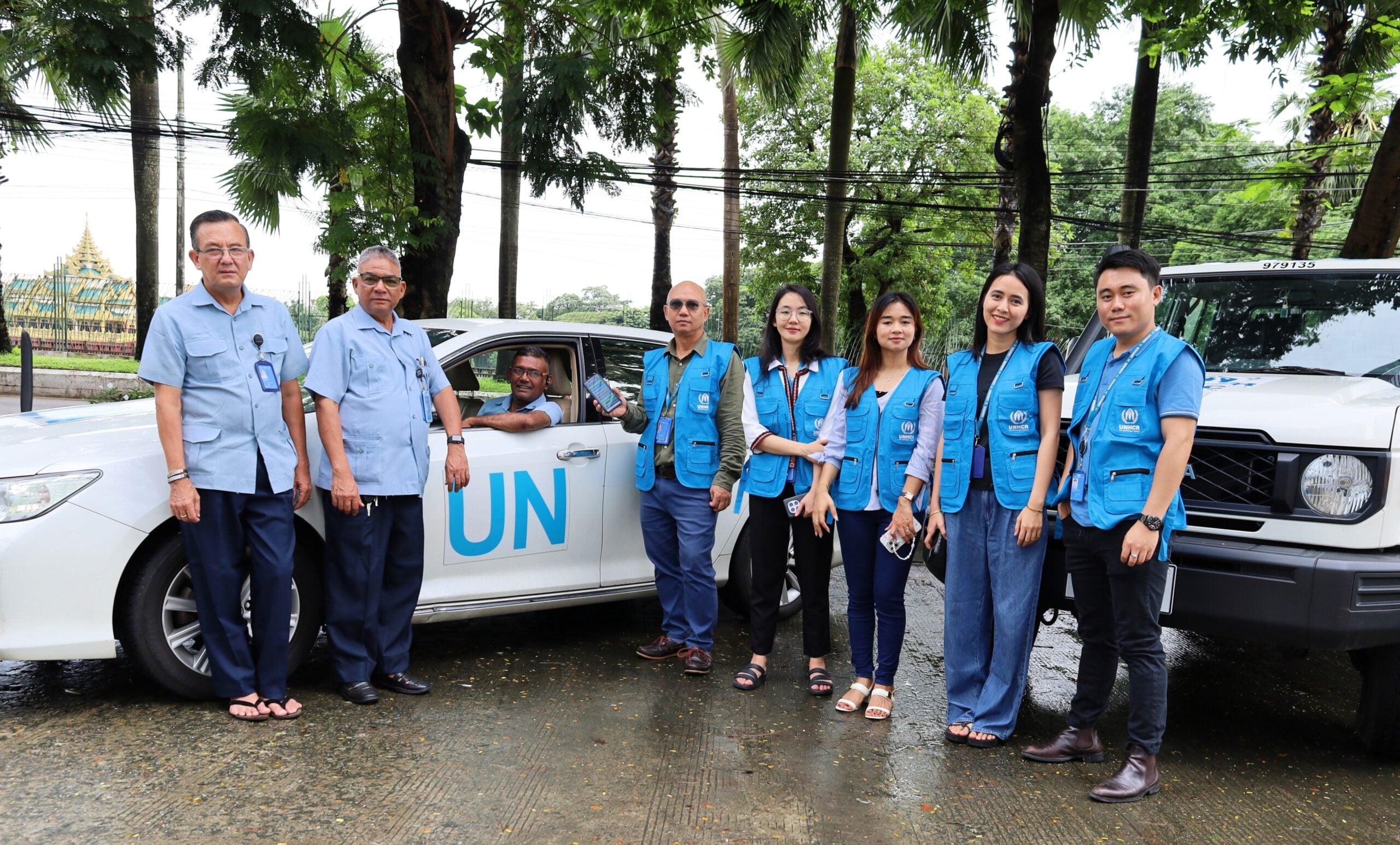
The UNHCR Myanmar team during the launch of Smart Fleet Ridesharing in Yangon in July 2025. © UNHCR/Pan Pwint
Transport is essential to humanitarian operations, enabling staff to deliver assistance. Within GMIS, the Asset and Fleet Management Section (AFMS) is leading UNHCR’s Sustainable Fleet Transformation, changing fleet services from a linear “procure–use–dispose” model to a more circular, data-driven, and efficiency-focused approach that cuts emissions and costs while improving oversight, safety, and operational flexibility.
➡️ Optimizing fleet use: UNHCR is actively adapting fleet supply to real operational needs—using utilization data, vehicle tracking, and shared-transport solutions to reduce kilometres travelled, fuel consumption, and operating costs while maintaining flexible response capacity. Real-time monitoring helps identify underused vehicles for redeployment or disposal, while the Smart Fleet Ridesharing and inter-agency carpooling programmes enable staff to share journeys more efficiently across operations.
➡️ Rethinking procurement: UNHCR is rethinking procurement through UN FLEET, the joint initiative with WFP that embeds sustainability criteria into vehicle leasing and supports the uptake of more fuel-efficient, hybrid, and electric vehicles where feasible. This shift is helping optimize vehicle management, lower lifecycle costs, and reduce CO₂ emissions.
➡️ Extending resource use and advancing circularity: UNHCR is also improving how vehicles and assets are maintained, reused, and recovered. Optimized maintenance standards and servicing plans help reduce waste and improve efficiency, including the extension of engine oil change intervals from 5,000 km to 10,000 km, following technical validation. In parallel, UN Global Auction and Disposal Services supports transparent, compliant disposal through public auctions—maximizing cost recovery, enabling reuse in secondary markets, and reducing waste as part of a more circular approach to fleet management.
3. Using data and innovation to drive smarter services
UNHCR is turning data into a driver of smarter, leaner, and more sustainable services. Across fleet and infrastructure, GMIS is using digital tools and operational insight to cut costs, sharpen decisions, and reduce environmental impact.
➡️ Smart Fleet: UNHCR is strengthening fleet oversight through data-driven tools that improve utilization, cost control, compliance, and safety. A Vehicle Tracking System provides real-time visibility of locations, routes, speed, and vehicle use, while the 2025 policy document, Standards on Fuel Management, strengthens control over fuel stocks, consumption, and costs. A mobile app for drivers is also being developed to support vehicle checks, fuel reporting, and safer driving. Together, these tools enable faster, evidence-based decisions and stronger accountability.
➡️ Smart Infrastructure: Across infrastructure services, UNHCR is using Green Boxes—energy monitoring systems—to track consumption in real time and turn data into action. The insights support business cases, project planning, and decisions on shifting from fossil fuels to renewable energy. Data monitors also power initiatives such as GenNet—a generator monitoring system that improves generator performance and reduces fuel use while giving offices live data to guide operational and strategic decisions.
➡️ Embedding sustainability in policy and practice: This transformation across transport and infrastructure services is backed by organization-wide policies, standards, and UN system frameworks that embed environmental requirements into fleet and infrastructure management. At the centre is UNHCR’s Policy on the Environment for Buildings, Facilities, Fleet and Travel, supported by instruments such as the Standards on Fuel Management and the Administrative Instruction on Asset Management.
4. Working together to scale sustainable solutions
Advancing more sustainable and efficient support services is possible through collaboration across UNHCR and beyond. GMIS works closely with operations, other UN entities, and the broader humanitarian sector to understand their needs, identify gaps, and use data analysis to improve approaches and develop more effective solutions.
Capacity development and collaboration are central to this effort. Through training, stronger engagement with implementing partners, and cooperation with donors and other agencies, UNHCR is helping scale more sustainable, accountable, and cost-effective solutions across its operations and the UN system. Initiatives such as UN FLEET show the value of working together to test and expand innovative approaches.
As climate change continues to intensify humanitarian needs, these synergies will be increasingly important to advancing sustainable, resilient, and efficient support services.
5. Delivering measurable impact
GMIS efforts are already delivering measurable results across energy, fleet management, cost efficiency, safety, and circularity—showing how sustainability can strengthen both operational performance and accountability.
✅ Cleaner energy: More than 3.84 MW of solar capacity and 7.6 MWh of battery storage have been deployed, helping avoid over 1 million litres of diesel, reducing emissions by 3,226 tonnes of CO₂, and saving about $17 million in energy costs.
✅ Lower-emission fleet: Since 2022, ridesharing has cut CO₂ by more than 1,700 tonnes. Fleet renewal reduced high-emission vehicles by 46% in 2025, and replacing the remaining 2,314 could avoid 1,960 tonnes of CO₂ and save 573,118 litres of fuel each year. In 2025, 25% of UN FLEET orders were for lower-emission models.
✅ Cost efficiency: Since 2023, fleet rightsizing has reduced the fleet by more than 2,000 vehicles and cut annual rental costs from $45 million to $35 million. Ridesharing has delivered $4.47 million since 2022, inter-agency carpooling added $0.4 million in 2025, and the Mobile Driver App could save around $1.5 million per year once fully deployed.
✅ Safer operations: Enhanced monitoring, driver identification, and targeted training have reduced crashes with injuries or fatalities by 19% per million kilometres in 2025, reaching the lowest level recorded since 2022. Pilot sites for the Driver Identification System achieved a 95% identification rate, strengthening compliance and accountability.
✅ Circularity and recovery: Doubling oil-change intervals avoids about 85,000 litres of waste oil and 9,600 waste filters each year. Since 2014, the UN Global Auction and Disposal Services has generated more than $330 million in cost recovery for the UN system, including $52 million in 2025.
A shared responsibility
On World Environment Day, UNHCR’s Global Mobility and Infrastructure Service reaffirms its commitment to delivering more sustainable, cost-efficient, and accountable support services. Across transport and infrastructure, these efforts are helping reduce UNHCR’s environmental impact, strengthen operations, and make better use of resources—because a sustainable future depends on caring for both people and the planet.