



Between displacement and returning home: the Houmani family waits for a way back
Between displacement and returning home: the Houmani family waits for a way back

Ali Houmani, his wife Iman and their three children outside the collective shelter where they now live in Abou Samra, northern Lebanon
For the Houmani family, home is more than a place.
It is where Ali built his livelihood as a daily worker, raised his family and spent more than three decades of his life. It is where his wife, Iman, ran her small online clothing business, and where their three children, Mohamad (10 years-old), Mehdi (8 years-old) and Asinat (7 years-old) grew up.
But when renewed escalation in southern Lebanon intensified in March 2026, the family of five had no choice but to leave.
They fled their home in Nabatiyeh al-Fawqa and headed north, carrying what they could with them, unsure of what lay ahead.
Their journey took them first to the southern coastal city of Saida, where they spent the first night sleeping in their car along the seafront Corniche. From there, they travelled to Beirut in search of a place to stay, before continuing further north to Tripoli, Lebanon’s second-largest city. There, they spent four months in a public school converted into a collective shelter. Like hundreds of schools across Lebanon, the building had been opened to host families fleeing the conflict when large-scale displacement left many with nowhere else to go. But as the new school year approached and classrooms were needed once again for students, displaced families were required to relocate. For the Houmanis, it meant packing up what little they had and moving yet again, this time to another collective shelter in Abou Samra, in Tripoli, where they are currently staying.
Yet while the family's location has changed several times since their displacement, home remains firmly on their minds.
For Iman, longing for home competes with the demands of everyday survival. As she waits for the day her family can return, she spends her time caring for three children, managing life in a shelter and trying to keep their education on track despite increasingly difficult circumstances.

Collective shelter in Abi Samra, northern Lebanon, where Ali and his family are currently taking refuge.
With the new school year underway, the three children, each in a different grade, are attending their lessons online using the only mobile phone they have, with only two hours of electricity per day.
For Iman, those two hours shape the entire day. She must make sure the phone is charged, coordinate lessons and carefully ration access to the device among her three children. Moving from one child to the next, she juggles competing class schedules during the brief period when they can connect, doing her best to ensure they can keep up with their studies.
While one child follows a lesson, the other two wait their turn. With only two hours of electricity a day, much of the school day slips away before all three children can connect. Every day becomes a race against time, leaving Iman exhausted as she struggles to keep her children learning and maintain a sense of normalcy despite the uncertainty of displacement.
“Imagine having to squeeze an eight-hour school day into two hours because of electricity cuts, while three children take turns using the same phone to attend class .”
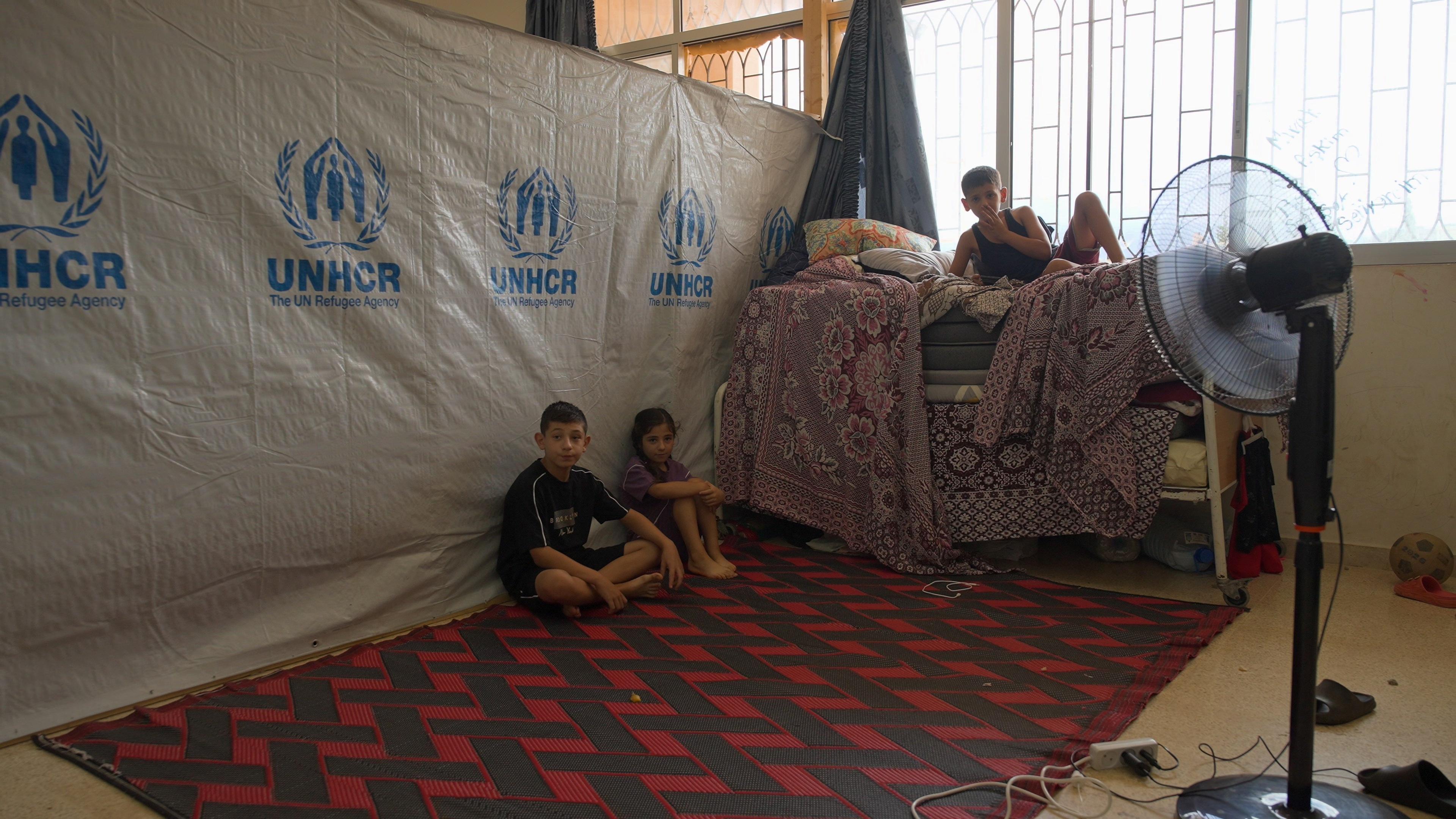
Mohamad, Mehdi and Asinat, inside a classroom that turned into their home during displacement.
The disruption has been particularly difficult for 10-year-old Mohammad.
Before displacement, he attended a school that specialized in supporting children with special educational needs, and received regular treatment and follow-up for ADHD (Attention Deficit Hyperactivity Disorder).
According to Iman, years of treatment and support had helped Mohammad make significant progress. But displacement disrupted that progress. “Everything we worked on with Mohammad is now gone. And his case is becoming more severe as displacement prolongs.”
The loss, Iman says, goes far beyond interrupted schooling. She worries constantly about Mohammad's wellbeing while also trying to ensure her other two children do not fall behind.
The weight is relentless. Displacement has stripped away the routines, services and support networks the family once relied on. Between caring for a child with additional needs, helping all three children attend school with limited resources and navigating the uncertainty of life in a shelter, Iman's days are filled with difficult choices and constant worry.
For Ali, moving from one shelter to another has not meant moving any closer to returning home.
“I am counting the days to return to my hometown. I miss the smell of my house, my land.”
Ali has not returned to Nabatiyeh al-Fawqa since March. With the village remaining under Israeli military control, he has been unable to return and assess the damage himself. According to information he has received, his home was severely damaged by Israeli bombardment and airstrikes during the conflict.
Nabatiyeh al-Fawqa lies opposite Ali Al-Taher Hill, an area that witnessed intense fighting and sustained shelling. Ongoing insecurity, explosive hazards and access restrictions continue to prevent residents from safely returning and assessing the condition of their homes.
“We cannot go home. The situation is still very dangerous. All I care about is my children’s safety now.”
Even as families long to return home, safe and adequate shelter remains an urgent concern for many who are still displaced. Destroyed homes, insecurity, damaged infrastructure and limited housing options continue to prevent hundreds of thousands from returning. Working with the Government of Lebanon and partners, UNHCR supports collective shelters and host communities through shelter rehabilitation and maintenance, emergency shelter assistance, and support for families living outside collective shelters. This assistance helps ensure that families who cannot yet return have a safe place to stay while they rebuild their lives and await a complete return to their towns and villages.
Displacement has changed almost every aspect of the Houmani family's daily life, from where they sleep and how they earn a living, to how their children attend school and access the support they need. For Iman and Ali, it has also meant carrying the often invisible burden of holding the family together while waiting for a future they cannot yet plan for.
But their destination has remained the same.
Home.


