


Nigerian Federal and State Governments, Germany and UNHCR Launch the Mobile One-Stop Shop Initiative to Bring Documentation and Protection Services to Displaced Communities in Hard-to-Reach Areas
Nigerian Federal and State Governments, Germany and UNHCR Launch the Mobile One-Stop Shop Initiative to Bring Documentation and Protection Services to Displaced Communities in Hard-to-Reach Areas

Abuja, Nigeria, 11 November 2026 – UNHCR, the UN Refugee Agency, today handed over ten Mobile One-Stop Shop vehicles to State Governments across Nigeria, in partnership with the Federal Government of Nigeria and with generous funding from the Government of Germany. The initiative will extend critical protection and documentation services to displaced and host communities in remote and hard-to-reach locations that have long struggled to access them.
The mobile units will deliver digital identification and civil documentation, protection counselling, case referral, and access to banking and phone services directly to communities across ten states: Borno, Adamawa, Yobe, Akwa Ibom, Benue, Cross River, Taraba, Katsina, Zamfara, and Sokoto. By bringing services to where people live, the fleet removes major barriers (distance, cost, and insecurity) that have historically kept displaced families from obtaining the documents they need to rebuild their lives.
“The Mobile One-Stop Shops are part of UNHCR’s shift towards supporting government capacity to deliver essential protection services and promote the socio-economic inclusion of displaced communities. This partnership between UNHCR, the Federal and State Governments, and Germany puts solutions into action: the first steps towards self-reliance,” said Arjun Jain, UNHCR Representative in Nigeria.
The Federal Ministry of Humanitarian Affairs and Poverty Reduction has reaffirmed the importance of strategic partnerships, institutional coordination and people-centred interventions in addressing the challenges confronting displaced and vulnerable populations across Nigeria. This aligns with the broader vision of the Honourable Minister, Dr. Bernard M. Doro, to strengthen humanitarian response, promote social inclusion and establish sustainable pathways through which vulnerable households can rebuild their lives and achieve self-reliance.
“When people cannot reach essential services, we must bring the services to them. The Mobile One-Stop Shop puts birth registration, NIN enrolment, SIM registration, BVN, bank accounts and enrolment into the National Social Register on four wheels. Identity is the first step out of poverty: you cannot be paid if you cannot be identified, and you cannot be protected if you cannot be counted. No Nigerian should be left behind simply because of where they live, or because they were forced to flee,”
A Partnership for Access and Inclusion
This initiative reflects a shared commitment by UNHCR, Nigeria’s Federal and State Governments, and Germany to close the documentation gap for displaced populations. For many refugees and internally displaced people in remote areas, the nearest registration office can be days away, a barrier that leaves children out of school, keeps families locked out of financial services, and limits access to justice and protection. The mobile fleet, made possible through German support, brings these services to the doorstep of communities that need them most, reinforcing the link between documentation and durable solutions. UNHCR, the Federal and State Governments, and Germany remain committed to expanding this model and reaching more communities across the ten states and beyond in the years ahead.
“Germany is proud to support this initiative. The vehicles bring access to documentation to displaced and host communities, enabling them, for example, to go to school or to access banking, in other words, to take their life in their own hands.”
Access to civil documentation and legal identity remains fundamental to the protection and socio-economic inclusion of displaced persons. Without appropriate documentation, individuals and families may experience difficulties accessing education, healthcare, financial services, livelihood opportunities and other essential public services. The Mobile One-Stop Shops therefore represent an important intervention in ensuring that displacement does not permanently deprive individuals of their rights, dignity and opportunities to rebuild their lives.
The initiative also underscores the importance of collaboration between the Federal Government, State Governments, international organisations and development partners in delivering effective humanitarian services. While the Federal Government provides national policy direction and coordination, State Governments remain critical to ensuring that interventions reach affected communities and respond to their specific circumstances. Similarly, partnerships with organisations such as UNHCR, supported by the Government of Germany, demonstrate how international cooperation can complement national efforts through resources, technical expertise and institutional support.
Elias' Story
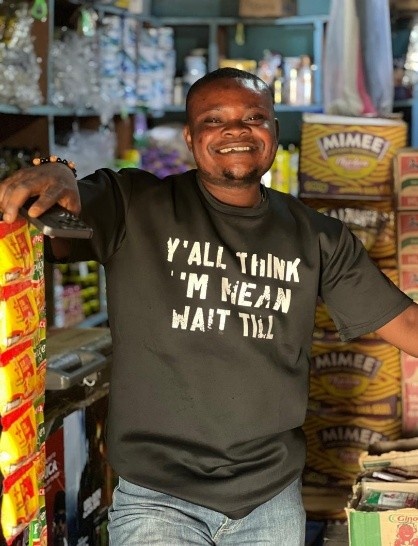
Elias smiles in his shop, where he runs his business.
Elias, a refugee from Cameroon, received his identity documents and National Identification Number in 2018 after fleeing violence in his home country.
“Once I had my documents, everything started to change,” he says.
With his documentation secured, Elias accessed assistance, enrolled his children in school, completed vocational training, and opened a bank account. He saved part of his earnings alongside cash assistance, gradually building the financial foundation needed to establish his own business and, by 2022, opened a small shop in the refugee settlement, demonstrating how access to documentation, when combined with appropriate support and livelihood opportunities, can help displaced persons regain economic independence. A year later, he expanded with a second shop in Ogoja.
Elias’s experience demonstrates that legal identity is more than an administrative requirement; it can serve as an important gateway to education, financial inclusion, entrepreneurship and sustainable livelihoods.
Fatima’s Story

Fatima and her children, proudly holding their birth certificates.
For Fatima, an internally displaced mother of three, documentation opened the door to her children’s future. After violence forced her family from their home, she worked as a petty vegetable seller to support them, but without birth certificates, she was afraid to enrol her children in school.
“I knew they were due for school, but I feared taking them because I did not want to be turned back,” she recalls.
With support from UNHCR and its partners, Fatima applied to the National Population Commission (NPC) for her children’s birth certificates. In March 2025, she received them, a milestone she calls emotional and fulfilling, opening up new possibilities for her children’s education and future.
“It was a feeling of fulfilment,” she says. “Having the birth certificates has opened doors for my children beyond primary school. These are documents they will need all through their lives.”
The experiences of Elias and Fatima demonstrate the far-reaching impact of humanitarian interventions when they address the actual needs of affected households. While Elias’s story illustrates how documentation and targeted assistance can support vocational development, financial inclusion and entrepreneurship, Fatima’s experience highlights how access to civil documentation protects children’s rights and creates opportunities for education and a better future. Both accounts reinforce the importance of interventions that go beyond immediate relief to address the barriers that prevent vulnerable people from rebuilding their lives.
Looking Ahead
Through this partnership, the Mobile One-Stop Shop fleet will bring documentation and protection services closer to families like Elias' and Fatima’s across ten states, a tangible step towards inclusion, self-reliance, and durable solutions for displaced and host communities in Nigeria.
These outcomes align with the policy direction of the Ministry under Dr. Bernard M. Doro, particularly the One Humanitarian, One Poverty Response System (OHOPRS), which seeks to connect humanitarian intervention, social protection and poverty reduction within a coordinated national framework. The overarching objective is to move vulnerable households beyond repeated emergency assistance towards sustainable pathways that promote dignity, resilience, economic participation and eventual graduation from poverty.
The Federal Ministry of Humanitarian Affairs and Poverty Reduction recognises that sustainable humanitarian outcomes depend on coordinated action, strong institutions and interventions that place people at the centre of development. Through continued collaboration with relevant government institutions and development partners, the Ministry remains committed to strengthening protection systems, expanding opportunities and ensuring that displaced persons, refugees and vulnerable host communities can rebuild their lives with dignity, independence and hope for a more secure future.
“Today we hand the State Governments more than vehicles. We hand them a responsibility: to keep these units fuelled, maintained and on the road, reaching the last camp, the last village and the last family. Ten states, one innovative response. If we get this right, these ten will become thirty-six, plus the FCT.”


