



For Displaced Nigerians in Benue State, Cash Assistance is Saving Lives and Restoring Hope
For Displaced Nigerians in Benue State, Cash Assistance is Saving Lives and Restoring Hope

Back in Tse Iortim Village, the community she was once forced to flee, Shinku Ukusuyol, 55, is finding her footing again with the support of UNHCR's cash for protection programme.
Abuja, 22 June 2026 – In Benue State, where repeated violence has displaced hundreds of thousands of people, families returning home face a stark reality: starting over with almost nothing. A cash for protection programme is providing life-saving assistance to some of the most vulnerable households — helping them meet their most urgent needs and restoring safety and dignity after displacement.
Through its Multi-Purpose Cash Assistance programme, UNHCR, in partnership with the Government of Nigeria and humanitarian partners and supported by the Nigerian Humanitarian Fund (NHF), is providing direct financial assistance to vulnerable households in Makurdi and Guma Local Government Areas.
For Stephen Mnguaor, a farmer living with a disability, that question — how to start over with almost nothing — is immediate and practical. When armed attacks forced him to flee Tse Iortim Village, he lost not only his home, but also his ability to earn. Now back in his community, even farming — his main source of income — has become difficult, often requiring him to hire labour he cannot afford.
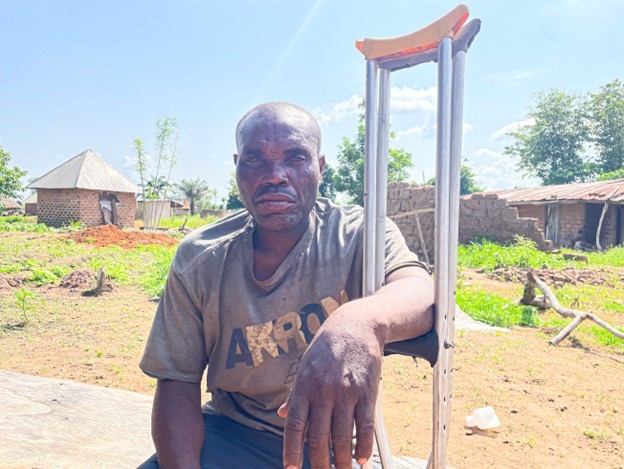
Stephen Mnguaor, 52, is one of the beneficiaries of UNHCR's cash for protection programme, funded by the Nigerian Humanitarian Fund (NHF), in Benue State. Photo: ©UNHCR/Paul Dugeri.
The targeted cash transfer from UNHCR is helping him begin again. With the support, Stephen plans to use part of the assistance to rebuild his home and provide a safe place for his family to live, small but critical steps toward stabilizing their futures.
His story reflects a wider reality. Nigeria has approximately 3.8 million internally displaced people, with at least 500,000 in Benue State alone — one of the highest concentrations in the country. Many families are attempting to return, but without resources, recovery remains fragile and uncertain.

Stephen Mnguaor sits with his family outside their home. The assistance has given him renewed hope to begin rebuilding his life, including repairing his damaged home to give his wife and children a safe place to live.
Why cash matters
Cash assistance is one of the fastest and most effective ways to protect and stabilize displaced families.
Rather than receiving pre-selected items, families decide how best to use the support — whether to pay rent, buy food, access healthcare, or restart livelihoods. That flexibility is critical in a context where needs vary widely from one household to another.
“When people are forced to flee, they lose control over almost everything,” says Arjun Jain, UNHCR Representative in Nigeria. “Cash gives some of that control back — quickly, and in ways no other assistance can.”
Targeting those most at risk
The programme focuses on the most vulnerable, including people with disabilities, single parents, older persons, and female-headed households.
Since April, UNHCR and partners have conducted vulnerability assessments across communities in Benue State. More than 10,000 households have been screened, leading to the identification of nearly 500 highly vulnerable households — representing over 3,000 individuals — eligible for support. Cash disbursements have already begun, with assessments continuing in additional communities. Many more will benefit in the coming months.

A UNHCR staff member conducts a vulnerability assessment with a displaced family in their shelter, gathering information to identify individuals and households eligible for Multi-Purpose Cash Assistance.
Beyond immediate relief, the programme also helps connect displaced families to essential services. During the assessment process, hundreds of individuals who lacked national identification or access to banking were identified and referred to the State Emergency Management Agency (SEMA), enabling them to obtain the documentation needed to access financial services and other support.
Reducing risks, strengthening safety
Without resources, displaced families often face difficult and sometimes dangerous choices — including withdrawing children from school, engaging in exploitative labour, or resorting to unsafe coping strategies.
By enabling families to meet their basic needs safely, cash assistance helps reduce these risks and creates space for more stable recovery.
For Shinku Ukusuyol, 55, the support has been critical. She fled the same wave of violence that affected Stephen, losing her home and loved ones. In the displacement camp in Makurdi, meeting even basic needs was a daily struggle.
Now back in Tse Iortim Village, she is rebuilding gradually. The cash support has allowed her to buy food and cover essential expenses — restoring a degree of stability after months of uncertainty.
“The support has brought hope back into my life,” she says.
More importantly, it has given her the confidence to stay and rebuild — rather than face continued displacement. For her children, it represents the possibility of growing up in a more stable environment.

Back in her community of Tse Iortim Village, Shinku Ukusuyol prepares a meal — a small act of resilience as she rebuilds her life after displacement in Benue State, with support from UNHCR's cash for protection programme.
Part of a broader protection response
The cash for protection programme is part of a wider NHF-funded effort to strengthen safety and support recovery for displaced populations in Benue State.
Alongside financial assistance, UNHCR and partners are supporting displaced families, strengthening protection monitoring and human rights reporting, improving safety in vulnerable areas through solar street lighting, and helping to decongest overcrowded displacement sites.
Together, these interventions are designed to move families beyond immediate survival and toward longer-term recovery.
For communities like Tse Iortim, recovery remains fragile. But with targeted support — and the freedom to meet their own most urgent needs — families are taking meaningful steps toward rebuilding their lives in safety and dignity.


