

In Salt Lake City, refugee women find healing through a local knitting group
In Salt Lake City, refugee women find healing through a local knitting group

Christine, a refugee from the Democratic Republic of the Congo, with a few of her knitting projects.
On a cloudy day in Salt Lake City, Utah, the warmth of the knitting circle at the THRIVE Center for Survivors of Torture offers a comforting contrast to the winter chill outside. Refugee women from the Democratic Republic of the Congo (DRC) sit alongside local volunteers, their knitting needles softly clicking as they talk. Among them are Aline and Christine. Bound by survival, their stories reveal the enduring wounds of war and the healing power of community.
“I wouldn’t be alive if I wasn’t connected to these people.”
From the First and Second Congo Wars between 1996 and 2003, and the Kivu conflicts in the eastern part of the country that continue to this day, the DRC has faced decades of conflict marked by widespread violence and human rights abuses. As of April 2025, over 7 million people are displaced within the DRC, and over 116,000 have fled across borders due to escalating violence in the eastern provinces driven by clashes between the government and armed rebel groups. This crisis has left millions of Congolese deeply traumatized by loss, fear, and prolonged uncertainty. Women and children are especially vulnerable, often directly targeted or forced to witness horrifying violence. Despite the severity of their needs, refugees frequently lack access to specialized care, leaving their emotional pain untreated.
UNHCR has long been at the forefront of providing lifesaving services to the hundreds of thousands of people forced to flee their homes in the DRC. Through the psychosocial support offered, many refugees have been able to address their complex mental health needs. However, resources are stretched thin. In many refugee communities, the need for psychosocial support far outweighs the resources and funding available, leaving many survivors without the support they need to recover and heal fully.
Aline and Christine, both from the DRC, are longstanding members of the THRIVE knitting circle. Aline is still haunted by the day her life changed. After school, she returned home to find her village was under attack by armed men. In a desperate bid to survive, she hid among her neighbors’ deceased bodies until it was safe to flee. She was later found and brought to the Gihembe refugee camp in Byumba, Rwanda, where she lived for nearly 20 years before resettling to Salt Lake City in 2014 with her children.
In 2014, Aline and her children found safety and community in Salt Lake City. Despite the newfound stability, the emotional scars of her past remained decades later, and she struggled with paralysis and memory loss. Aline’s doctors eventually connected her with the THRIVE Center for Survivors of Torture, where she received vital support, including therapy, transportation, interpretation services, and assistance managing medical appointments.
A pivotal part of Aline’s healing was joining the center’s knitting group. What started as a simple activity became a transformative experience, allowing her to learn new skills, make meaningful connections, and rebuild her self-esteem. “When I’m at home, I face loneliness a lot. But since I joined this group, I laugh, I learn, I feel happy," she shares. "My kids and I are happy."
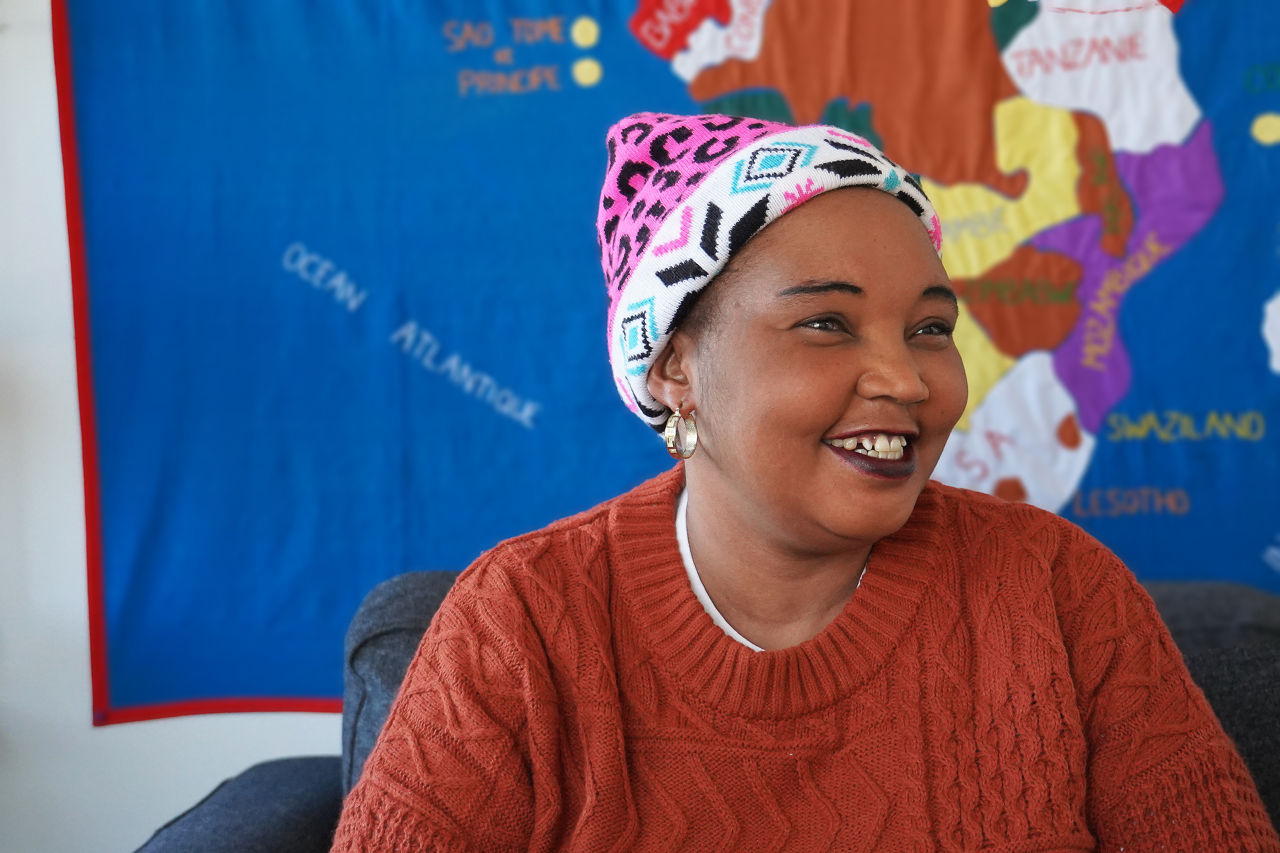
Aline, a refugee from the Democratic Republic of the Congo, at the THRIVE Center for Survivors of Torture
Christine’s story is tragically similar. After fleeing violence in the DRC in 1993, she spent over two decades in a refugee camp in Rwanda, where she faced unimaginable loss — losing three children, her brother and his entire family. In 2015 she found safety and a new home in Salt Lake City. She continued to struggle with the emotional aftermath of her experiences, including PTSD and anxiety. Like Aline, Christine was connected to THRIVE, where she accessed group therapy, among other support services.
Learning to knit and crochet not only eased her stress but helped her rebuild self-worth and an opportunity to connect with others. “Before I joined the group, it was tough for me,” Christine says. “I was really stressed.... This helped me to feel like I’m doing something.” Her stress lessened as her hands learned to knit scarves, sweaters and hats for her grandchildren. Now, she teaches others – passing on not just a skill, but a sense of purpose.
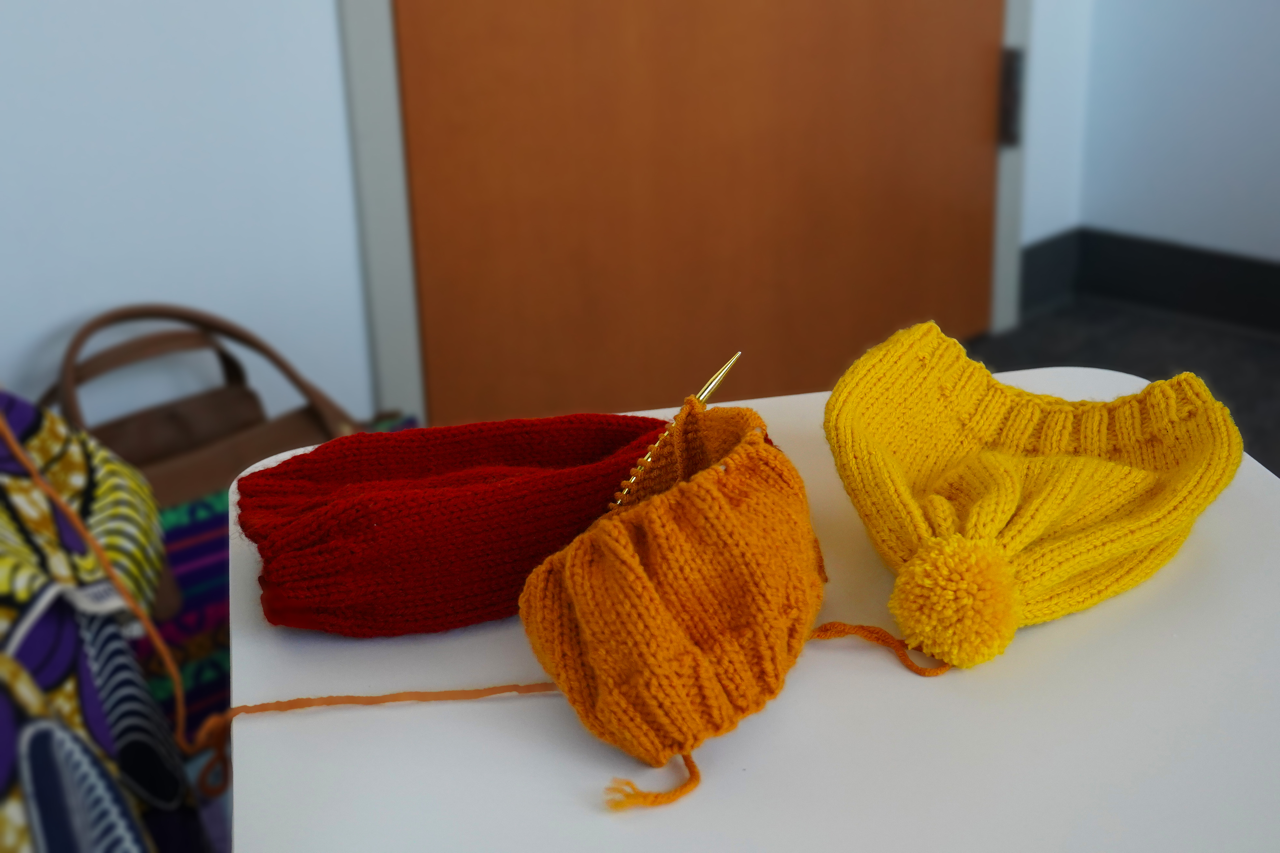
Hand-knit hats made by refugee women at the THRIVE Center in Salt Lake City, Utah.
In the quiet room at THRIVE, women like Aline and Christine gather each week, their hands busy with knitting projects as conversation flows between them. It's in these shared moments that healing takes root. A knitting circle might seem small, but for survivors of torture, it can mean everything: a place to speak freely, to laugh again, to pass on skills, and to begin writing a new chapter. For Aline, for Christine, and for many others, this circle is more than a group — it’s a lifeline.