



Côte d'Ivoire
Côte d'Ivoire
The country is making notable progress in addressing statelessness and displacement and leading the region with Africa’s first legal process to identify and protect stateless persons.


Are you a refugee, asylum-seeker or stateless person looking for help? Visit the HELP site to find support and services from UNHCR.
Côte d’Ivoire continues to make significant strides in addressing statelessness and supporting displaced populations. The country remains home to one of Africa's largest populations at risk of statelessness, with over 900,000 individuals affected. In a landmark move, Côte d’Ivoire adopted Africa’s first legal process to identify and protect stateless persons, establishing procedures to regularize their status and facilitate access to nationality.
Since 2011, more than 310,000 Ivorian refugees have voluntarily returned home, following years of civil unrest. In 2022, UNHCR proclaimed the cessation of refugee status for Ivorians, acknowledging the country's progress in restoring stability, supporting returnees' reintegration, with communities welcoming them back.
Côte d’Ivoire also continues to host refugees fleeing violence in neighboring countries, including Burkina Faso. UNHCR works closely with Ivorian authorities and partners to protect their rights and find durable solutions.
The Côte d'Ivoire multi-country office covers activities in Benin, Côte d'Ivoire, Ghana, Senegal and Togo and also covers, without a presence, Cabo Verde, The Gambia, Guinea, Guinea-Bissau and Sierra Leone.
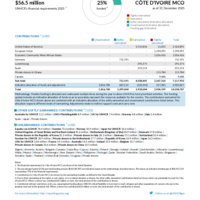
Population and financial overview
Data on population and financials are available at the multi-country office level, which oversees operations across several countries.
Côte d'Ivoire
Use the year selector to access strategy information from previous years.



Office contact details
For information about our operation in Côte d'Ivoire, please contact us through our Headquarters in Geneva, Switzerland.


