



Bridging the Gaps: Albania takes steps to improve access to documentation for refugees, with support from UNHCR under the EU4Migration Project
Bridging the Gaps: Albania takes steps to improve access to documentation for refugees, with support from UNHCR under the EU4Migration Project

Participants from key national institutions gathered in Tirana for a UNHCR roundtable under the EU4Migration project to discuss how to strengthen access to documentation for refugees and others under international protection.
Having an ID or a birth certificate is something most people take for granted. But for refugees, having documentation is one of the first and biggest steps.
In Albania, refugees without the right documents struggle to enroll their children in school, see a doctor, find work, or open a bank account - despite having the legal right to these services. Removing these barriers is crucial to ensuring equal access and fostering true inclusion.
To support this goal, UNHCR, the UN Refugee Agency, organized a roundtable in Tirana on 17 October, under the EU4Migration project, funded by the European Union. The event brought together participants from key government institutions to discuss how to remove practical barriers and make documentation easier and faster to access for refugees and others under international protection.
Together, they mapped out each step of the documentation process, from arrival and registration at the border, to getting civil documents, a residence and work permit, and access to services like education, housing or healthcare.
“This kind of dialogue helps us connect the dots,” said Dardana, a representative from the Ministry of Economy and Innovation. “When institutions coordinate better, refugees get real access to opportunity, to study, work, and take part in society.”
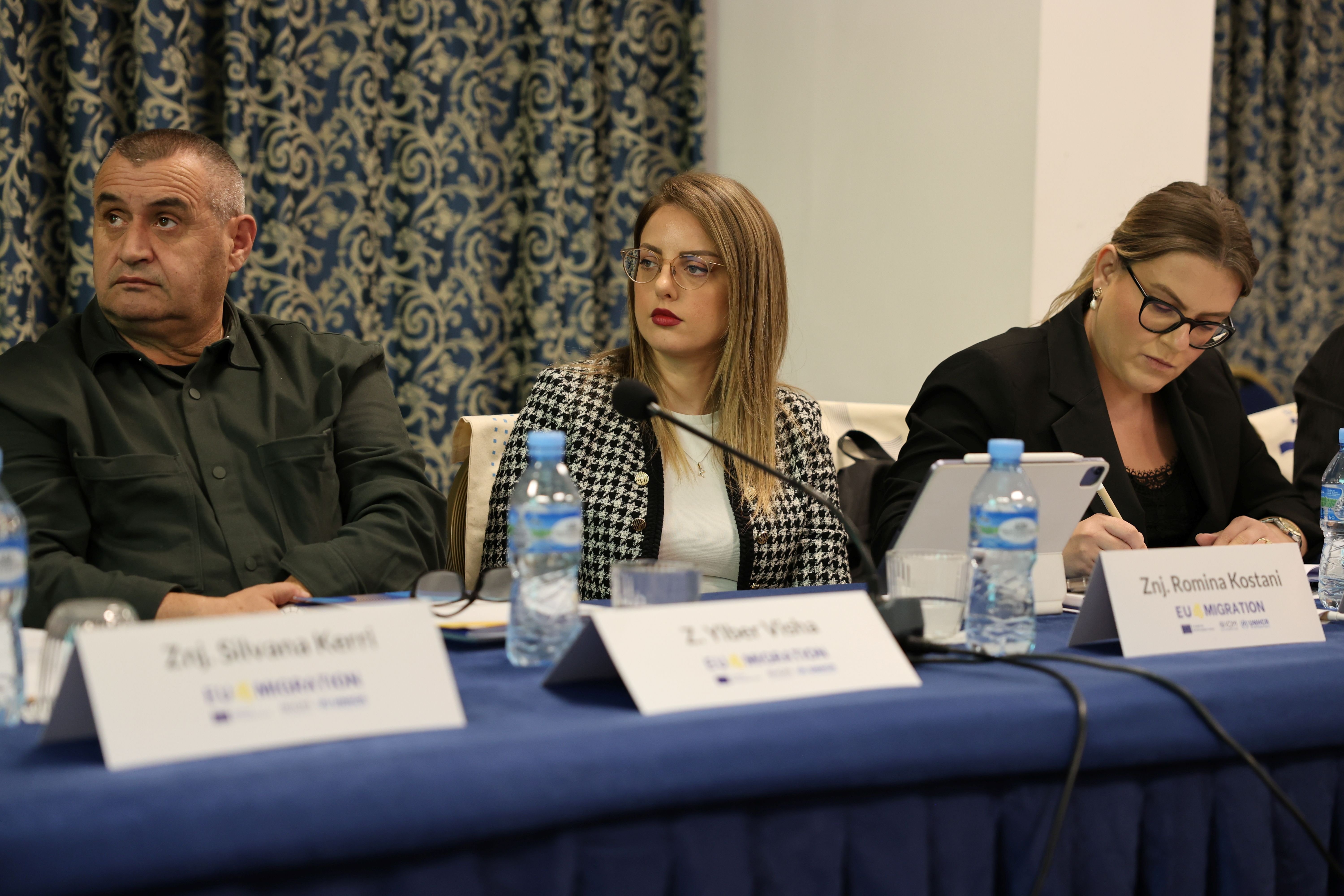
Participants from national institutions exchange views during the Tirana roundtable on enhancing access to documentation for refugees and others under international protection.
While Albania’s legal framework has seen notable improvements and creates the conditions for inclusion, participants acknowledged that differences in procedures, system compatibility, or local interpretations can result in delays, especially when documents must be issued across multiple agencies.
One recurring issue was digital interoperability. As Albania continues to modernize its e-government services through the e-Albania platform, ensuring that refugees and asylum-seekers can access these tools remains an ongoing challenge.
“These are not gaps of intent,” said one participant. “They are gaps in systems that are still evolving. Stronger coordination, clearer communication, and shared digital tools can go a long way in solving them.”
The roundtable also served as a platform for peer exchange and technical learning. Participants highlighted the importance of improving data exchange, increasing clarity on required documents, and providing better guidance to refugees navigating the process.
“When refugees have documentation, they can access the same rights and opportunities as others, from health care and education to employment and a sense of belonging,” said Enkelejda Shtufi, Senior Protection Associate at UNHCR in Albania. “This is what integration truly means.”
The roundtable concluded with practical recommendations to simplify registration processes, improve data flow, and strengthen communication between agencies. These insights will guide ongoing collaboration between government institutions, UNHCR, and RMSA, helping build a more inclusive system that leaves no one behind.
The initiative is part of broader efforts supported by the EU4Migration project, a four-year project funded by the European Union and implemented by UNHCR and IOM, in partnership with the Government of Albania.


