



One Classroom, Many Journeys: How Albanian lessons are helping asylum-seekers in rebuilding lives
One Classroom, Many Journeys: How Albanian lessons are helping asylum-seekers in rebuilding lives

Jorida Pina, a seasoned Albanian language teacher, stands in a classroom at the National Reception Centre for Asylum in Tirana, teaching a lesson on commonly used Albanian verbs.
Inside the library-turned-classroom at the National Reception Centre for Asylum in Tirana, Albania, ten asylum-seekers sit around a long wooden table, notebooks open, listening intently. They're from Cameroon, China, Nigeria, Saudi Arabia, Syria, Uganda and Ukraine.
Some arrived early November 2025. Others have been there for months. All are here for one reason: to learn the language that shapes the country they now call home.
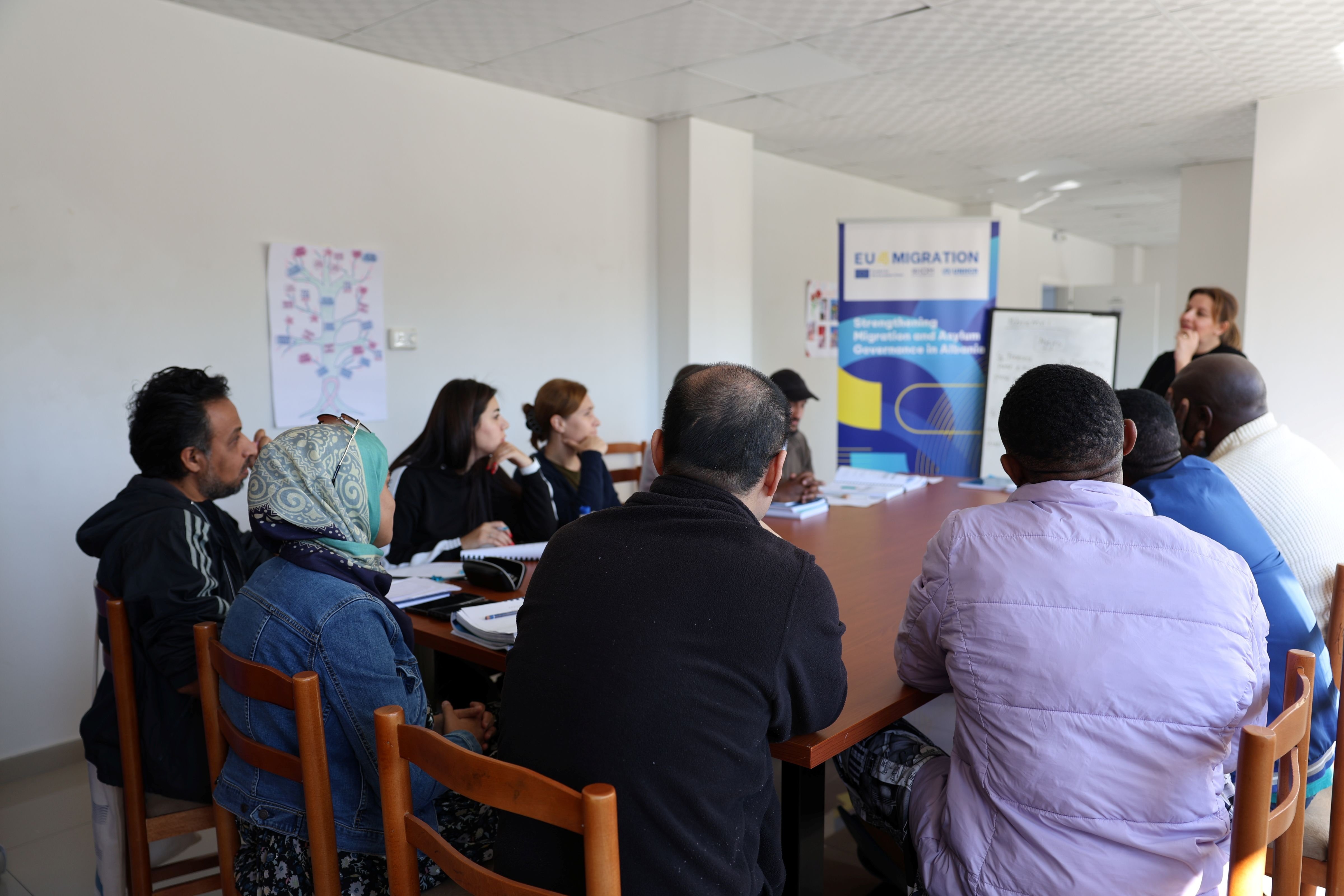
A mix of new and continuing students take part in an introductory round during an Albanian language class at the National Reception Centre for Asylum in Tirana, led by teacher Jorida Pina.
At the front of the room is Jorida, their teacher. She doesn’t just teach Albanian, she helps students find their footing in a foreign place.
Jorida has been teaching the newcomers how to read, write, and speak Albanian through a programme supported by the European Union under a project called “EU4Migration”. EU4Migration is a four-year that strengthens Albania’s asylum and migration systems while promoting access to services, integration, and long-term inclusion for refugees, asylum-seekers, and migrants.
“Language is power,” she says. “If you want a job, education, or just to buy groceries without fear, you need the words.”
Her classroom environment is welcoming and informal. One group practices verbs through conversation, whilst another pair reads out loud from a booklet she created with everyday words, like “market,” “doctor,” and “bus stop”.
“I always start by telling them that Albanian is easy to read,” she explains. “You pronounce it exactly as it’s written.”
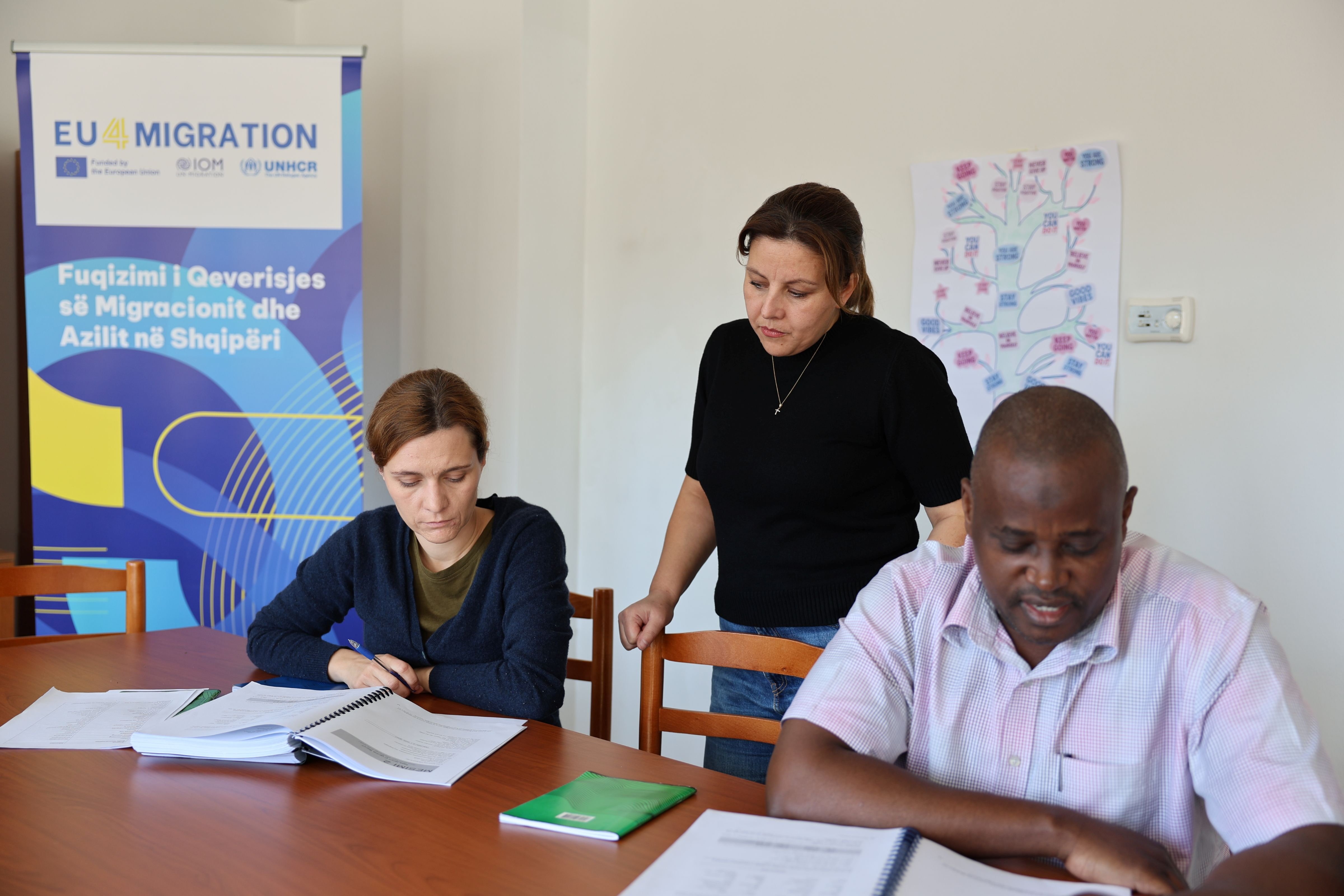
During a reading exercise, Jorida supports refugees Irma and Ibrahim as they practice pronunciation and comprehension.
In Jorida’s class, students work toward different language goals. Irma and Ibrahim focus on pronunciation through slow repetition, while Marwa prepares for a language certification with one-on-one coaching. On some days, Jorida also supports children with their school homework over WhatsApp.
But it’s not just one-way learning. “I ask them to teach me a word from their language too,” she says. “It motivates them. And I’ve learned so many words from so many cultures.”
Her classroom doesn’t end at the edge of the whiteboard. For Jorida, teaching language is about unlocking potential and preparing students for what comes next. “Language is key to finding a job, to feeling independent. One of my students, Merit from Syria, has learned good Albanian and now works. That’s the kind of outcome I hope for.”
And now, she’s thinking even bigger. Inspired by Ibrahim’s IT background, along with some other asylum-seekers with a background in IT, Jorida hopes to lay the groundwork for a new project: a mobile app for learning Albanian, created by and for asylum-seekers and refugees.
“I dream of building it with the students, turning their skills into something lasting. It would help others who come after them, and create a sense of ownership and contribution,” she explains. “There’s so much talent in this room. Why not build something meaningful together?”
For newcomers, Jorida offers gentle encouragement and one phrase "avash avash", or slowly, slowly. “There’s no rush,” she tells them. “You’ll get there.” And as one student, Maiwan from Syria, puts it: “If you want to learn Albanian, you have to love it and study hard.”
This initiative is supported by the European Union under the EU4Migration project, implemented by UNHCR in partnership with Refugee and Migrant Services in Albania.


