



A New Chapter with Dignity: How EU Co-Funded Cash Assistance Helps Rohingya Families Rebuild in Indonesia
A New Chapter with Dignity: How EU Co-Funded Cash Assistance Helps Rohingya Families Rebuild in Indonesia

Abdul, Hafiza and their children at the communal kitchen in the shelter where they live alongside nearly 100 Rohingya refugees in need of protection.
Indonesia, 8 August 2025 - When Abdul* and his wife Hafizah* boarded a crowded wooden boat with their three children, they knew the journey could cost them everything. Yet after years of statelessness, persecution and trauma, they believed it was a risk worth taking. “We knew we might die on the way,” Abdul said, “but staying behind was equally dangerous and meant no future for our children.”
The couple, both Rohingya refugees originally from Myanmar, had already fled once before. In 2017, violent attacks tore through their village, burning homes and scattering families. Abdul and Hafizah escaped to Bangladesh, where they lived in the refugee camps for nearly seven years.
But life in the camps became increasingly unsafe in recent years. In 2022, the family was traumatized further when their young son was kidnapped. While he was later released, they did not feel secure anymore. “After that, we couldn’t stay,” Abdul said. “Even though we had nothing, we still had my wife’s gold chain and ring to pay an agent to take us elsewhere. We just wanted to survive.”
The family endured a harrowing 25-day sea journey with 149 others, often without enough food and clean water. Many people in the journey fell ill at one point, including Hafizah who suffered difficulty in breathing. Still, she held close their then youngest daughter, just two months old, throughout the journey. Finally in December 2023, they landed in Sabang, Aceh. What followed was a long, uncertain period—first in makeshift shelters in a forest, then in a warehouse—before finally being relocated to Lhokseumawe.
Today, Abdul and Hafizah live among 30 Rohingya families in a site designated by the authorities in Lhokseumawe to shelter refugees. They remain extremely grateful to the Indonesian authorities for allowing them to stay, and to the local people for the support and friendship they have shown. The conditions at the shelter are basic, and privacy is minimal. But here, they found something they hadn’t had in years: a sense of temporary stability—and hope.
That hope is sustained in part by the modest monthly cash assistance they receive through UNHCR, made possible with co-funding from EU Humanitarian Aid (ECHO).
The funding initially supported UNHCR’s in-kind meal distribution programme to Rohingya refugees in Aceh and North Sumatra. However, in March 2025, the programme transitioned to basic cash assistance to enable refugee families, including Abdul’s, to buy staple foods and cook their own meals—something that brings both nourishment and dignity.
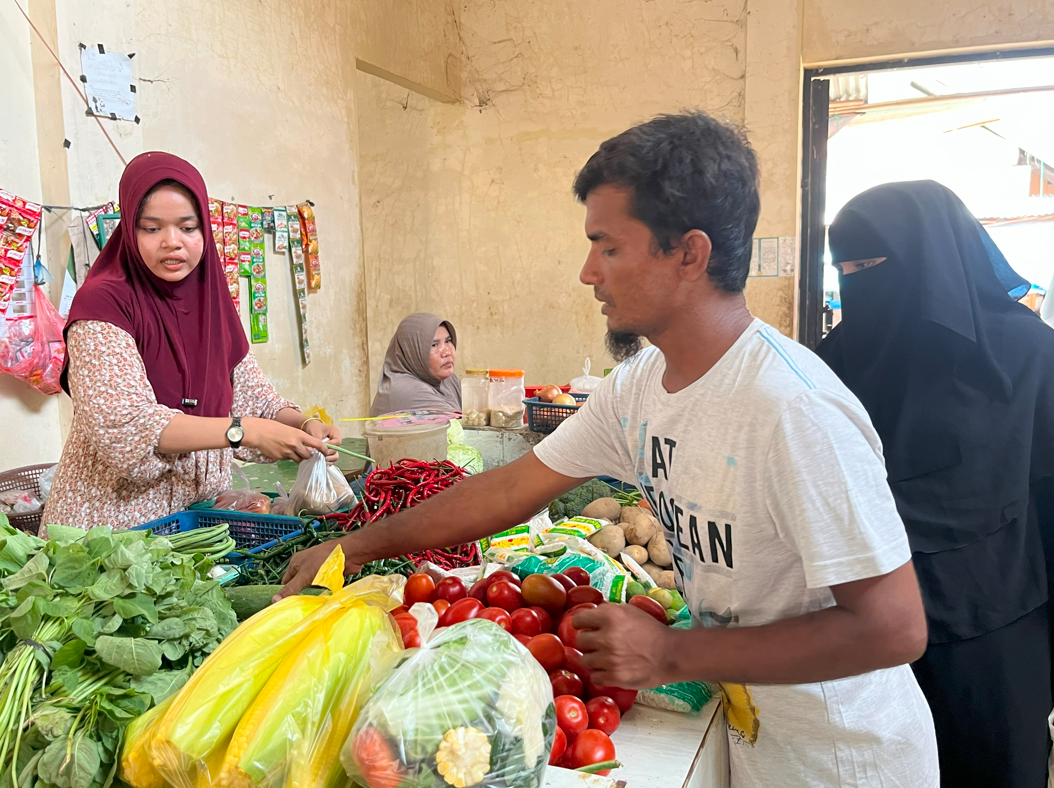
Thanks to cash assistance co-funded by the European Union, families like Abdul’s are able to purchase staple foods at the local market and prepare home-cooked meals. At the same time, their daily spending helps stimulate the local economy, benefiting small vendors and market sellers.
“We use the money to buy rice, onions, vegetables, and fish. My wife and I cook together for our children,” Abdul shared. “Sometimes we make chicken curry or soup. If we have a little extra, we buy dragon fruit and ice cream—those are the children’s favorites.”
The cash assistance also enables families to make their own choices and prioritize their needs. “We go to the market every day because we can’t store food,” Hafizah explained. “We cook fresh meals daily. The children like it when we make special food just for them without chili.”
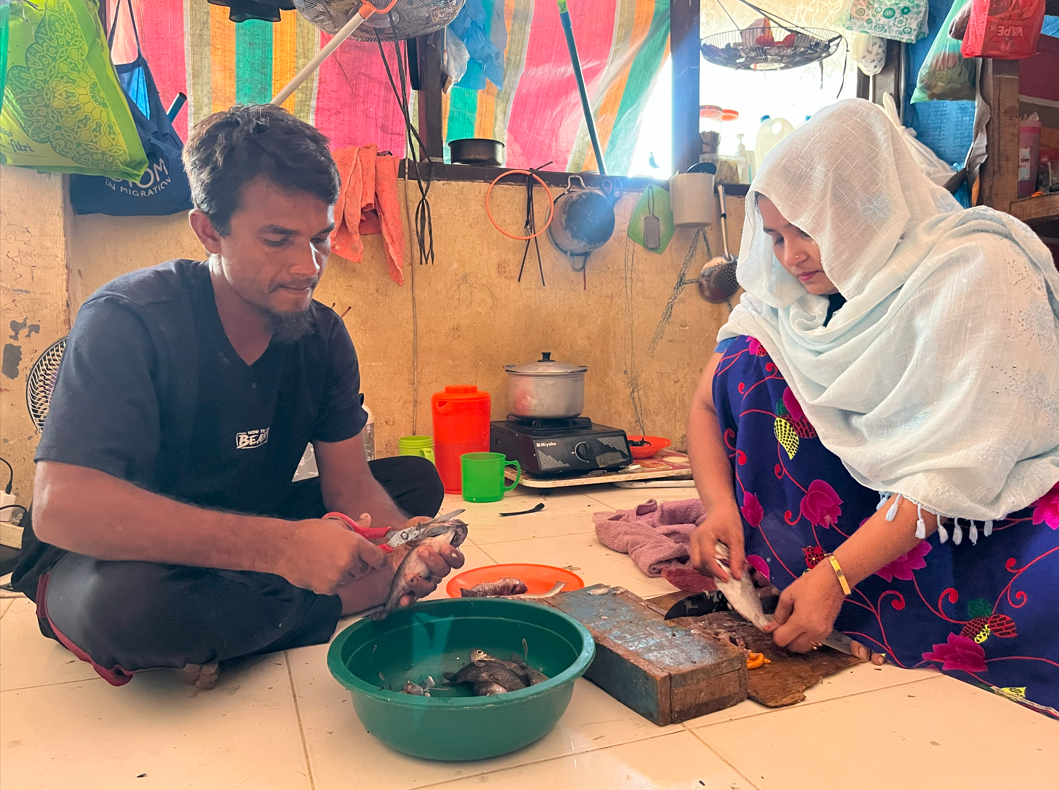
Abdul and Hafiza buy their supplies in the market and cook for the family daily as they don’t have storage to keep the food for the days ahead.
At the refugee site, refugee families also receive hygiene kits, clean water and medication support from other partners. Yet, challenges remain. The shelter has no individual rooms, only divided spaces with sarongs and blankets. The communal toilets are also far apart from the refugees’ spaces, a particular difficulty for Hafizah, who suffers from chronic pain.
Despite all this, the family is grateful. “We don’t have challenges like before. We are safe,” Abdul said. Still, he worries most about the future of his children, who—at ages 10 and 9—have never attended formal school. In the absence of education services, Abdul and Hafizah teach the children themselves. “I used to teach English in the camps in Bangladesh while my wife used to teach Arabic to children there,” he added. “Now, we use PDFs materials to teach our children basic reading and the Qur’an.”
While the cash assistance covers their basic food needs for a month, it does not stretch far enough to cover medical expenses, clothing or savings. “I still had to borrow some money from the others this month,” Abdul said.
Above all, they dream of a peaceful future in a country where their children can go to school, grow up in safety and build a life free from fear. “I don’t have hope for myself,” Abdul said quietly, “but I have hope for my children.”
Thanks to generous support from ECHO and other donors, more than 430 refugees from some 130 Rohingya refugee families in Aceh are taking the first steps toward rebuilding their lives with dignity and resilience — even in displacement.
*names changed for protection reasons.
To know more about European Civil Protection and Humanitarian Aid Operations visit https://civil-protection-humanitarian-aid.ec.europa.eu/


