



Civil Documentation opens doors for Iraqi nationals returning from North-East Syria
Civil Documentation opens doors for Iraqi nationals returning from North-East Syria

Abdulrahman holds his newly issued ID card.
Hind’s gaze drifts as she recalls her family home in Samarra, Iraq — the concrete walls, the dry scent of the air, the life she left behind after getting married more than a decade ago. In 2019, her husband was killed during the conflict between US-led coalition forces and Daesh, leaving her alone with three young children. With few options, she crossed the border into North-East Syria with other women in similar circumstances.
For more than seven years, Hind lived in Al-Hol camp. “It was difficult, it was hard to raise my children in that environment,” she recalls. Reopened in May 2016, Al-Hol was initially intended to shelter Syrians and Iraqis fleeing violence. By early 2019, following further hostilities against Daesh, the camp expanded rapidly to accommodate tens of thousands of people. Its population, like Hind and her family, was largely made up of women and children, many with perceived or alleged family links to Daesh fighters.

Hind and Jumana outside their tent in Al-Amal centre.

Intersos paralegal, Israa, hands over the UID cards to Hind and her family.
In 2025, an opportunity arose to return home through a process facilitated by the Iraqi Government to repatriate its citizens from North-East Syria. In October last year, Hind and her three children were part of the 30th organized return movement, marking the first step toward rebuilding their lives in Iraq. Between May 2021 and February 2026, before the closure of Al-Hol camp, more than 21,500 Iraqi nationals returned from Al-Hol and Al-Roj camps through 35 organized movements.
Since then, Hind and her family have been living at Al-Amal Centre, where they have spent eight months accessing programmes designed to support reintegration into Iraqi life.
One key aspect of reintegration is obtaining the Iraqi Unified ID card (UID), the primary identity document issued by the Ministry of Interior. Hind explains she has never had a UID, which became mandatory in 2024 and replaced older paper-based documents. The only papers she carries are expired Civil Status ID cards from 2010. She smiles at the faded baby photos of her children, Jumana and Abdulrahman, now 14 and 15. “They look completely different now,” she says.
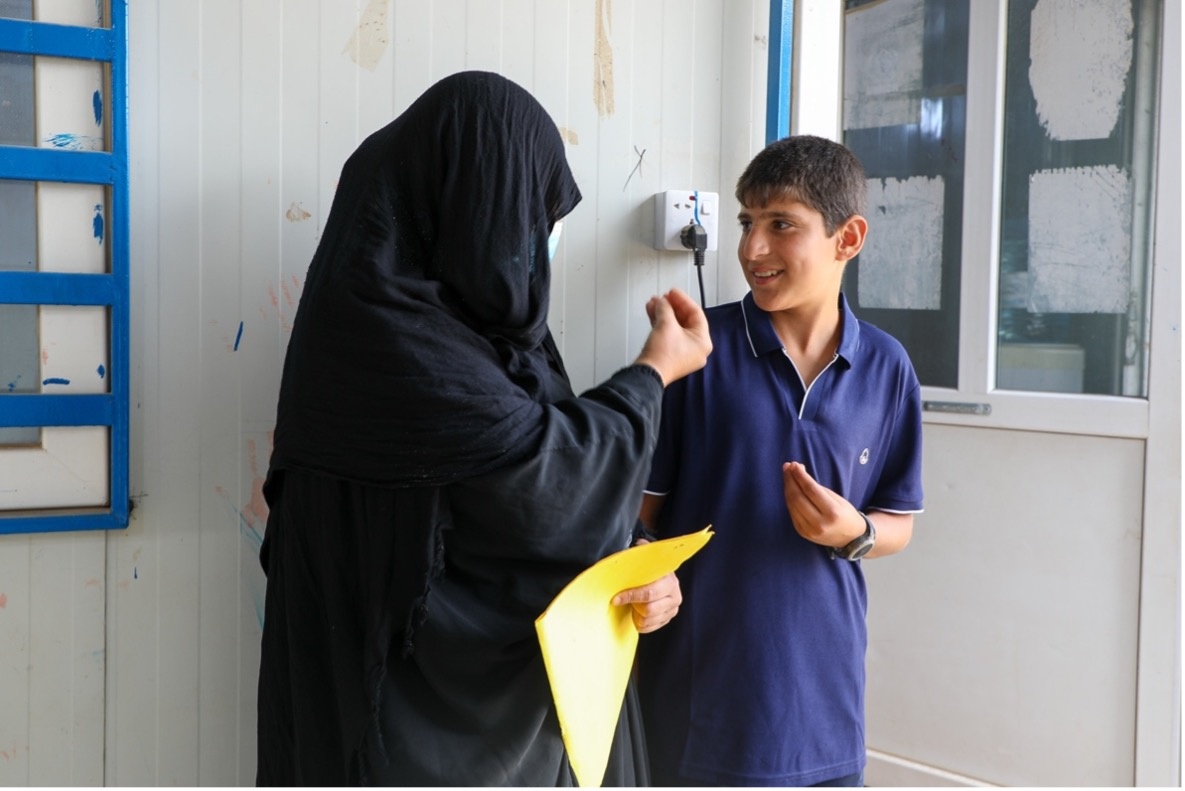
Hind and her son Abdulrahman speak in sign language.
Getting UID documents for her children is one of Hind’s main motivations. Her son Abdulrahman, who has a hearing impairment, has struggled with disrupted education in both Al-Hol and Al-Amal. “They won’t accept him without an ID,” Hind explains.
“Without this card, he can’t enter school, can’t learn sign language, and can’t have people understand him. He would be isolated, an outsider in his own society.”

Iraqi women at Al-Amal centre prepare to board the bus to travel to the Civil Affairs Directorate in Mosul to apply for their UIDs.

Hind finalizes the preparation of her case files with lawyer Salah Husain.

Hind and her children submit their UID application.

Hind holds old expired paper-copies of their old ID documents from 2010.

Iraqi nationals from Al-Amal arrive at the central registration department of the Civil Affairs.
Her daughter Jumana also hopes to continue her studies. “She is currently in Grade 2, even though she is 14, because she missed so many years of school,” Hind says. “She needs the national ID card to take her exams and progress through school. They absolutely can’t do it without it.”
For residents of Al-Amal, obtaining the UID is rarely straightforward. The process is complicated by the perceived or actual affiliation of some families with Daesh, the security checks required, and the absence of prerequisite documents such as birth, marriage, death, or divorce certificates. Restricted freedom of movement for residents is another challenge, preventing them from independently approaching Civil Affairs Directorate offices to apply.
This is where the work of UN agencies comes in. At Al-Amal, UNHCR, IOM and UNICEF, operating under a joint legal task force, employ specialized lawyers and paralegals to prepare files for each family with each agency supports cases related to its mandate and expertise. In Hind’s case, UNHCR’s partner Intersos visited her upon arrival, identified her missing documents and assigned a lawyer to follow up. Assessments show that over 99 per cent of residents at Al-Amal are missing a UID.
For Hind, the process first meant securing proof of marriage, then a death certificate for her husband, followed by custody papers for her children before her file was ready to present for a UID.
After months of preparing the necessary paperwork, Hind and her children were finally ready to submit their applications. On the morning of the trip, they joined around 50 other residents from Al-Amal Centre, each accompanied by lawyers who had helped assemble their files. The group boarded buses organized by UNHCR and Intersos, beginning the hour-and-a-half journey to Mosul’s Civil Affairs Directorate.
The ride carried a sense of anticipation. For many, it was the first time leaving the confines of Al-Amal since their return to Iraq. As the buses rolled along dusty roads, families looked out at the passing fields and villages — a reminder of the country they were re-entering after years in Syria.
Arriving in Mosul, families lined up at the Civil Affairs Directorate, clutching folders of documents, waiting for their turn to submit applications. Hind and her children followed their lawyer through the process, having their biometrics taken by officials and their details submitted into the digital UID application system operated by the Ministry of Interior.
“Once I get my ID card, I will be able to travel back home and see my mother again,”
For Hind, holding the cards was more than a formality. They mark a step toward stability, and a future built on belonging.