



Financial support brings relief to vulnerable refugee families
Financial support brings relief to vulnerable refugee families

In a small and aging house in Erbil, Eiman prepares simple zaatar sandwiches for her three children's breakfast. Putting food on the table is no easy feat. After her husband passed away during Ramadan last year, she has struggled to support her family’s basic needs.
“I have suffered greatly,” she says. “My children are still very young, and I am the only one providing for them.”
Eiman was once a schoolteacher in Syria. “My life was somehow manageable before,” she recalls. But war shattered everything, and even going to work became a dangerous challenge. “I was afraid of kidnapping,” she adds.
When her husband needed life-saving kidney dialysis, they found treatment in Syria impossible to reach. “Accessing hospitals was very hard because of the many security checkpoints.” With no steady income and no reliable care, they borrowed money and fled to Iraq, hoping to find treatment and protect their children.

Eiman serves a simple breakfast to her children at home before heading to work.
When they arrived in Iraq, the family moved from place to place, searching for stability, safety, and basic services. Now, living in Baherka, Eiman works as a cleaner for a local company in Erbil earning an informal daily wage paid by the hour. When she returns home exhausted, her work continues, cooking, cleaning, helping her children with schoolwork, and managing the household.
“I struggle every day to survive. I work more than 12 hours a day. My salary is not enough. It cannot cover rent, electricity, or my children’s needs,” she says.
At the end of 2024, Eiman started to receive financial assistance from UNHCR. Since then, she has received six distributions of cash, the first three at 580,000 IQD before UNHCR was obliged to reduce the amount to 390,000 IQD in June 2025 due to funding shortages. She collects the cash assistance up at a nearby Zain Cash store, which is the financial servicer provider used for UNHCR’s cash assistance distributions.
This financial aid has become a lifeline, bridging the gap between her household needs and the small amount her cleaning salary is able to cover. It has allowed Eiman to pay rent, buy food and provide for her children with dignity. “My health and the need to be with my children means I cannot work longer hours, but my income alone does not cover our needs.”
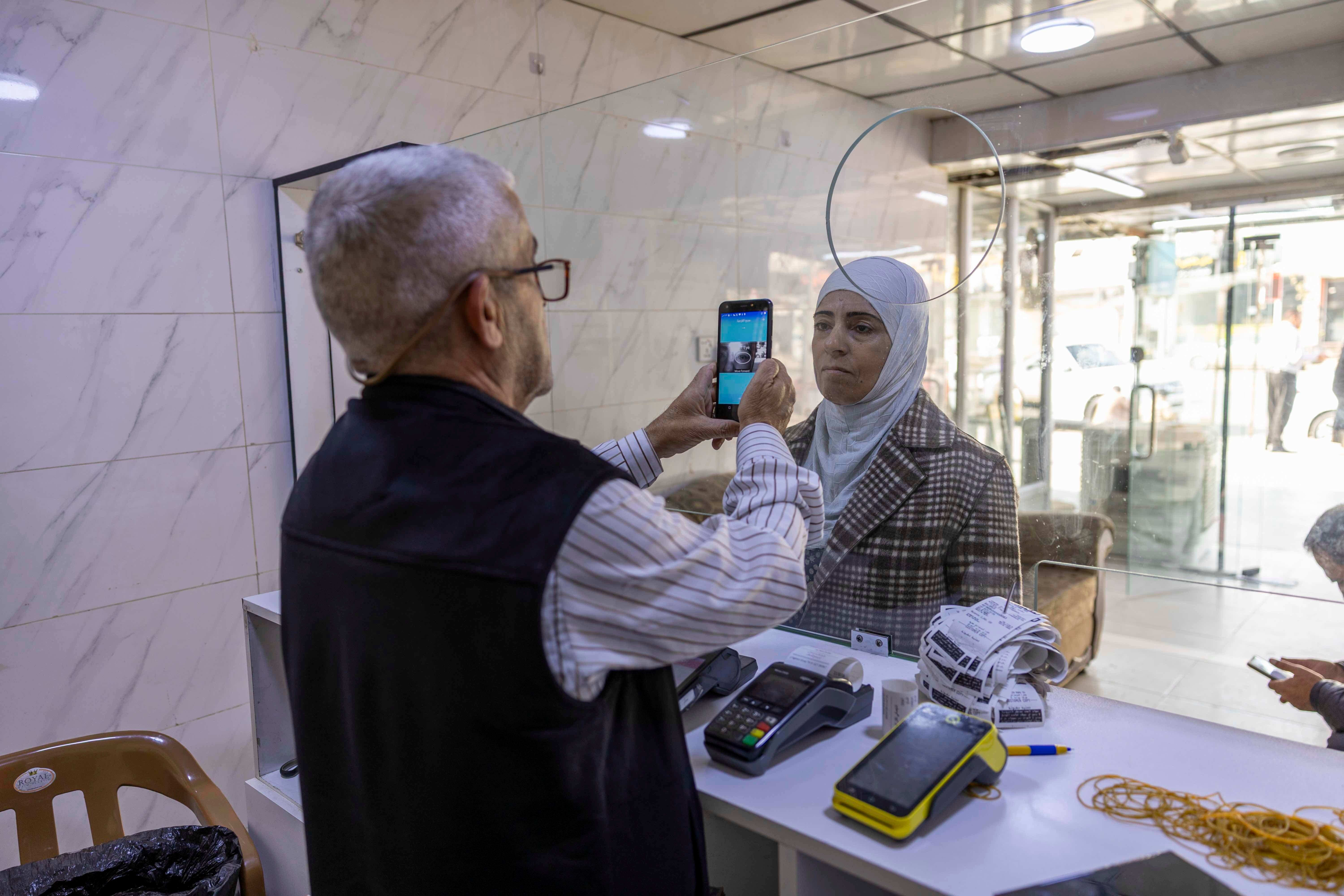
The cash agency scans Eiman's eye with an IRIS scanner to confirm her identity before she receives her aid.
“Everything here is expensive. Sometimes I cannot even provide enough food for my children,” Eiman adds, citing the rising cost of living, especially expenses related to transportation, food and utilities. More than half of her salary goes to rent alone.
In 2025, UNHCR provided regular financial assistance to more than 5,500 of the most socio-economically vulnerable refugee families (approximately 30,000 people) across Iraq, including the elderly, people with disabilities, and single mothers with no other source of income. This was made possible thanks to the support of donors such as the United States and Italy, as well as those who provide flexible funding.
Now, that lifeline is being cut. Due to critical funding shortages, UNHCR has been forced to stop its cash assistance programme in Iraq, leaving Eiman, and thousands like her at risk of falling deeper into poverty or facing eviction and hunger if they are not able to afford basic essentials.
UNHCR is appealing to the international community to step forward and provide funding to allow this vital assistance to continue into 2026.
For Eiman and thousands of vulnerable refugees in Iraq, cash assistance is not just support. It is survival, dignity, and hope for a safer future.
Lilly Carlisle contributed reporting to this story.


