



UNHCR and Permanent Committee for Refugee Affairs - Ministry of Interior mobile registration missions bring documentation closer to refugees and asylum-seekers in Iraq
UNHCR and Permanent Committee for Refugee Affairs - Ministry of Interior mobile registration missions bring documentation closer to refugees and asylum-seekers in Iraq

Inside the Residency Directorate in Tikrit, the capital of Salah al-Din Governorate, numbers are called one after another as refugees and asylum-seekers wait for their turn to meet UNHCR’s mobile registration team.
“Number fifteen!” calls Habeeb Ahmed, UNHCR Assistant Registration and Identity Management Officer, looking across the room. Habeeb and 10 colleagues have travelled from Baghdad for a seven-day mobile mission to register refugees, renew documentation and support those wishing to complete the procedures required for voluntary return.
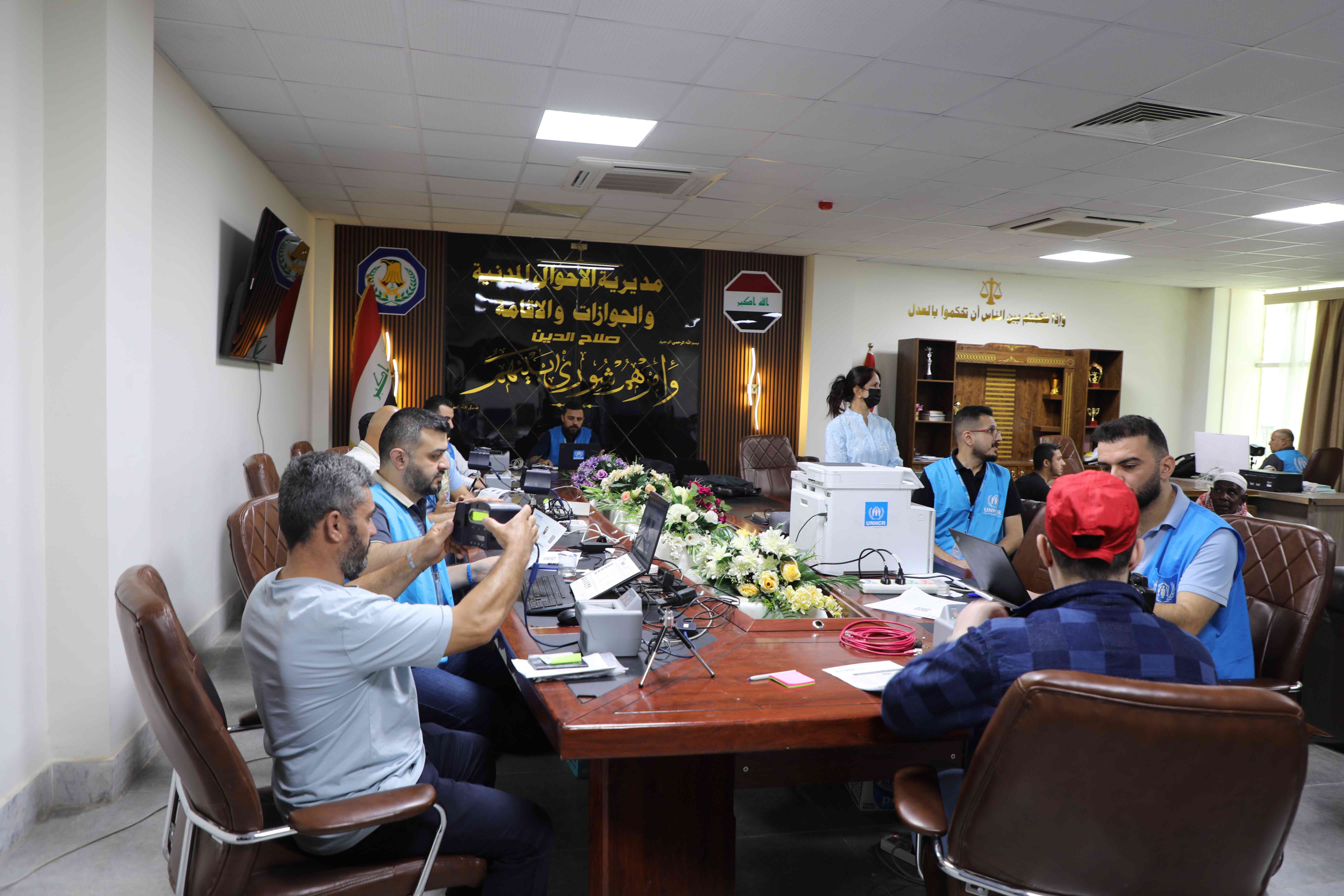
UNHCR staff process registration and certificate renewals for refugees in Salah al-Din Governorate, helping them maintain valid documentation and access protection and services.
In Iraq, UNHCR registers refugees and asylum-seekers at its registration centres in Baghdad, Erbil, Dohuk, and Sulaymaniyah governorates and refers them to government procedures to obtain official government documentation. For those living in other parts of the country, reaching one of these centres can mean a full day of travel and a cost a family cannot easily afford – and, for those without valid documentation, the risk of arrest or detention at checkpoints along the way. Mobile registration missions, therefore, help bring essential services closer to where refugees live.
Over the course of a week in Tikrit, UNHCR’s team can register new arrivals, renew existing documentation and update records with key life events, including births, marriages, divorces, and deaths. They also prepare files for consideration by the Permanent Committee for Refugee Affairs – Ministry of Interior (PC-MOI) which issues the government-documentation to refugees and asylum seekers. A PC-MOI team will follow the UNHCR mission to Tikrit two weeks later.

Staff from the Permanent Committee for Refugee Affairs – Ministry of Interior (PC-MOI) process records of the refugees.
In Tikrit, one by one, people climb the stairs to the first floor and join the queue leading to UNHCR’s team. Among them is Shihab, a young pastry chef from Syria, who has come to register with UNHCR for the first time. “The process was very smooth,” he says. “I applied through the platform and received my appointment.”
A few seats away, Ahmad has travelled from Samarra, about an hour from Tikrit, to renew his UNHCR certificate — a document whose importance he understands from experience. After fleeing Syria and arriving in Iraq, he submitted a request to register as an asylum-seeker with UNHCR in 2023. A few months later, while still being without the document, he was arrested on immigration-related charges. When he appeared in court, UNHCR’s lawyers assisted him presenting his case for asylum, and he was subsequently released.
After his release, Ahmad obtained his UNHCR certificate at the Baghdad Registration Centre, proof of his asylum-seeker status. Since then, he has made sure to renew it before it expires, recognizing the value it holds. “This time, I booked my renewal appointment three months ago through the platform, and I received a call yesterday,” he says.

Ahmad sits with a UNHCR staff member as his asylum seeker certificate is renewed, a document he knows is important in helping him access protection and assistance.
UNHCR’s mobile registration missions also support refugees in central and southern governorates who wish to return to Syria. In January 2026, UNHCR worked together with PC-MOI and the Residency Directorate in Baghdad to establish a joint voluntary return programme for Syrians registered with UNHCR. Accurate and up-to-date UNHCR documentation is an essential part of the return process, allowing the return to be recorded, and any pending legal or documentation issues to be resolved before departure. The missions are also an opportunity for UNHCR to counsel refugees and asylum-seekers about the process, so that they can make an informed decision about returning.
Nisreen has come with her two children, 11-year-old Fatima and six-year-old Yousif. They have decided to return home, while her husband, Khalil, will remain in Iraq for now.
Khalil submitted the family’s expression of interest to return. “A friend from the Syrian community told me about the process with UNHCR,” he explains. “I submitted our application through the online portal and then received a phone call confirming the appointment. Today, we came here to complete the procedure. The whole process has been easy.”
For many families, travelling to Baghdad to access registration services with both UNHCR and PC-MOI is simply not an option due to financial and protection reasons alike. “Last year, due to funding constraints, we could not carry out these mobile missions, which are vital for refugees and asylum-seekers living far from Baghdad,” says Habeeb. “For a family of three people, travelling from Tikrit to Baghdad can cost around IQD 100,000, or approximately USD 80. For a refugee family of four or five, the cost becomes very high.”
With support from EU Humanitarian Aid and the Swedish International Development Cooperation Agency, UNHCR was able to resume mobile registration missions in 2026, reaching refugees and asylum-seekers living far from registration centres. After Salah al-Din, teams travelled in July to Qadisiya, Thi-Qar and Muthanna. Further missions have been carried out in August to Wasit, Babil, Diyala, Kerbala, Najaf, Anbar and Maysan, which will be followed by Basrah in September — more than 500 kilometres from Baghdad. Complementing this, PC-MOI is conducting registration missions to Salah Al-Din, Muthana, Qadisiya, Babl, Wast, Thi-Qar and Basrah.
Complementing this, PC-MOI is conducting registration missions to Salah Al-Din, Muthana, Qadisiya, Babl, Wast, Thi-Qar and Basrah.
By bringing registration services closer to refugees and asylum-seekers, UNHCR and PC-MOI help reduce the distance, the cost and risk that stand between a refugee family and the documentation that underpins their protection and safety in Iraq. Registering with UNHCR is the first step to access government registration procedures and documentation. It is equally a basis for voluntary return to Syria.
Overall, mobile registration missions organized by UNHCR and PC-MOI help ensure refugees and asylum-seekers can obtain the documentation that protects them, no matter where they live in Iraq.