Indicator Report 2025

Indicator Report 2025
The Global Compact on Refugees (GCR) Indicator Report tracks progress towards achieving the four objectives of the GCR.
This year, 2025, sees the launch of the third GCR Indicator Report, which builds on insights from previous editions and draws on data from the 16 GCR indicators to provide a comprehensive analysis of both progress made and challenges encountered in implementing the Compact. Additionally, the report provides evidence-based examples of how the Compact has impacted refugee responses worldwide. The findings of this report will inform the Global Refugee Forum (GRF) Progress Review in December 2025.
The report highlights some progress seen across the four objectives and emphasizes how impactful collective action can be, and how crucial it is to maintain momentum in implementing the Global Compact on Refugees. Data availability is improving, supporting more informed policies. However, these gains are at risk due to declining funding and weakening international solidarity.

"As we look ahead to the Global Refugee Forum Progress Review in December 2025, it is essential to sustain momentum and to reaffirm our collective commitment to the principles outlined in the Global Compact on Refugees. Nobody should imagine any of this will be easy. But neither must we resign ourselves to fatalism."
Key findings
The global context
While refugee numbers grew slowly after 2022 and remained relatively stable in recent years, the sharp reduction in funding in 2025 has heightened vulnerabilities. The period 2023 to mid-2025 saw a slowdown of the rise of total numbers of refugees, which had more than doubled between 2016 and mid-2025. Ten countries hosted over half of the world’s refugees, with low- and middle-income countries hosting 2.5 times more refugees than high-income countries.
Growth rate of the absolute number of refugees, 2010-2024 (year-on-year) – mid-2025
The Global Compact on Refugees is more essential than ever for promoting equitable, lasting solutions and addressing the root causes of displacement in the face of increased funding shortfalls.
Burden- and responsibility-sharing
There has been a modest but consistent improvement in burden- and responsibility-sharing since the affirmation of the GCR. However, it remains evident that only a small fraction of global wealth continues to bear the bulk of the responsibility. In 2024, countries with collectively just 27 per cent of global wealth hosted 80 per cent of the world’s refugees.
Cumulative global wealth hosting 80 per cent of the world's refugee population, 2010-2024
The support base — especially for low- and middle-income host countries — is in urgent need of being further broadened and better aligned with actual needs.
Ease pressure on host countries
For 2022-2023, Official Development Assistance (ODA) for refugees in low- and middle-income countries amounted to USD 27.7 billion. However, overall ODA funding declined in 2024 and is expected to fall further in 2025. Available funding continues to be unevenly distributed, and despite growing local partnerships, support to national actors remained limited at 13 per cent in 2022-2023. While donor engagement has grown since 2020, over half of the funding came from just three providers.
Total ODA for refugee situations, by Humanitarian-Development-Peace (HDP) components, 2020-2023, USD disbursements in 2023 constant prices, Millions
Aid for refugee responses must be rebalanced and protected by reversing funding cuts, broadening and coordinating the support base, and empowering local actors to lead inclusive, sustainable solutions.
Enhance refugee self-reliance
Access to work in law, public education, and freedom of movement for refugees has improved in some countries. In 2024, nearly half of refugee children were enrolled in national schools, 67% of refugees could move freely within their host countries, and 62% had access to work in law. Yet, persistent barriers, underinvestment and widespread poverty continue to undermine self-reliance, limiting the economic contributions refugees can make to host communities.
Proportion of refugees with access to work in law and freedom of movement in law, 2022-2024 (year-on-year) and mid-2025
Inclusive laws must be supported by targeted investment and stronger implementation in order to provide refugees with real access to jobs, education, and services.

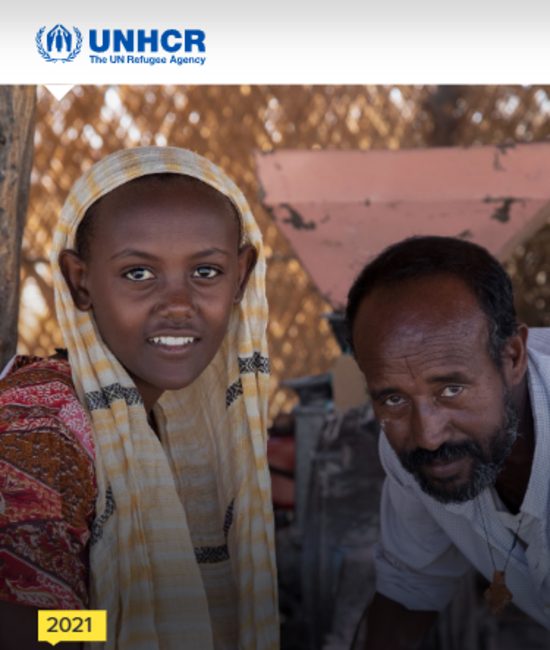
Yasin Mohamed, Somali refugee at his shop serving both refugees and host community members, Kebribeyah Refugee Camp.
Text and media 5
Engage in different works and use the opportunities before you to generate income and become independent from aid dependency.”
Yasin Mohamed's life in Kebribeyah refugee camp changed in October 2024, when he received his digital identity card from the Ethiopian Government. Ethiopia's commitment to inclusive policies for refugees has enabled Yasin, and thousands of other refugees, to access employment and entrepreneurship opportunities, enhancing their self-reliance.
Expand access to third-country solutions
In 2024, the number of refugees resettled in third countries surpassed annual targets. While this was followed in 2025 by a sharp decline, overall, complementary pathways have increased, with 38 countries issuing permits to over 1.7 million refugees between 2016 and 2023.
Percentage of the target reached in the number of UNHCR-assisted resettlement departures, 2021-2024
New actors need to be mobilized, and States encouraged to increase commitments, while migration systems can scale complementary pathways through improved travel documentation and community sponsorship.
Support conditions in countries of origin for return in safety and dignity
While funding for returnees increased by 6 per cent between 2020 and 2023, it remains far below the level needed to meet their needs, particularly given the sharp increase in returnee numbers. Only 3.5 per cent of ODA for refugee situations reached returnees, while peacebuilding and development work remains chronically underfunded.
Number of total returnees in the largest countries of refugee return, 2016-mid-2025
The pursuit of security must be shifted towards a human-centred, multidimensional approach grounded in dignity, human rights, and sustainable development.
Further investment in statistical inclusion is essential to ensure refugees are systematically represented in national planning and data systems, leaving no one behind.