



Faida Aggregation Hub gives Syrian refugee farmers a new route to market
Faida Aggregation Hub gives Syrian refugee farmers a new route to market

Sulayman is excited as boxes of his freshly harvested produce await sorting and packing at the Faida Aggregation Hub in Dohuk, ready to make their way to local markets.
At the Faida Aggregation Hub in Sumel district, Sulayman sorts through crates of tomatoes, aubergine and bell peppers grown on his family's rented plot of land. Around him, fellow farmers wash, clean and pack their produce before it is loaded for delivery to markets, supermarkets and retailers across Dohuk governorate. It is a different scene from the one just a few months earlier, when this harvest was still in the ground.
Back in May, Sulayman knelt between rows of tomato plants on that same rented plot of land in Sumel district, Dohuk governorate, checking soil his family had cleared and cleaned of dirt and debris. "At present we are growing tomatoes," he said. "I used to cultivate tomatoes back in Syria as well, and we will soon plant cherry tomatoes."
Sulayman and his brother fled Qamishli, in northeast Syria, over a decade ago. After arriving in Dohuk governorate, local residents offered them a house free of charge for a few months. They stayed on afterwards, paying rent and living within the local host community rather than in a camp. "When we arrived here, we thought we would not stay long. We never imagined it would last so many years," Sulayman said. "My son was five years old when we arrived; now he is a grown man."
In Syria, Sulayman had also worked in agriculture, growing a wide range of vegetables, including onions and potatoes, on fertile land with equipment built for the job. In the Kurdistan Region of Iraq, he explains, life as a farmer has not been as easy: the soil is poorer, agricultural inputs cost more, and much of the specialized machinery he once relied on back home is simply not available. Climate change has added a further layer of unpredictability this season, delaying bell peppers that should already have been visible and slowing the tomatoes' growth.

Sulayman checks on the plants growing in his family’s rented plot of land, where each harvest brings hope for a better future.

Sulayman stands proudly with his freshly harvested eggplants at the Faida Aggregation Hub, where his produce is sorted, packed and prepared for local markets.
Even so, Sulayman and his brother chose farming over the irregular construction work available in Dohuk. "We have agricultural experience and skills, and we prefer this work to construction jobs in Dohuk, which are irregular and not guaranteed every day. We did not want to ask others for money. I prefer to work hard to support our lives and our families." Some of his children now work alongside him in the fields, even though, as he states the work is very hard.
The plot of land the family rents can produce up to 30 tons of vegetables a day during harvest season. But for most of the years Sulayman has farmed in Iraq, the market has not been able to absorb it. He relied on selling his produce at the main market in Semel district. Retailers from outside the governorate sometimes came with trucks to buy produce during peak season, but this was inconsistent, and last year the family's production was too limited even to meet that demand.
"As refugees, we were not connected to many distribution networks, including those serving central and southern governorates," he says. "So far, our only option has been to sell our produce through traditional local markets." Transporting the harvest from field to market is a further cost the family had to absorb.
Water has been one of the family's hardest problems to solve. Last year, they built their own pipe system to bring water to the fields but roughly 100 pipes burst because the system was stretched too long, at a cost of about USD 30 each. This year, heavy rainfall and access to a nearby dam eased the pressure, but irrigation, insects, and delayed harvests remain constant threats to the crop.
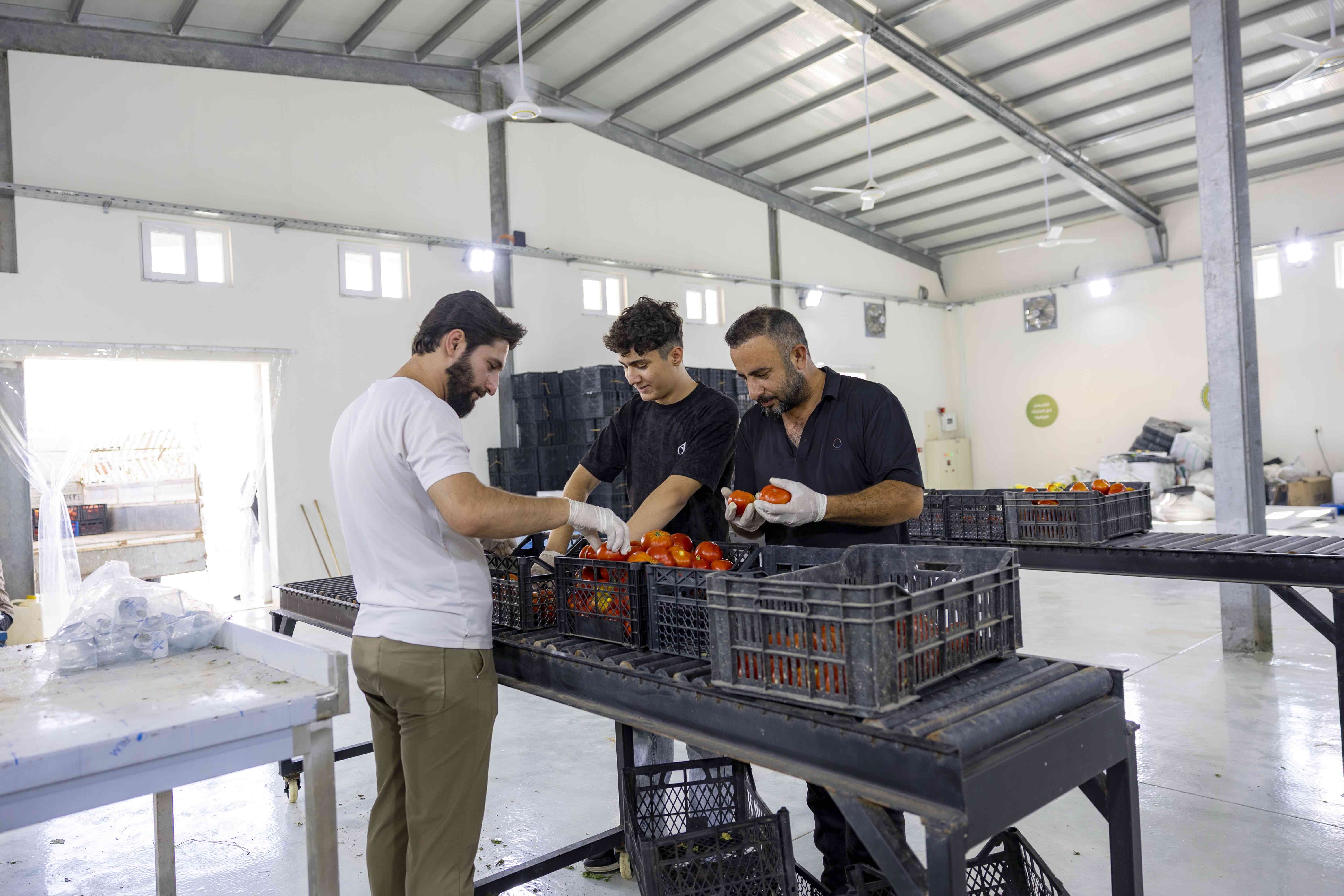
Staff sort the produce and pack it according to quality, ensuring each item is carefully prepared for the market.
It was against this backdrop that Sulayman first placed his hopes in the Faida Aggregation Hub, built by UNHCR in Sumel district in 2025. Now fully operational and run by the Dohuk Directorate of Agriculture, with additional support from the International Trade Centre (ITC), the hub completed its first commercial transaction back in February: 1.5 tons of washed, professionally packed potatoes from an alliance of local farmers – many of them refugees, internally displaced people and host community members – sold to Carrefour Dohuk. The potatoes sold out within 24 hours, and demand has kept growing since.
"I believe the Aggregation Hub's links with large retailers will benefit us," Sulayman said. "Until now, we have sold through the local market, where retailers could not absorb the quantities we produce."
That belief is now playing out. This harvest season, Sulayman brings his tomatoes, eggplant and bell peppers to the Aggregation Hub for washing, cleaning and packaging before they are sold onwards to markets, large supermarkets and retailers, as part of the wider Farmers Alliance. Because the hub is close to the family's fields, he delivers produce there himself, cutting the transport costs that long ate into his margins.
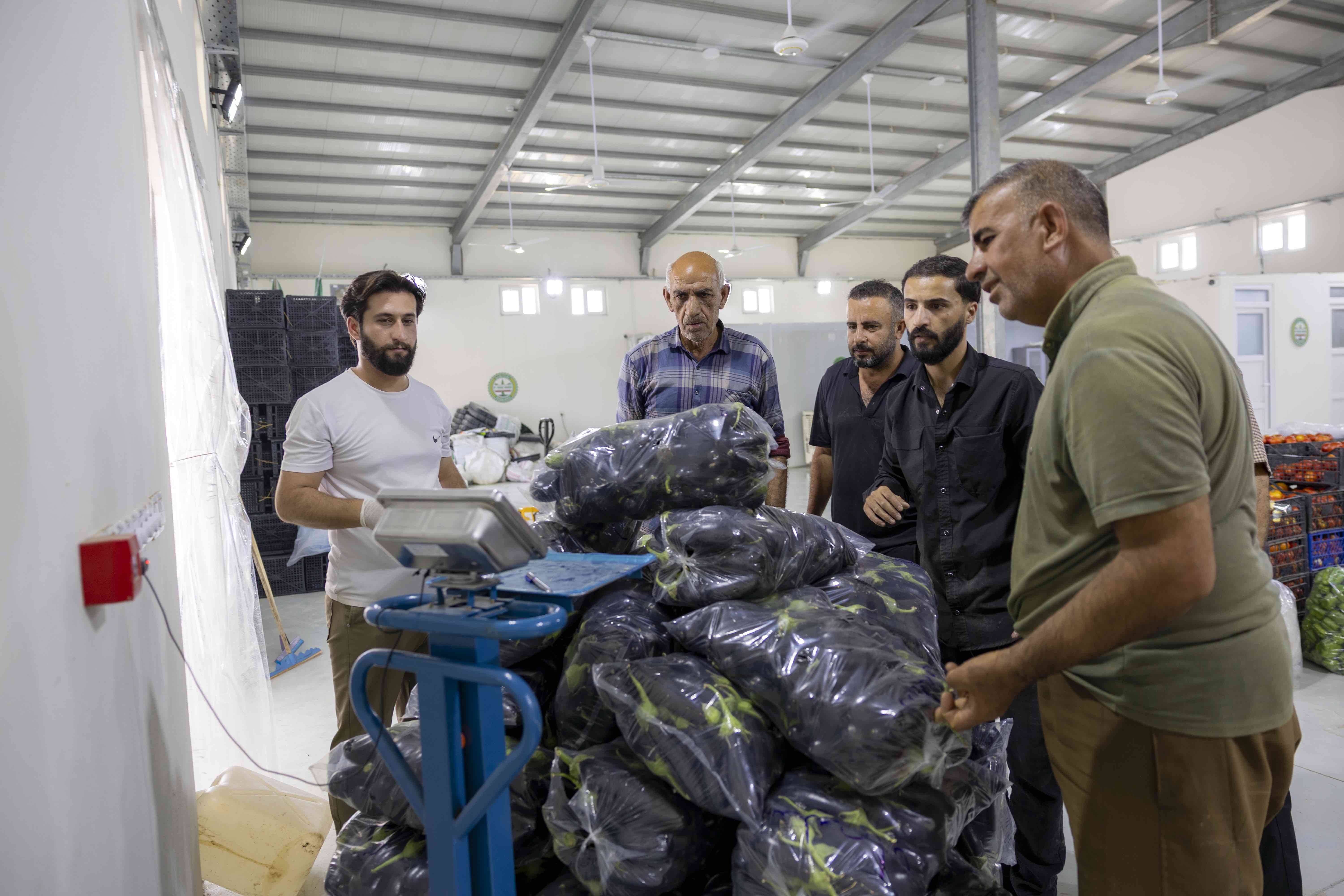
Staff at the Aggregation Hub weigh Sulayman’s freshly harvested eggplants as they are packed and prepared for delivery to local markets.
Now fully operational, the hub also offers space for training, equipped with solar-powered systems and dedicated training areas that promote modern farming practices. To date, farmers have received training in packaging, entrepreneurship and branding, building awareness of product quality and market competitiveness. Through an inclusive, market-oriented approach, the project has organized 47 farmers – refugees, IDPs and host community members – into the Al-Etifaq Farmers Alliance for collective planning and market engagement.
The Faida Aggregation Hub is also now part of the JOBS (Jobs and Entrepreneurship Opportunities to Build Sustainable Inclusive Development) project, implemented by ITC with financial support from the European Union. Moving forward, refugee and Iraqi farmers alike will continue to benefit from the hub and the support ITC provides – a demonstration of the catalytic impact UNHCR can have, through the construction of a single facility, on the future livelihoods and self-reliance of displaced and host communities alike.
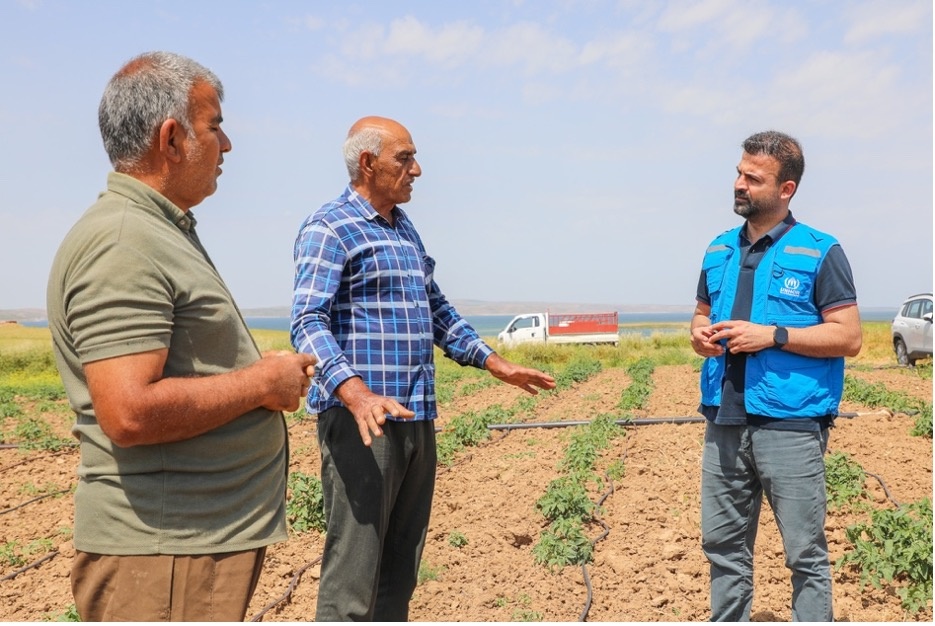
Sulayman and his brother, Abdulqdir, speak with UNHCR field staff about how their family uses the rented land to grow produce and earn a living.
By combining improved sorting, grading, washing, packaging and short-term cold storage with training and direct links to retailers, the hub is helping refugee, displaced and host community farmers like Sulayman move from occasional sales to more stable, predictable income.


