



Stories from the Field: “When given the chance, refugees really want to contribute to their society”

Stories from the Field: “When given the chance, refugees really want to contribute to their society”
An interview with our Swedish UNHCR colleague Yesper Widell in San Pedro Sula, Honduras
“Stories from the Field” is an interview series providing insight into the daily lives of some of our Northern European colleagues, working for the organization all over the world.
Why did you choose to work for UNHCR?
“For various reasons, I think. This work combines many interests of mine, and perhaps a stroke of chance was involved. For one thing, when I saw the level of hardship facing the millions of forcibly displaced people around the world, more than triple the population living in all the Nordic countries combined, my natural reaction was to want to assist in some way. It’s horrific, and the pure scale of it is staggering.
Perhaps that’s what urged me to do something back in 2005, when I engaged with local NGOs in Stockholm, mostly working with global solidarity campaigns. But the real eye-opener for me was the devastating 2008 Sichuan earthquake in China, where I was doing an academic exchange program at the time. I could see the destruction with my own eyes, and how people came together with different relief and rebuilding efforts, and so I started thinking about how I could contribute in these situations.
After Sichuan, I did a master’s degree in International Humanitarian Action, and within that field, I found myself gravitating towards working with refugee protection. In the end, I happened to get an internship with UNHCR, and then I continued because I like the protection work we do.
What motivated me then, and what still inspires me now, is the amazing resilience and capabilities of the displaced populations we assist. It’s a misconception that refugees are passive victims. When given the chance, they really want to contribute to their society. They have a really strong sense of agency and contribute to the communities they’re in, as long as they are given the opportunity."
How do you describe your work?
"The one word that comes to mind is diversity. UNHCR is quite unique in the sense that we cover a very broad range of responsibilities. Even in one duty station, there’s a variety of tasks for each staff member. In the morning you might help refugees dig a latrine or construct a house, at midday you’ll have a protection interview with a family who has recently crossed the border, and in the afternoon you’ll attend a high level meeting to advocate for a policy change in the country.
But I also think of the diversity in our programs. We strive to involve all the people we help and let them have a voice, regardless of age, gender or other factors. It’s also diverse in terms of the working environment; the staff is very international and we rotate to new locations when needed.
I now work as the Head of Office in San Pedro Sula, Honduras. It’s a new, challenging position and it’s also a new context for me. Many people might associate UNHCR with refugee camps where people have limited resources in confined, but secure, areas. Here in San Pedro Sula, it’s totally different: various street gangs dominate entire sectors of the city, both physically and socially, and use violence, extortion, and forced recruitment to keep the population under their control. The people who risk being displaced are actually living side-by-side with the perpetrators, with little or no state presence, which makes it a highly complex situation to address. This has led to hundreds of thousands of people fleeing communities within Honduras, as well as seeking refuge abroad.
To provide protection and solutions in this environment, we work very closely with the municipality, the private sector, civil society and development actors to formulate and implement a strategy. We also try to use the opportunities a city provides, including the infrastructure and more technological solutions. This whole-of-society approach has been very successful, especially in strengthening the resilience and protection of communities at risk through local government engagement. The San Pedro Sula declaration that we organized here some years ago was an important political stepping stone in this process."

Yesper Widell in UNHCR
- Head of Office (a.i) in San Pedro Sula, Honduras
- Originally from Sweden
- Has a master’s degree in International Humanitarian Action
- Has worked with UNHCR for six years in Tanzania, Thailand, South Sudan and now Honduras
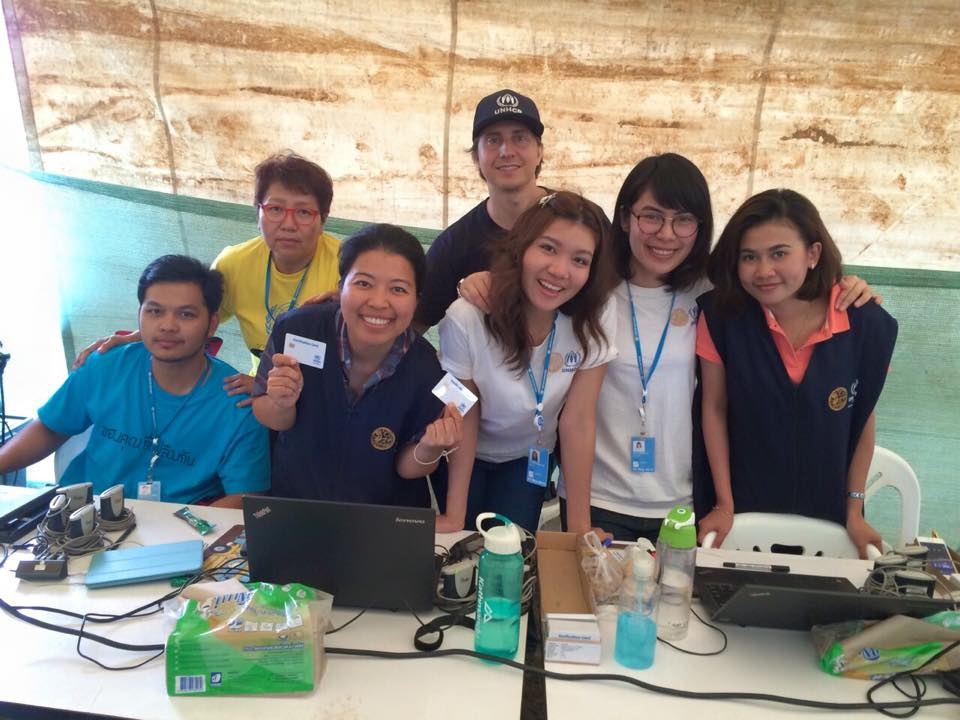
Yesper Widell is the Head of Office (a.i) in UNHCR's office in San Pedro Sula, Honduras. Before moving to Honduras he worked in Tanzania, Thailand and South Sudan. Private photo

"It can be very rewarding to see how the family goes from being in an insecure, desperate state to being and feeling safe," Yesper Widell explains. Private photo

“We strive to involve all the people we help and let them have a voice, regardless of age, gender or other factors," says Yesper Widell. Private photo


