



Sudanese refugees find safety, rebuild lives in Rwanda
Sudanese refugees find safety, rebuild lives in Rwanda

Yusif, a Sudanese refugee in Mahama camp, sells phone accessories from his small shop.
When the war suddenly broke out in Khartoum, Sudan, in April 2023, Yousif had no choice but to flee with his wife and two children. They left behind all their belongings to seek safety.
Their long and difficult journey took them through South Sudan and Uganda before they found a new home in Mahama Refugee Camp, located in the eastern part of Rwanda, in June 2024.
“The situation was bad. We left everything behind us: our home, our possessions,” the father of two recounts. “We came to Rwanda to seek protection and safety. Thank God, Rwanda welcomed us with open arms. It offered us shelters, safety, access to health services, food, and drinks.”
Arriving in Rwanda with nothing but hope, Yousif and his family had to start from scratch. The language barrier made it even harder for them to communicate and adapt to a new environment.
Yousif’s family are among over 12 million Sudanese who have been displaced by the war, including more than 1400 who have sought asylum in Rwanda over the past two years.
Despite the newfound safety, life was far from easy when Yousif first arrived in the camp. With no job to keep him occupied and no clear way to provide for his family, each day felt painfully uncertain. His family relied on in-kind humanitarian aid, including food and other essential items. Having nothing to do only deepened his sense of loss and made it tough to cope with the memories of all he had left behind.
Starting over
Earlier this year, things started to get better when he learned about a new opportunity to help refugees in the camp stand on their own. The UN Refugee Agency (UNHCR) works together with Caritas Rwanda, a local NGO, to implement a project meant to support Sudanese refugees become self-reliant, thanks to funding from the Mastercard Foundation.
This support helped Yousif regain the dignity of running his own business in February of this year. He now runs a tiny shop in the refugee camp offering haircuts, phone accessories, and perfumes.
“When Caritas [Rwanda] put us together and trained us to do business, I said ‘it's better to do the business that I have experience in’, that's why I started this kind of business selling phone accessories, because I used to do the same back in Khartoum,” explains Yousif.
Through this livelihoods project, beneficiaries like Yousif received a cash grant of 800,000 Rwandan francs to start or expand their businesses. They also received training in areas such as business planning, bookkeeping, and marketing.
“In the beginning, when I received this money, I told my family that this is capital we are going to use for work. We are not going to eat it or misuse it,” Yousif explains. “Things are now going well, compared to the beginning when we came.”
The determination and resilience of Sudanese refugees shine through throughout Mahama Camp. 40-year-old Samia provides another example with her successful phone charging business on the other side of the camp.
A primary school teacher before the war broke out in Sudan, she decided to leave her job in search of safety. Even after losing everything, Samia refused to give up. When Caritas provided her with the cash grant, she bought two solar panels, two inverters, one controller, two batteries, and phone chargers so that she could start offering phone charging services to her neighbours in the camp.
She arrived in Rwanda in July 2024 and launched her business in December of the same year.
“When the sun is there, things are going well. I may earn 5,000 or 6,000 Rwandan francs a day,” she explains. “I'm depending on my business. In the past, when I didn't have a business, things were tough. But now, because I'm able to gain something from this business, I'm able to save some, I'm able to buy what I need, and also to buy some food for myself. So, this business is helping me a lot.”
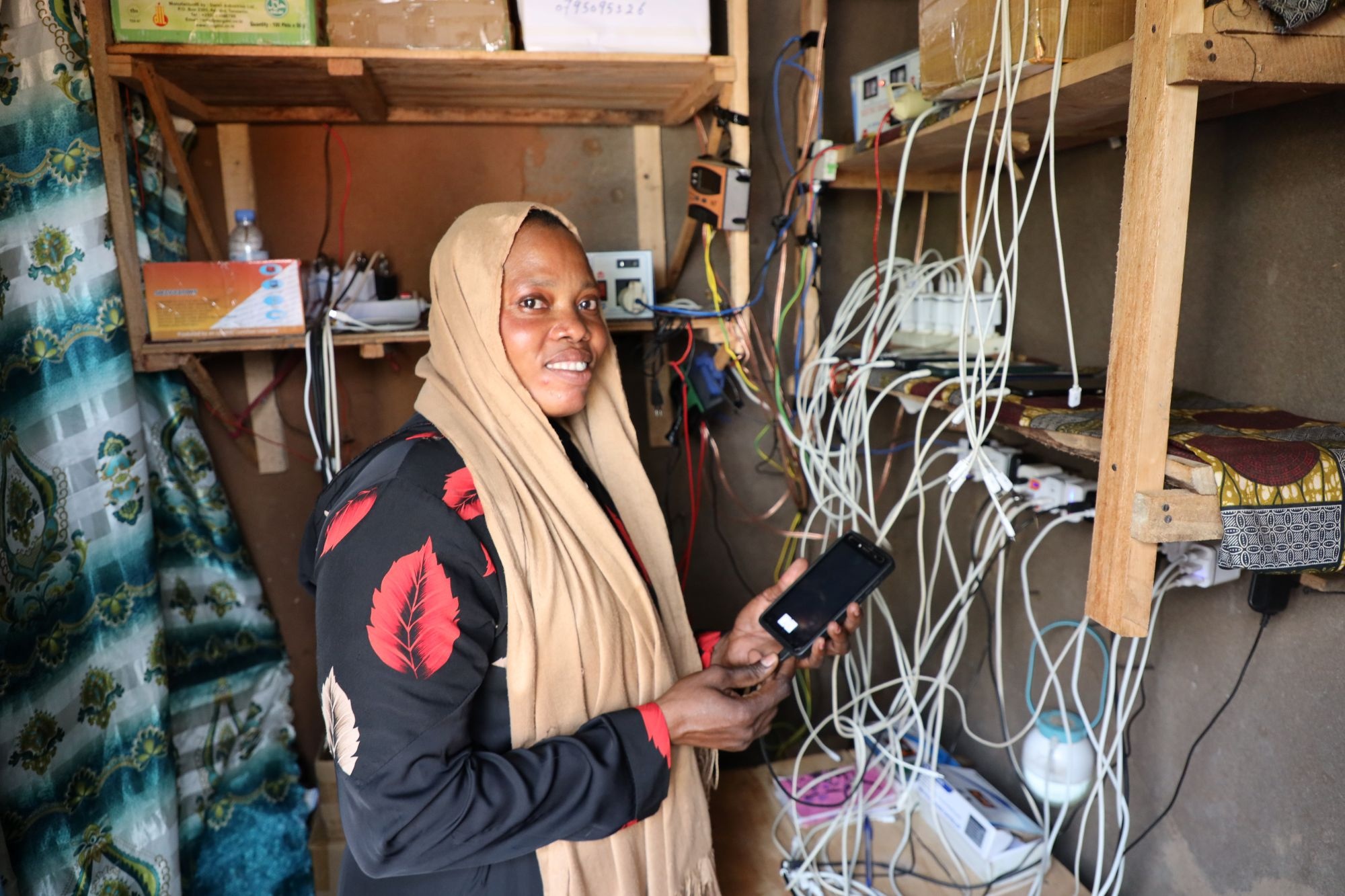
Samia, a Sudanese refugee, runs a solar-powered phone charging business in Mahama Refugee Camp.
While refugees like Samia and Yousif are rebuilding their lives thanks to the cash grant they received to start businesses, many of their neighbours still struggle to make ends meet.
Samia believes that livelihood programs should be expanded to benefit more refugees, especially as the cost of living continues to rise and humanitarian cash assistance decreases, making it harder for many to afford even the basic necessities.
“I saw for myself that with support, my life turned around,” Samia points out. “So if someone else, like my neighbours, gets support, their life is going to improve. And they'll be able to do something.”
As global funding for humanitarian aid grows tighter, supporting refugees like Yousif and Samia to stand on their own feet offers a sustainable way to invest in their own capacity for self-reliance.
“There are so many people who have dreams of starting a business, but what’s holding them back is support,” Samia says. “If there’s anyone who can help, I encourage them to do so because it can change someone’s life.”


