



Stateless Persons
Stateless Persons
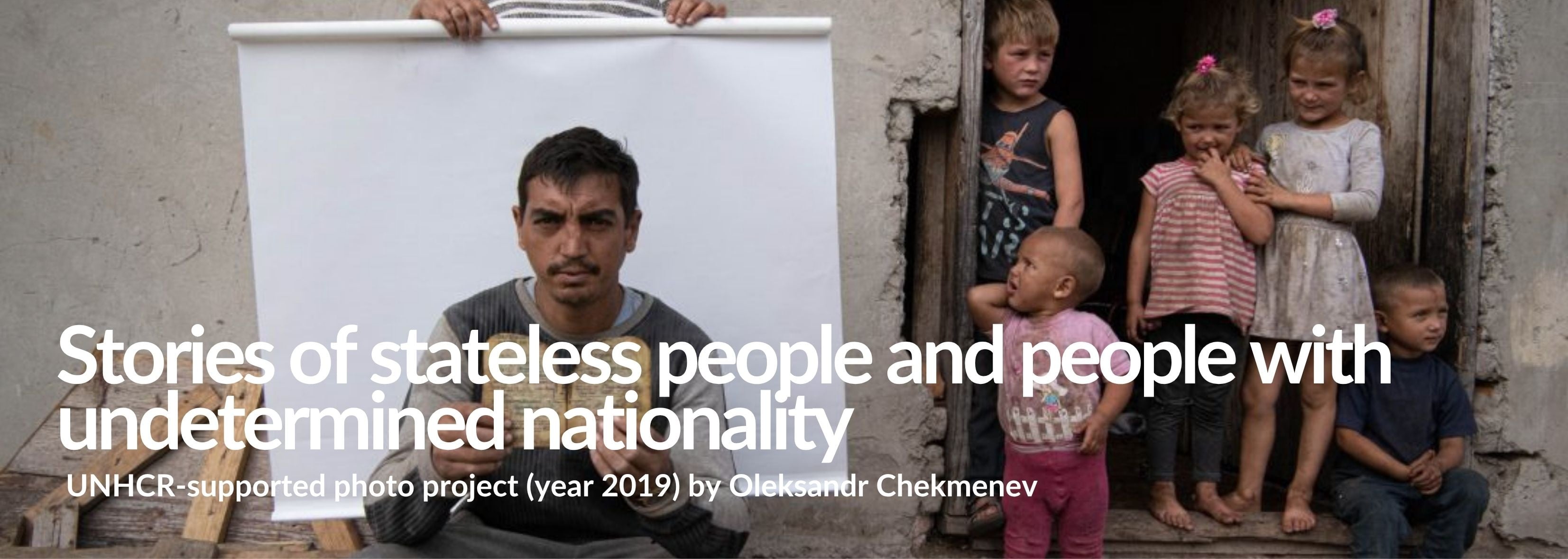
Stateless people are found in all regions of the world. The majority of stateless people were born in the countries in which they have lived their entire lives. Today millions of people around the world are denied a nationality. As a result, they often aren’t allowed to go to school, see a doctor, get a job, open a bank account, buy a house or even get married.

The mural “Little Citizen” was inaugurated by UNHCR in Kyiv for the 5th year anniversary of the global #IBelong campaign to eradicate statelessness. © UNHCR/Alina Kovalenko
Do you need help?
UNHCR provides free legal aid to stateless persons, persons with undetermined nationality and people who are at risk of statelessness. The legal aid is provided through several partner organizations. Find more info on the UNHCR Help page.
Statelessness in Ukraine: UNHCR’s work to address and reduce statelessness
PAST: Historic role for UNHCR in Ukraine
UNHCR began its work in Ukraine in the early 1990s to primarily address issues of statelessness as the agency supporting the return of Crimean Tatars to the Autonomous Republic of Crimea after they had been forced into exile during World War II.
Through the NGO Foundation “Assistance”, UNHCR supported Formerly Deported Persons (FDPs) and their descendants returning to Ukraine in the process of relinquishing their previous citizenship and acquiring Ukrainian nationality.
In 1997, amendments to Ukraine’s Citizenship Law led to some 25,000 stateless FDPs acquiring Ukrainian nationality by 2001. In addition, Uzbekistan and Ukraine concluded an agreement – backed by both UNHCR and the OSCE High Commissioner on National Minorities – which ensured that further 90,000 FDPs acquired Ukrainian nationality during 1999-2001.
UNHCR continued its advocacy and work with Ukraine’s government and authorities to address key gaps and challenges. In 2001, Ukraine adopted a new Citizenship Law introducing a simplified procedure for acquiring citizenship, ensuring solutions for more stateless people or people at risk of statelessness. Later, Ukraine acceded to the two UN Conventions on statelessness.
PRESENT: The full-scale invasion enhances risks of statelessness
Thousands of people in Ukraine are stateless, undocumented or otherwise at risk of statelessness – and since 2014, the war and later full-scale invasion have only increased some of the risks that can lead to statelessness.
Reasons for statelessness in Ukraine:
Dissolution of the Soviet Union and related population mobility
Russia’s full-scale invasion with occupation and illegal annexation of parts of Ukraine’s territory as well as displacement
Situation of minority groups
Complex procedural requirements
UNHCR works with several local NGO partners, and with the Government of Ukraine, to address gaps and challenges as well as provide support and legal aid to stateless and undocumented people to help them find solutions and acquire documentation and citizenship.
FUTURE: The way forward
UNHCR has launched the Global Alliance to End Statelessness to build on the momentum from the global ten-year long #IBelong campaign (2014-2024), foster knowledge sharing and enhance collaboration among states, civil society and stateless communities.



Collective action is needed to:
Simplify access to birth registration and documentation for all.
Explore group solutions for population groups at risk of statelessness.
Prevent future situations of statelessness, including those emanating from the temporary occupation and illegal annexation of parts of Ukraine’s territory.
Expand access to free legal aid to all people at risk of statelessness, including those without birth certificates, and waive administrative and court fees for easier access to documentation for economically vulnerable people.
Include stateless and those at risk in national and international development planning so as not to leave them behind.