



From experience to leadership: refugee communities shaping protection in Armenia
From experience to leadership: refugee communities shaping protection in Armenia

Older refugees and members of the local community participate in a cultural activity during the Harvest Festival in Dzoraghbyur, Kotayk Province.
People affected by displacement bring knowledge, skills and experience that can strengthen the services and communities around them. With support from the European Union through its Humanitarian Aid Operations, UNHCR and partners helped create opportunities for refugees to share priorities, organise community activities and contribute to more inclusive protection systems in Armenia.

A community activity at the Ukrainian Forum in Yerevan brings refugee children and families together to learn, connect and support one another.
By drawing on lived experience, refugee-led organizations can provide practical guidance, create trusted spaces and help newcomers navigate unfamiliar systems with greater confidence. Their work strengthens social connections while recognizing refugees as contributors to community life, rather than only as recipients of assistance. RLOs understand when information is available but difficult to interpret, when language or distance prevents someone from reaching a service, and which community relationships are most likely to create trust.
Ukrainian Forum NGO created spaces where children and parents can learn, maintain cultural connections and build relationships in their new communities. Their educational, cultural and recreational activities respond to needs identified through their own experience and close engagement with refugee families.
“I am happy to meet new friends and take part in educational activities and games,” says Maksym, a refugee child from Ukraine. “While I am here, my parents can focus on work and other responsibilities as we build our life in Armenia.”
Between June 2024 and March 2026, UNHCR and partners sought to place this knowledge at the centre of protection programming supported through the EU Humanitarian Aid -funded project.
Refugees and asylum-seekers participated through household interviews, focus-group discussions, community meetings, participatory assessments, thematic consultations and Hotline feedback. Their perspectives informed outreach, information materials, referrals, case management and engagement with national and local authorities.
Eight analytical protection-information products brought monitoring findings and community feedback together to inform programming, coordination and advocacy.
From consultation to community leadership
Participation extended beyond consultation. Refugee-led organizations were also supported to strengthen their ability to design activities, represent community priorities and engage with institutions and donors.
Community-based grants supported selected refugee-led and community organizations to implement activities for women, children, families and groups facing heightened protection risks.
Working with the Eurasia Partnership Foundation, UNHCR and partners identified 55 refugee-led organisations, surveyed 36 and supported capacity development for their representatives.
Thirty-four representatives, including 23 women, participated in institutional-capacity development covering strategic planning, project design, fundraising, communication, accountability, protection frameworks and engagement with donors and public institutions.
The support aimed to strengthen their roles as community representatives, service actors and contributors to programme design, while respecting the independence and priorities of each organization.
Creating spaces for women, girls and families
Community leadership took many forms, from sports and cultural activities to information, peer support and specialized protection.
Through GOALS-Armenia, 75 refugee and host-community girls aged 8 to 15 participated in safe sports and educational activities in Pokr Masrik, Zovaber and Garni. Football created opportunities to build confidence, develop friendships and strengthen teamwork among girls from different backgrounds.
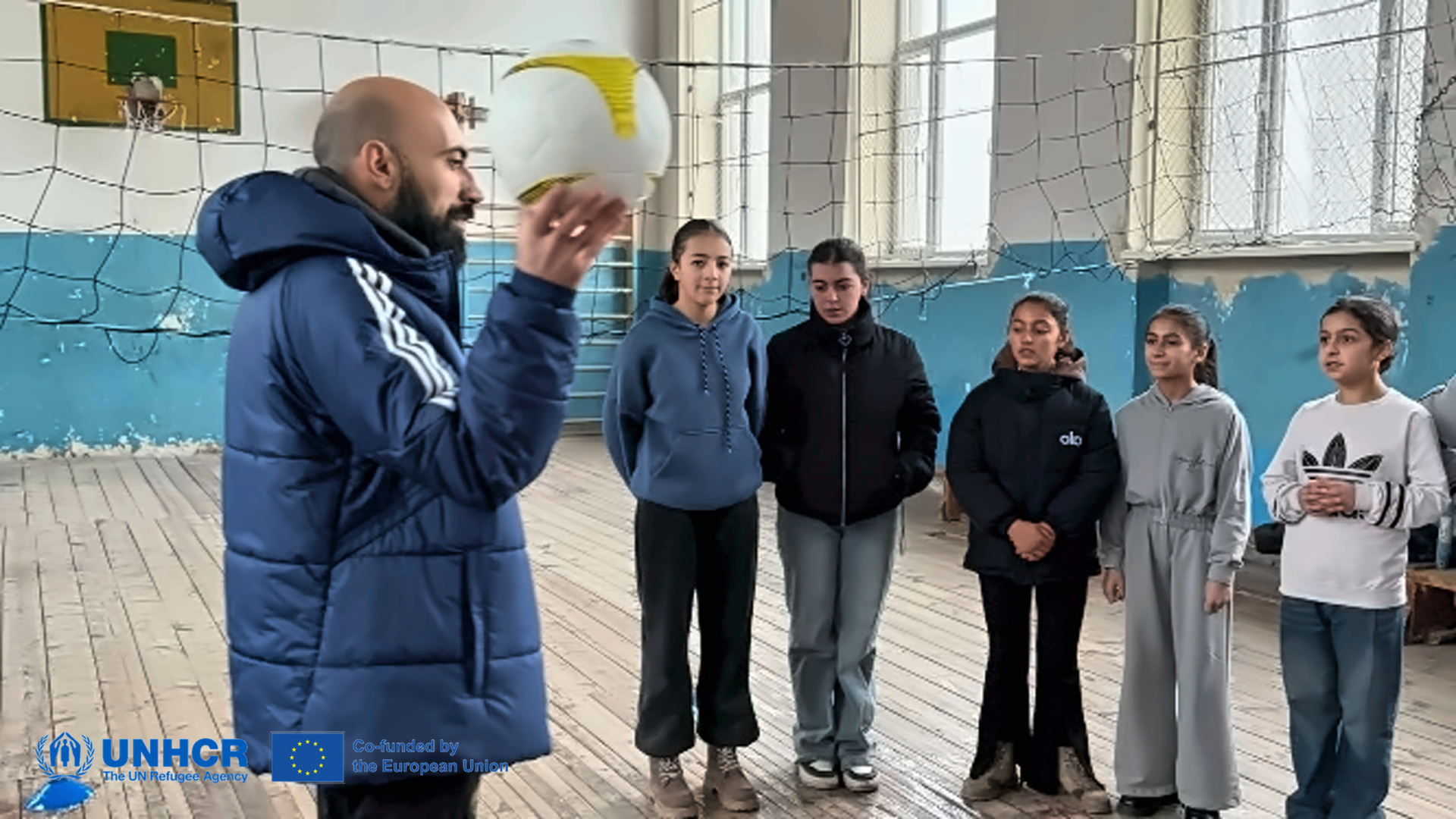
Refugee and host-community girls take part in sports and educational activities in Zovaber, Gegharkunik Province, building skills and friendships through teamwork.
“We enjoy the sports activities because we do not often have opportunities like this in our village,” says Hasmik, a refugee girl from Karabakh. “Our coach teaches us football, teamwork and how to support one another.”
Beyond physical activity, the sessions created a safe space for girls to build friendships, communicate across different backgrounds and feel part of their communities.
For older refugees, partner-led social and cultural activities created opportunities to overcome isolation and reconnect with community life. Such activities recognised that protection also includes dignity, participation and the ability to build meaningful relationships after displacement.
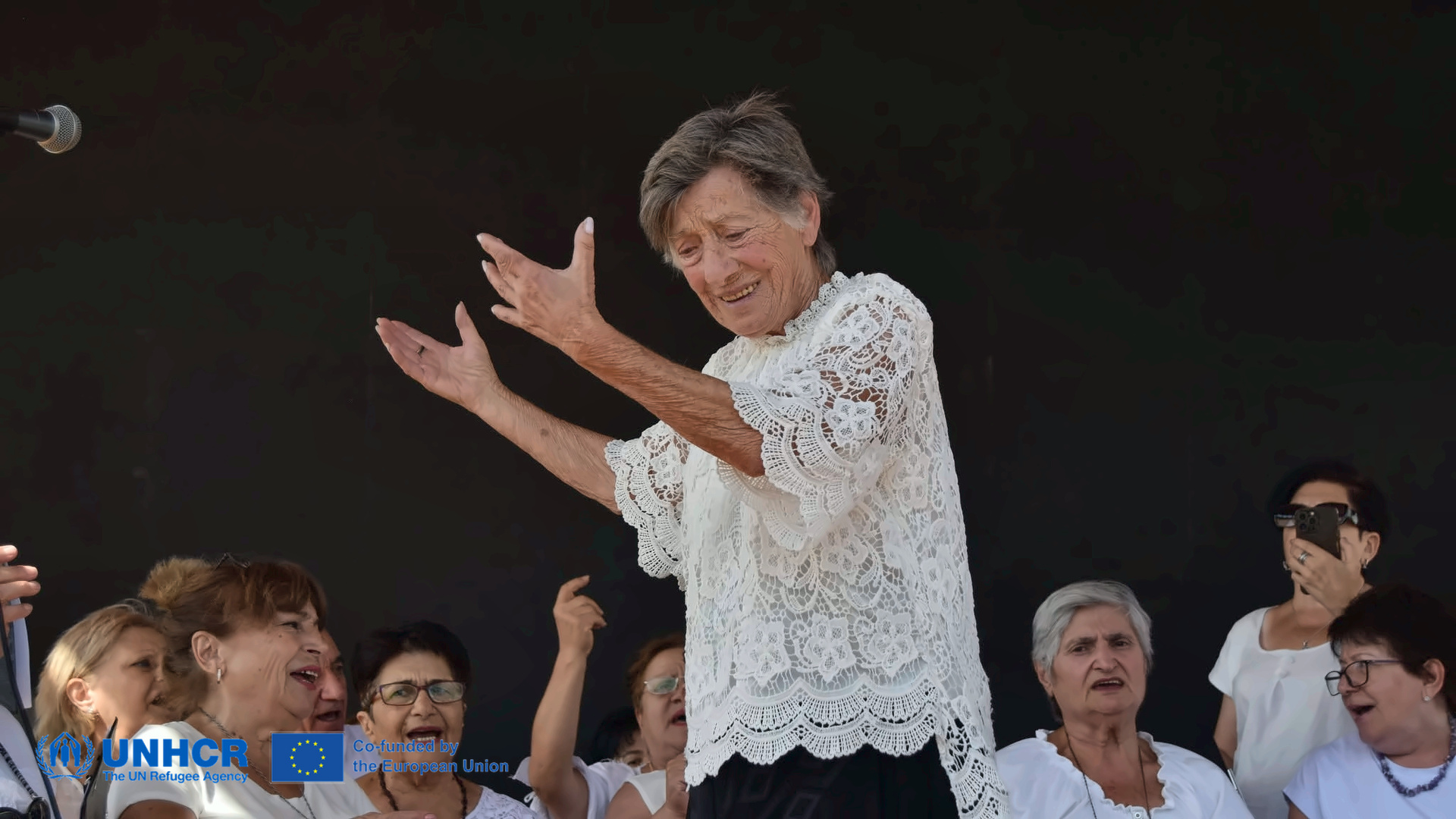
Older refugees and members of the local community participate in a cultural activity during the Harvest Festival in Dzoraghbyur, Kotayk Province.
At 87, Tereza participates in a community choir and dance group with other refugees and local residents. Supported by Mission Armenia social workers, the activity has given her a place to build friendships and reconnect with the music and traditions she values.
“When the music starts, my heart feels lighter,” says Tereza. “Dancing gives me energy and reminds me that it is never too late to make new friends.”
Tailored support where risks were heightened
The project supported temporary safe accommodation for 48 LGBTIQ+ refugees and asylum-seekers facing discrimination, violence, homelessness or the absence of a safe support network. Individuals were also connected with legal, health and psychosocial services.
This support was delivered through New Generation Humanitarian NGO, based on individual risk assessments. Confidentiality and protection-sensitive approaches were essential because disclosure could expose people to further stigma or harm.
UNHCR and partners also prioritized women and children at risk, older persons, persons with disabilities and people facing multiple or intersecting barriers. In-person outreach, telephone support, interpretation and digital information helped adapt services to differences in mobility, language and access.
Information as participation
Participation depends on people having the information needed to make decisions and express informed views. During the project, more than 65,000 people accessed information on rights, entitlements, procedures and available services.
Mission Armenia combined community sessions with personalised consultations, while the UNHCR Hotline provided a nationwide channel for information, feedback and complaints. Legal-awareness visits, television, radio and digital communication helped reach people beyond the capital.
Community feedback was not treated as a communications exercise. It informed geographic targeting, service referrals, Hotline content, legal priorities and advocacy.
Stronger communities and stronger systems
The Government of Armenia’s national and local institutions remained central to the response. UNHCR and partners worked with the Migration and Citizenship Service, the Ministry of Labour and Social Affairs, Unified Social Services, municipalities, the Human Rights Defender’s Office, legal professionals, social workers and civil-society organizations.
At the same time, refugee-led and community-based organizations were supported to identify needs, propose solutions and engage constructively with public institutions and service providers.
These two dimensions were connected. Stronger national systems are more responsive when affected people can participate in them. Community initiatives are more sustainable when they can connect with institutions, services and decision-makers.
The project therefore connected community experience and evidence with practical support and national and local systems.
Its wider contribution lies in refugees being recognized as people with knowledge, skills and agency—able to participate, organize initiatives and contribute to the communities and institutions of which they are part.
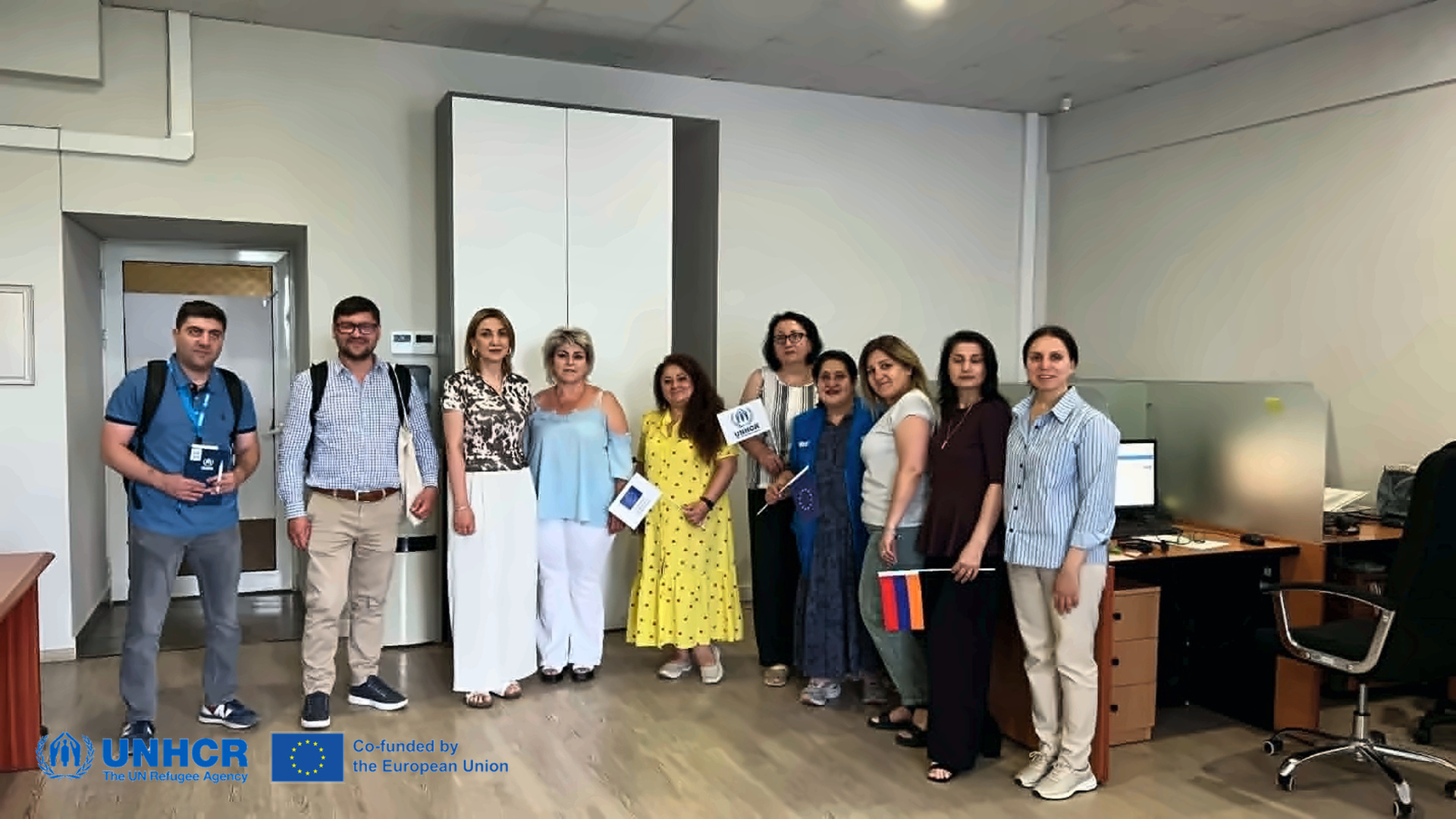
Representatives of EU Humanitarian Aid and UNHCR meet operators of Armenia’s 114 social-services Hotline at the Unified Social Service Call Centre. Yerevan.
Some Hotline operators and social workers had themselves experienced displacement from Karabakh. Their language skills and understanding of the displacement experience helped build trust with callers seeking information, guidance and referrals.
In a later reflection at the world refugee day, social workers who had themselves been displaced from Karabakh spoke about how their experiences shaped their work supporting others. Many of these social workers had once relied on the same support services they now help deliver. Their stories illustrate how people affected by displacement can become leaders within their communities, contributing their experience, language skills and understanding to support others facing similar challenges.

20 June 2026 – World Refugee Day. Komitas Museum-Institute, Yerevan, Armenia.
“I know what it feels like to leave everything behind and start over,” says Narine, a social worker in Gyumri. “The support I received gave me strength and inspired me to help others navigate the same journey.”
“I could often recognize a refugee from Karabakh through their dialect,” says Mariam, a social worker in Hrazdan. “That shared experience created an immediate sense of trust and helped people feel understood.”
Narine and Mariam’s experiences show that refugee participation is not limited to being consulted or receiving services. When people affected by displacement are able to contribute their knowledge, professional skills and lived experience, they can strengthen trust, improve access to support and help shape more responsive communities and systems.
Their journeys, from receiving support to supporting others, capture the wider purpose of the project: ensuring that refugees are recognized not only as people in need of protection, but also as partners, professionals and community leaders helping build a more inclusive future in Armenia.
About the project
From June 2024 to March 2026, UNHCR and its partners, working in support of the Government of Armenia and co-funded by the European Union through its humanitarian aid operations, implemented a nationwide Protection Action linking documentation and legal assistance with social work, protection monitoring, referrals and rights-based information. The project aimed to help refugees and asylum-seekers exercise their rights while strengthening the national systems and services that support them.
Across Armenia, the Action reached an estimated 144,706 people. 119,706 people obtained documentation or legal status, 1,649 received legal counselling, assistance or representation, and 65,760 received information on their rights and entitlements.

