



Support from the British People helps sustain life-saving services for refugees and host communities in Kakuma
Support from the British People helps sustain life-saving services for refugees and host communities in Kakuma

In north-western Kenya, Kakuma hosts hundreds of thousands of refugees living alongside the Turkana host community. Access to safe water, healthcare, and essential household items remains critical to daily life - particularly for newly arrived refugees and the most vulnerable families.
While UNHCR, the Government of Kenya, and partners continue to advance self-reliance and long-term solutions, many households still depend on humanitarian assistance to meet their most basic needs, making sustained and dependable support essential to ensuring their safety, health, and dignity.
While UNHCR, the Government of Kenya, and partners continue to advance self-reliance and longer-term solutions, many households still depend on humanitarian support to meet basic needs. Predictable funding remains essential to help ensure people can live in safety and dignity.
With support from the British High Commission in Nairobi, UNHCR, and partners are sustaining life-saving assistance across key areas, including water, sanitation, and hygiene (WASH), health and nutrition, and the provision of core relief items for new arrivals. The support also contributes to government-led coordination and refugee management under the Shirika Plan and the Kalobeyei Integrated Socio-Economic Development Plan (KISEDP), in partnership with Kenya’s Department of Refugee Services (DRS) and county authorities.
Safe water close to home

Fardowsa Abukar, a refugee tap stand manager in Kakuma, checks a water point as it distributes safe water to the community, part of ongoing support by UNHCR and partners to ensure reliable access to water for refugees and host community members.
Fardowsa Abukar, a Somali refugee mother of five living in Kakuma, depends on reliable access to safe water - both for her family and for the community where she serves as a tap stand manager.
“Water is life,” she says. “My responsibility is to make sure everyone in the community receives water as planned, and when there is a problem, I report it so it can be fixed quickly.”
As a mother of five, including eight-year-old twins Abdidea and Abdirazak, she knows how important it is to have reliable water for cooking, drinking, and keeping her children healthy.
“When water is close to our homes, life becomes easier,” she explains. “Before, people had to walk long distances to fetch water. Now they can use that time to take care of their children, work, or do other important activities.”
She adds that access to nearby water points improves safety for women and girls.
“When water is nearby, people are safer. Women and young girls do not have to walk far or wait until dark to collect water. This makes a big difference for our community.”
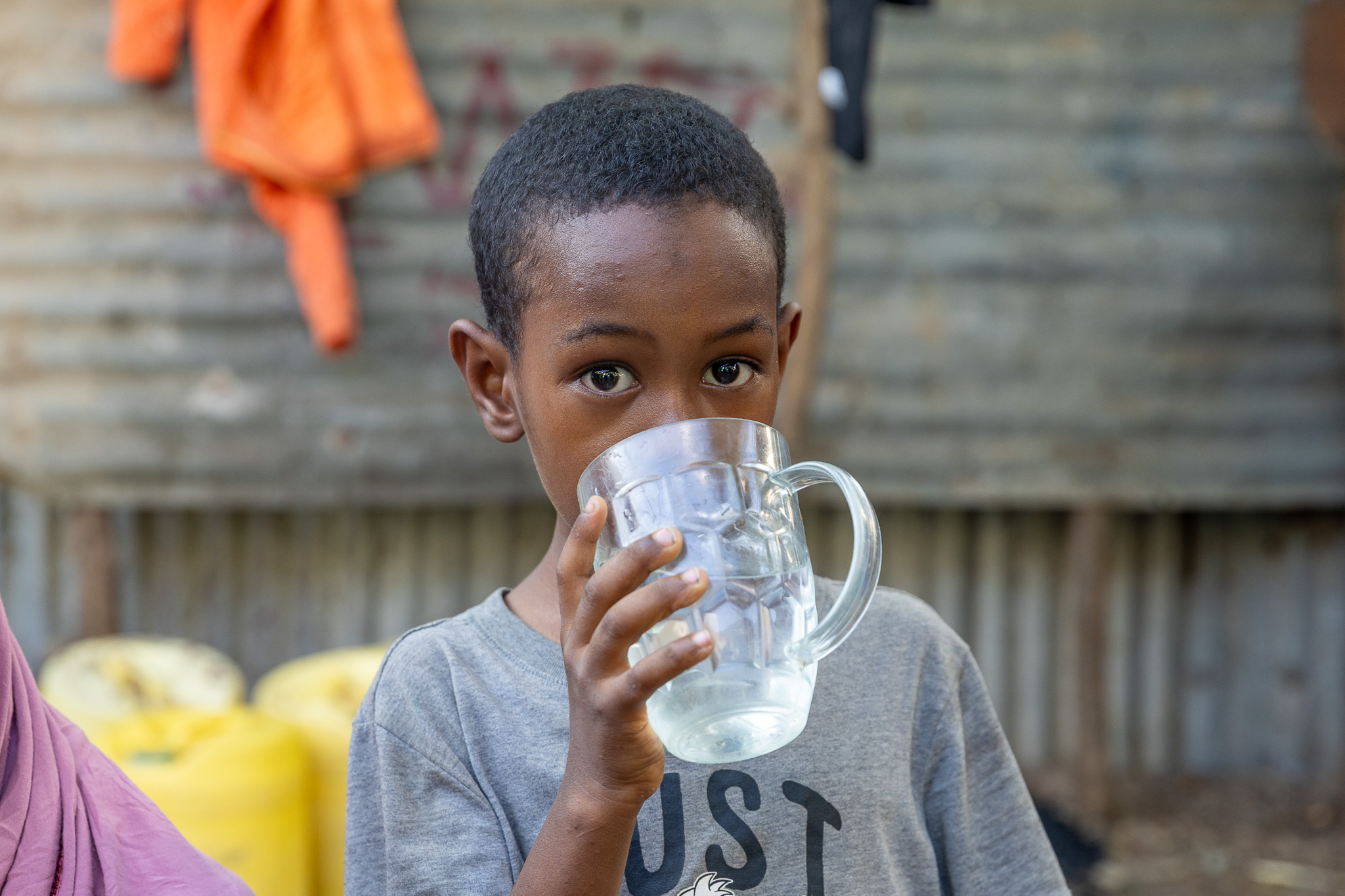
Eight-year-old Abdirazak drinks a glass of clean water in Kakuma, where reliable access to safe water helps families stay healthy.
Starting again with dignity

Susan Ichang receives essential items, including blankets, soap, mats, sanitary pads, and a water bucket at the Kalobeyei Reception Centre in Kakuma, helping ensure a dignified stay for newly arrived refugees as they settle in safety.
Every week, new arrivals continue to reach Kakuma after fleeing conflict and insecurity in neighbouring countries. Many arrive with nothing, often after long and dangerous journeys.
Susan Ichang, a 20-year-old mother of one from South Sudan, arrived in Kakuma with her young child after being forced to leave her home.
“On the way here, life was very hard,” Susan recalls. “We walked for a long distance, and I could not bring the things I owned. I arrived with nothing, only my child and the clothes we were wearing.”
Upon arrival, Susan was received at the Kalobeyei Reception Centre, where UNHCR and partners provide immediate support to newly arrived refugees.
“When I arrived, I was thinking about how I would start again because I have no relatives here and no one to ask for help,” she says. “I did not know how I would get the things we need to live.”
At the reception centre, Susan received essential core relief items, including a blanket, sleeping mat, water bucket, soap, and sanitary pads - basic items that help families meet immediate needs as they wait to be relocated to the community.

Susan Ichang carries the items she received, relieved and grateful for the support after her arrival in Kakuma.
“I was very grateful for the way we were received,” she says. “These items helped my child and me because I did not have anything. Without this support, life would have been very difficult for us.”
With assistance from the British High Commission in Kenya, thousands of newly arrived refugees in Kakuma and vulnerable households receive core relief items each, helping ensure that families can live with dignity from the moment they arrive.
Sustaining essential services through partnerships
Beyond water and emergency assistance, support from the British High Commission in Kenya also helps sustain access to health and nutrition services for refugees and host communities. It further supports coordination with the Government of Kenya and county authorities as the operation continues transitioning toward more integrated refugee management under the Shirika Plan. The support also contributes to maintaining peace and social cohesion in Kakuma by enabling UNHCR and partners to support law enforcement operations, facilitate community dialogue forums, and promote coexistence messages that help strengthen stability among refugees and between refugees and the host community.
These efforts are delivered through close collaboration between UNHCR, the Department of Refugee Services, the Turkana County Government, and humanitarian partners working across Kakuma Municipality.
In a context where many refugees have limited means to provide for themselves, ensuring access to water, health care, and essential household items remains critical to protecting lives and preserving dignity - while providing a foundation for families to pursue education, livelihoods, and longer-term solutions.
UNHCR expresses its sincere gratitude to the Government of the United Kingdom for its continued support and to the Government of Kenya and the Turkana County Government for their leadership and partnership in advancing a coordinated and inclusive refugee response.


