

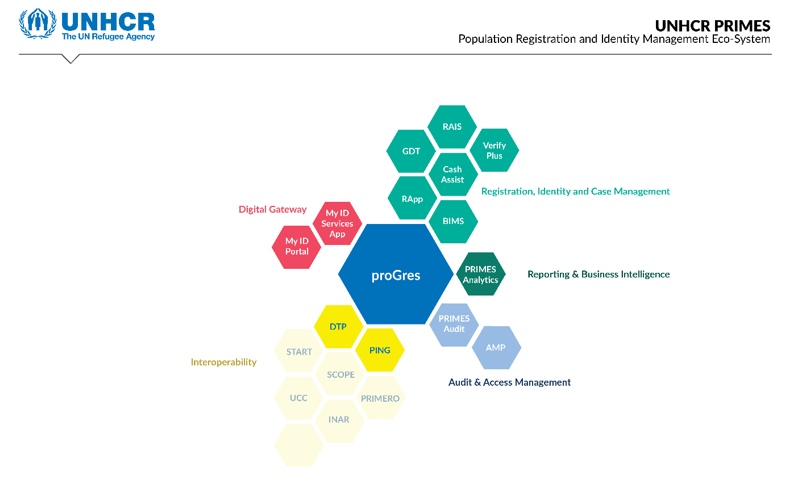
PRIMES stands for Population Registration and Identity Management Eco-System. PRIMES is a concept that brings together a set of interoperable tools used for:
- Registration, and Identity management, as well as Case Management related to Refugee Status Determination, Resettlement, Voluntary Repatriation, Legal and Physical Protection, Child Protection, Gender-Based Violence, Fraud, and assistance.
- Reporting & Business Intelligence for statistical reporting and data analysis at operational and organizational levels.
- Administrative purposes to provide access rights and permissions to users as well as examine and monitor data.
- Interoperability to exchange data internally and externally.
- Digital Access for Persons with and for whom UNHCR works to allow access to UNHCR’s services via PRIMES.
PRIMES applications are designed to work in online and offline environments and are interoperable with systems used by governments and partner organisations such as WFP (SCOPE) and UNICEF (Primero).
More detailed information about PRIMES can be found on the PRIMES Support website (only accessible by UNHCR colleagues and by PRIMES users).
ProGres
-

proGres is UNHCR’s corporate, centralized, web-based registration and case management application. proGres supports operational functions ranging from the registration of individuals to a wide range of UNHCR case management functions including assistance, protection case management, protection interventions and the provision of documentation and cash-based assistance.
proGres was first developed in 2003 to meet UNHCR’s refugee registration and population data management requirements. proGres has, over the years, become the backbone for individual data in the majority of UNHCR’s field operations. It is now a key instrument for the delivery and tracking of protection and assistance services to persons of concern around the world.
proGres enables UNHCR to grant access to partners, including host Governments, ensuring a common platform for collaboration and it is interoperable with other corporate tools such as RApp, BIMS, CashAssist, GDT, PRIMES Analytics, Digital Gateway, PING, PRIMES Audit and AMP.
Rapid Application (RApp)
-
RApp stands for Rapid Application. RApp is an application that has been designed for rapid data collection in emergency settings and for registration in locations with no or limited connectivity where proGres cannot be used for such data collection.
RApp is built on a RESCO Mobile CRM application which allows data to synchronize with proGres and to be linked to BIMS. RApp data can be uploaded into proGres and linked to other functionalities of PRIMES, such as biometrics and the various case management modules.
RApp collects data at the group and/or the individual level, allowing the collection of data at pre-registration for scheduling, organized movement and initial assistance distribution as well as individual registration of biographical data, photographs, biometrics and specific needs information for case management purposes. RApp allows for the issuance of documentation, including entitlement documents such as ration cards at the group level.
RApp can be used by UNHCR and partners who have access to proGres.
Dataport (Decommissioned)
-
As of 15 April 2025, PRIMES Analytics has officially replaced Dataport as the platform for business intelligence and reporting related to PRIMES llive data. As part of this transition, the Dataport cubes have been decommissioned. For reporting on visualizations, based on proGres live data, please use PRIMES Analytics.
For reporting that relies on historical proGres data, continue using the Data Warehouse. Reports such as ASR, RSD and RSR will remain available through the Dataport DWH.
The Dataport was a ‘smart’ inventory of UNHCR’s current population information with real-time connectivity to proGres. The Dataport pulls population data from proGres and organizes the records with the help of indicators and attributes that cover all thematic, sectoral and case management areas such as for example, number of minors that have spontaneously departed to their country of origin or number of individuals with specific needs that have departed for resettlement. This tool maximizes the potential of the data collected by UNHCR and provides a quality resource for analytical and comprehensive information on persons of concern and contribute to global intelligence on displacement.
PRIMES Analytics
-
PRIMES Analytics is a UNHCR service designed to analyse and report on operational and organisational data collected through PRIMES applications, with a particular focus on proGres data.
PRIMES Analytics plays a crucial role in monitoring, evaluating, and improving operational efficiency. PRIMES Analytics can offer deep insights into registration trends, case management statistics, and other performance indicators relevant to one’s specific role.
By using PRIMES Analytics, users access proGres data more easily, and with pre-defined metrics, gaining a more complete understanding of key population indicators and areas needing attention.
PRIMES Analytics can be used by UNHCR and will eventually be accessible to partners looking for statistics on forced displacement.
proGres is the first PRIMES application to be integrated into PRIMES Analytics. It is expected that this infrastructure will be extended to other PRIMES applications in the near future.
Biometrics Identity Management System (BIMS)
-

BIMS is UNHCR’s biometric identity management system. First rolled out in 2015, BIMS has a centralized database allowing real-time consolidation and checking of identity across all UNHCR sites using the system. The system operates under a wide range of environmental, infrastructure and connectivity conditions, and is able to operate with weak or non-existent internet availability.
BIMS secures, preserves and anchors individual identities, ensuring continuity of identity over time and across operations. This reduces avenues for identity fraud and other misrepresentations, since registered individuals can no longer be lost or registered multiple times against different names.
BIMS can record fingerprints and irises from individuals to build a globally available biometric record. The use of a multimodal system, rather than relying on fingerprints or irises alone, provides a more complete and accurate coverage of populations.
Digital Gateway
-
The Digital Gateway is designed to empower displaced persons interacting with UNHCR. By creating an online account through a dedicated web Portal, displaced persons gain access to digital services, including applying for registration or resettlement. UNHCR and partner users can access the data via the Digital Gateway Services App to verify identities, schedule appointments, dispatch notifications or distribute documents.
- My Services Portal: The Portal is a web-based identity management system, enabling displaced persons to create an account using their personal e-mail. This account facilitates their digital access to various protection and assistance services. Designed with accessibility in mind, the Portal supports multiple languages and automatically manages user data through the Digital Gateway Services App.
- Digital Gateway Services App: The Digital Gateway Services App is a complementary application that utilizes the data input by displaced persons through the portal. It provides a platform for UNHCR, partner or call center users to interact with the data, share updates with the portal, and synchronize data with proGres.
PING
-

PING facilitates secure, standardized and efficient data exchange between UNHCR’s PRIMES applications and other internal and external partner systems.
PING allows UNHCR and partners to receive and share data with each other using a variety of data transfer modalities.
PING is available to UNHCR and any partner with whom UNHCR has established a Data Sharing Arrangement.
PRIMES Audit
-

PRIMES Audit is designed to generate audit reports from the PRIMES Audit Database. Whenever a PRIMES user creates a new record or updates the data contained in a field, the application will record these changes in the audit history and this will be saved in the PRIMES Audit database.
PRIMES Audit is currently only available in proGres but will be gradually incorporated in other PRIMES applications.
Verify Plus
-

Verify Plus is a globally unique digital signature inserted in a QR code that can be printed on documents issued from proGres. The signature allows for anyone scanning it with the Verify Plus app to determine if the document is a genuine and valid document issued from proGres.
The verification is performed through a QR code generated through proGres with a unique Verify Plus signature and the use of the application is intended for law enforcement authorities, UNHCR partners who are engaged in refugee protection and assistance work.
Access Management Portal (AMP)
-

AMP is designed to create users and assign access rights in proGres, RApp, Digital Gateway and PING, and will become available to locally manage user access rights in other PRIMES applications in the future.
Refugee Assistance Information System (RAIS)
-
The Refugee Assistance Information System (RAIS) is a secure web-based assistance management platform used by UNHCR, implementing partners, and donors to ensure effective tracking and coordination of assistance, enhanced accountability, and to reduce duplication of efforts. RAIS was developed by colleagues in MENA to address the demands for a more coordinated approach for the delivery of refugee assistance amongst all relevant actors.
RAIS was also adopted in Ukraine’s emergency response as the main coordination tool for assistance delivery. It is currently used in field operations in countries such as Moldova, Slovakia, Romania, Poland, Ukraine, Georgia, Armenia, Belarus, Bangladesh and others. In addition, several major donors have made this a requirement in their agreements with partners, regardless of whether their funds are channeled through UNHCR.
RAIS also helps partners access proGres data to coordinate assistance, manage referrals, handle call center tickets, and integrate home visit surveys. This core feature of RAIS allows UNHCR partners who don’t have direct access to proGres data to support UNHCR users in helping refugees by creating tickets for various needs like assistance, referrals, and more
IrisGuard
-
IrisGuard is UNHCR’s other primary biometric tool, collecting two iris scans and a facial photo from each individual. The system was initially introduced in Jordan to support the Syrian response and has since expanded throughout the Middle East sub-region.
First applied in the context of administering cash assistance for refugee beneficiaries, IrisGuard introduced a technical framework, known as EyeCloud, that permits humanitarian partners and financial service providers to validate identity and qualification for assistance via their irises. In consultation with WFP, iris-enabled point-of-sale devices were introduced in camp supermarkets to ensure access to food assistance without requiring vouchers, cards or PINs. EyeCloud was then expanded to provide cash interventions to the refugee community directly through the Cairo Amman Bank’s ATM network. EyeCloud is also used by IOM to verify identity during resettlement interview processing. The IrisGuard solution has therefore become an integral part of identity management for persons of concern as well as an effective mechanism for assistance delivery in the Middle East operations.
Global Distribution Tool (GDT)
-
The GDT helps operations use biometrics to verify identities in food and assistance distribution scenarios. The GDT:
- uses biometrics to quickly and accurately verify food collectors during distribution
- reduces avenues for fraud
- speeds up the overall process
- provides greater integrity and better management information
- generate reports at any time.
The GDT accepts food distribution lists or manifests from a variety of sources including proGres and provides real-time reporting on exactly who has collected assistance by using a biometric verification with BIMS. Reports also provide detail on which households have been served, and the specifics of exactly which commodities have been distributed.
The GDT provides UNHCR and partner staff with secure access to its biometric database for verification and digitizes the entire food distribution process to remove the need for time and resource consuming paper-based manifests checks.
The GDT can manage multiple distribution lists simultaneously as well as supporting alternative food collectors for households which need to designate others to collect assistance on their behalf.
The application also has a mobile app, which can be installed on any android handheld device, enabling users to track admission, and successfully record collection of assistance.