



Live blog: UNHCR Ukraine Response to the COVID-19 pandemic

Live blog: UNHCR Ukraine Response to the COVID-19 pandemic
Displaced people and host communities all over the world are at heightened risk as the coronavirus pandemic spreads.
Here are some of the ways they – along with UNHCR staff and partners – are taking action to stay smart, stay safe and stay kind.
Check back here for update.
_______________________________________________________________________________________________
On July 6, the Ambassador of Latvia to Ukraine Juris Poikans handed over medical equipment worth 25,000 euros to the Sloviansk Central Hospital. Assistance to the hospital's surgery department was provided thanks to financial assistance from the Government of Latvia and with the support of UNHCR in Ukraine.


5 May. For IDPs who are now living in collective centers for IDPs the availability of hygienic and personal protective equipment is a key factor for maintaining their own health. Therefore, the use of masks, sanitizers and basic handwashing is the only solution for people to at least protect themselves from the risk of infection. UNHCR, together with the partner organizations "Right to Protection" and "Slavic Heart", delivered 132 hygienic kits to 43 collective centers in Donetsk, Zaporizhzhia, Dnipro, Kharkiv oblasts. Distribution is being conducted through Nova Poshta (to the door) and some of our partners delivered the kits themselves. We hope this will help protect the health and wellbeing of local residents.

In April 2020, Vodafone Ukraine and UNHCR agreed to cooperate and support conflict-affected persons in east Ukraine by providing them with free mobile phone credit. Based on the data provided by UNHCR, Vodafone Ukraine made available free talk time to 2,489 people suffering from the effects of armed conflict and restrictions imposed to prevent the spread of coronavirus in Ukraine. This will allow people, especially those whose mobility is limited, to stay connected without further depleting their limited resources. Since April 24, 2,489 people living in isolated villages along the contact line in the east of Ukraine have received 1000 free minutes within Ukraine or a monthly package of services (unlimited calls within Vodafone Ukraine and 500 Mb of Internet).

27 April 2020. Villagers in Staromarivka will be able to buy products, receive their pensions and get access to medical services. Upon negotiations between numerous humanitarian missions including NGO “Proliska” and JFO, one of the checkpoint crossings will renew its work allowing people to come to Hranitne village. With the support of UNCHR, a box with disinfectants, masks and temperature screening device was set up to check incoming people and make sure they follow quarantine rules.

On April 17, 500 protective masks were handed over to the staff of the medical point (FAP) in Zolote-4 and another 500 were handed over to the employees of the municipal institution "Popasnyansky district center for social services".
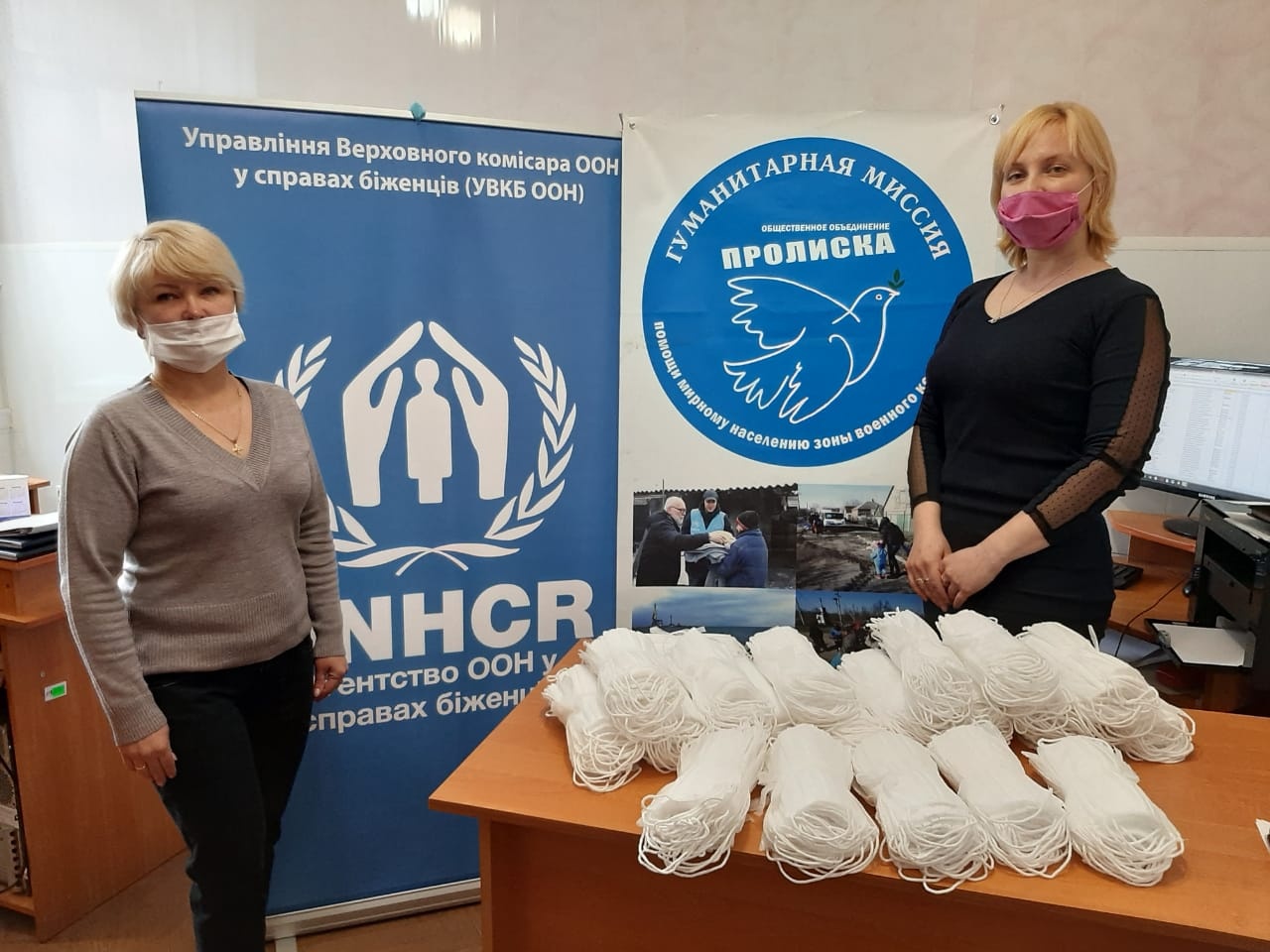
Protective masks were sewn by local volunteers and materials for their production were provided by the Humanitarian Mission "Proliska" with the financial support of UNHCR in Ukraine.
To prevent the spread of the infection, the Cabinet of Ministers of Ukraine has decided to strengthen the quarantine measures introduced by April 24 throughout Ukraine. One of the mandatory restrictions is to wear a protective mask while in public.
On 31 March, UNHCR Ukraine and its partner Humanitarian mission Proliska released a Protection Monitoring Report on needs in settlements nearby the contact line in east Ukraine. If it were to spread to areas along the contact line, COVID-19 could have a devastating impact. The population in isolated settlements along the contact line includes a large proportion of older persons (41 per cent) who suffer from the additional stress imposed by the armed conflict. Additionally, the infrastructure for prevention of the COVID-19 (such as plentiful clean water for hygiene) and response (medical facilities) has been weakened by the conflict. UNHCR’s partner organization Proliska has a network of community workers who live in settlements along the contact line. They have compiled initial information about preparedness levels and the impact of quarantine measures in 119 settlements in a geographic area approximately five kilometers along the contact line in government-controlled areas of eastern Ukraine. Report contains some of the challenges identified.
Eleven initiatives on medical masks production from the communities located nearby the contact line in east Ukraine were supported by UNHCR and its partner NGO Proliska during the week of 23 - 27 March. The community members will produce medical masks for medical workers, personnel of outpatient clinics, hospitals, nursing homes and employees of communal institutions and strategic enterprises working along the contact line in Donetsk and Lugansk regions. The masks will be made in line with the WHO recommendations.

On 27 March, staff members of UNHCR and NGO Right to Protection delivered a webinar lecture to 14 appeal court judges from different provinces of Ukraine on the protection of asylum seekers. The event has been organized by the National School of Judges and covered issued related to access to the territory and asylum procedures, RSD and court challenges in Ukraine. The participants were provided with the UNHCR position on the treatment of asylum seekers during the COVID-19 pandemic, with the latest information from Afghanistan, Eritrea, and Syria.

On 26 March, detergents provided to Refugee Temporary Accommodation Centers (TAC) by Unilever Ukraine: UNHCR partnered with Unilever Ukraine that has donated Domestos detergent products that contains hypochlorite, a disinfectant recommended by WHO. These were delivered to Temporary Accommodation Centers where refugees and asylum seekers reside. The products were delivered to TAC's in Yahotyn where 84 persons reside; Mukachevo with 69 persons and in Odesa where 95 persons benefited from this support. Thank you Unilever Ukraine!
World Health Organization (WHO) COVID-19 Prevention Posters in government controlled areas (GCA): On 25 March 2020, UNHCR finalized installing 200 WHO COVID-19 prevention posters in villages near the ‘contact line’. UNHCR also installed posters informing residents of recent legislative updates related to COVID-19 produced by the NGO Right to Protection (R2P). In total, UNHCR and its NGO partner Proliska reached 70 villages located near the ‘contact line’ and 80 additional villages in Donetsk and Luhansk Oblast in GCA with 500 posters and 40 000 leaflets on COVID-19 prevention.
Raising awareness in non-government controlled areas (NGCA): UNHCR and WHO joined forces to raise awareness of COVID-19 prevention in NGCA. UNHCR received 5,000 COVID-19 prevention posters from WHO that will be distributed in Donetsk NGCA by the Donbas Development Center, UNHCR’s NGO partner in Donetsk NGCA. These will be distributed in social institutions located along the ‘contact line’ such as in Debaltseve, Dokuchaevsk, Horlivka, Donetsk and Novoazovsk.

Psycho-Social Support (PSS): UNHCR’s NGO partner Slavic Heart continues to provide PSS to survivors of SGBV along the contact line by Slavic Heart mobile teams equipped with sanitizing gel and individual masks. Slavic Heart also produced a series of videos on positive coping mechanisms during quarantine and self-isolation. The videos have been shared with a network of women, men, girls and boys living along the contact line via social messaging apps and email. Furthermore, a Viber chat of self-support has been established, so far there are 101 participants from locations on the contact line. Finally, a Facebook group has been created on women self-support with 34 participants so far.
Community mobilizing against COVID-19: In 2017, thanks to funding provided by GIZ, UNHCR rehabilitated an older building in Bakhmut that became a multi-functional community center called KvARTal. Thanks to sewing machines provided by UNHCR in 2018, the community has identified volunteers who are currently producing 200 masks that will be distributed to the most vulnerable community members using precaution measures. The materials used in the production of the masks were provided by the local authorities.
Situation on the entry-exit checkpoints (EECP): UNHCR received reports that some persons were allowed to cross the ‘government controlled side’ (GCA) of the contact line based on ‘humanitarian consideration’ of their specific case (as they had a residence permit for GCA only) but were blocked as they reached the non-government controlled side of the checkpoint because of the closure of the ‘contact line’ on 21 March. Therefore, these people had to return to GCA. UNHCR was informed of 13 cases on 23 March and seven cases on 24 March.
Meeting with Deputy Head of Donetsk Oblast Administration
On 23 March, UNHCR met with the Deputy Head of Donetsk Oblast Administration who is responsible for social welfare issues, as well as the Donetsk Oblast Heads of Social Protection and Health Departments. The Head of the Health Department is heading the oblast’s multi-sectoral entity established to deal with the COVID-19 pandemic. During the meeting, it was agreed that:
- UNHCR received a voice recording of actions advising the population to respect the quarantine. These recordings will be broadcasted in localities along the contact by UNHCR’s partner Proliska through loudspeakers provided by UNHCR.
- At the authorities’ request, UNHCR will print maps of Donetsk oblast to be distributed to all state authorities in all localities along the contact line to be used in operationalizing the response to COVID-19. UNHCR provided the maps as of 24 March. On 26 March, copies of the maps (around 50) will be sent to Luhansk oblast administration in order to further distribute to Luhansk oblast and local administrations.
- Authorities asked UNHCR to donate fabric to produce masks and medical gowns for hospitals. As a response, UNHCR is currently planning two projects implemented through community mobilization in which masks will be produced.
During the meeting, authorities informed that approximately 37,900 persons living near the contact line in Donetsk oblast are in need of special support with food and hygiene items. These persons are the recipients of different types of state social benefits and are unable to access these because of the quarantine measures in place. They all belong to ‘high risk’ categories. The authorities also informed that some 11,500 persons who are physically unable to leave their homes because of disabilities and other reasons, are in need of material assistance (food and hygiene items).
Instalment of World Health Organization (WHO) posters in east Ukraine: on 18 March, UNHCR teams in east Ukraine started to place WHO COVID-19 posters to raise awareness on coronavirus. Two hundred posters that promote hand washing and other preventive measures will be placed in collective centers (photo right), isolated villages along the ‘contact line’ (photo left), checkpoints, as well as in some locations in non-government controlled areas (NGCA). On 18 March, UNHCR and its NGO partner Slavic Heart started placing the WHO COVID-19 posters in collective centers for internally displaced persons (IDPs) in Sviatohirsk. Many of the IDPs who live there have disabilities and serious medical conditions.
On 19 March, UNHCR continued to place WHO COVID-19 posters in isolated villages along the ‘contact line’. According to an assessment in 2019, in these isolated settlements around 41% of family members are over the age of 60, and 13% have a disability. Furthermore, UNHCR’s NGO partner Right to Protection produced, printed and is distributing posters with information on newly amended legislation related to pension payments, social services provision, etc.

Situation at the checkpoints in east Ukraine: UNHCR and its NGO partner Proliska and the Right to Protection have reinforced protection monitoring of the checkpoints in east Ukraine. On 18 March, UNHCR visited Novotroitske and Mariinka checkpoints. Normally these two checkpoints have about 7,000 crossings per day combined; yesterday just over 1,000 persons went to the NGCA and about 100 came to GCA. The number of crossings has dropped dramatically. Both checkpoints report that the number of people going to NGCA is ten times higher than those entering. People who cross continue to face difficulties at checkpoints. UNHCR witnessed four cases where parents got separated from their children or families due to being in different locations at the time of quarantine or having different residence registration. Nevertheless, both checkpoints have informed UNHCR and NGO Partners that they will make exceptions on humanitarian grounds and on an individual basis in consultation with the Joint Forces Operation, especially if individuals travel for purposes of medical treatment or attending funerals. Furthermore, the de facto authorities of NGCA in Donetsk have announced that their side of the contact line will close starting from 00:00 on 21 March. As a response, UNHCR’s NGO partner Donbas SOS (this NGO manages a hot line conflict affected and internally displaced persons) is informing all callers about crossing the contact line, and they have set up an answering machine with information about the closing of the checkpoints.
People unable to cross: UNHCR’s NGO partner Proliska is collecting information on the individuals who are unable to cross the checkpoints due to quarantine restrictions. In total Proliska registered 81 cases in the three days since introduction of the new restrictions (16 March). The majority of cases (52) were documented on the first day (Monday) as previously reported. Out of those, 31 were allowed to cross the checkpoints. Among documented cases, 35 were identified as vulnerabilities or specific needs (family separation, serious medical condition, caregivers of persons with serious medical conditions, and lack of accommodation for students). Of these vulnerable individuals, 21 were allowed to cross and 14 were not allowed. NGO Proliska is keeping in touch with those who were unable to cross and following up.
On 11 March 2020, the World Health Organization (WHO) upgraded the status of the COVID-19 outbreak from epidemic to pandemic. A day earlier, on 10 March, Filippo Grandi, the UN High Commissioner for Refugees stated that COVID-19 “can affect anyone and it is our collective responsibility to ensure that the global response includes all people.” Since 16 March, the Government of Ukraine introduced restrictions aimed at mitigating the risks related to the spread of coronavirus infection. Among other measures, the restrictions related to crossing of the contact line in the east (through the Order of the Commander-in-Chief of the Joint Forces) and across the administrative border with Crimea (through the Decree 291-R of the Cabinet of Ministers as of 14 March 2020) were introduced. For the period of quarantine measures, the residence registration determines who can cross the contact line and in which direction: Individuals with residence registration in non-government-controlled areas (NGCA) or Crimea can enter NGCA/Crimea respectively, while individuals with residence registration in government-controlled areas (GCA) can enter GCA. In short, people are allowed to travel to the home registered in their passports. Under these regulations, IDP certificates are not considered as a proof of residence in GCA.
Since the restrictions were announced less than 24 hours in advance, they have severely impacted freedom of movement across the contact line and caused a series of complications for persons who wanted to cross. On the first day of restrictions enforcement (16 March), NGOs, including UNHCR’s partners Proliska, Donbas SOS and Right to Protection, received over 450 individual inquiries (in person through monitors present at EECPs and through hotlines) regarding problems with crossing. These include but are not limited to:
- IDPs who traveled for a short-term visit to NGCA, (e.g., to check on their property) and could not return before the measures were introduced;
- IDP students who have residence registration at their dormitories in GCA. The dormitories have been closed, and the students are not allowed to return home to their parents in NGCA;
- Residents of NGCA with chronic illnesses; they depend on medicines available only in GCA;
- Individuals with ID cards and without documents to confirm residence registration (e.g., at Maiorsk there are no ID reading machines);
- Individuals without residence registration at all (many ID-holders from NGCA have not been able to obtain any document confirming residence registration);
- Mothers who traveled for a short period and are separated from their minor children;
- Women who have residence registration in GCA, but who actually reside in NGCA to care for elderly parents;
- Couples who are separated because husband and wife have residence registration in different locations (GCA and NGCA);
- Pensioners who came for verification/identification/other business, wish to return home, but cannot confirm residence registration in NGCA;
Examples of Individual Stories
| Woman registered in Luhansk NGCA. She has an IDP certificate and lives in Kyiv. She went to NGCA to visit her newborn great-grandson. Now she cannot return home to Kyiv. | Student, studying in Kyiv, and has only a student card. Both his university and hostel were quarantined. She was not allowed to travel to Donetsk to self-quarantine with her parents; she has nowhere to self-quarantine in Kyiv. | An elderly woman, left Donetsk for GCA to receive her retirement benefits and register herself in Zaporizhia (although she actually lives in Donetsk city), but was refused to return home. | Elderly woman registered in Ivano-Frankivsk (GCA), but actually lives in the city of Krasny Luch (NGCA). Went to GCA to buy medicine for her paralyzed husband and now cannot return home. |