



Four years on, employment and purpose can transform Ukrainian refugee lives in Europe
Four years on, employment and purpose can transform Ukrainian refugee lives in Europe

Svitlana Zaluzhna is a 43 year old refugee originally from Odessa. Arriving in Lithuania in 2022, she established a social enterprise to support Ukrainian refugees become integrated into communities.
As we approach four years of full-scale war in Ukraine, more than 5.9 million refugees are seeking safety and rebuilding their lives in other countries, the majority remain in Europe. UNHCR, the UN Refugee Agency, is on the ground in Ukraine, delivering critical protection services and humanitarian assistance and supporting the economic inclusion of refugees in hosting countries in the region.
From the beginning of the crisis, European countries opened their borders and communities – welcoming Ukrainian refugees and providing not only a safe haven, but also temporary protection status which provided access to rights and essential services, and critically, the right to work from day one. But challenges do persist, with refugees reporting socio-economic inclusion challenges, including access to decent work, education and social protection.
A warm welcome in Lithuania
For Svitlana Zaluzhna, a 43-year-old refugee from Odessa, arriving in Lithuania with her family and three children could have been daunting. “From the very beginning, Lithuania welcomed Ukrainians with warmth and respect. It felt like being received by an older sister — attentive, protective, and deeply understanding. For years, the streets were filled with Ukrainian flags, and even today you can still see messages in public transport saying, “Lithuania loves Ukraine.” These are not just symbols; they shape how you feel as a person living here.”
Lithuania is one of several neighboring countries hosting Ukrainian refugees. They have provided safety and a sense of normalcy to support refugees in rebuilding their lives within their new communities.
More than half of working age Ukrainian refugees are employed, but challenges remain
But meaningful inclusion into communities requires effective policies with whole-of-society approaches to ensure access to decent work. A recent UNHCR report analyzed labor market integration of Ukrainian refugees aged 20-64 across Europe in mid-2025. Based on responses from more than 6,000 people, it was found that 57% reported that they are employed. Although this is still 22% less than the comparable rate for host-country nationals, it is an encouraging sign that refugees across the region are increasingly able to participate in the local economy.

Svitlana speaks during a cultural event at the Open Nations space in Vilnius, Lithuania.
Svitlana established a social enterprise “Open Nations”, which she founded in Lithuania in 2023 aiming to support refugees from Ukraine and help building bridges to Lithuanian society by transforming division into social cohesion.
Svitlana reflects that maintaining her professional identity as a refugee was critical to her family’s inclusion into the country. “I founded a non-governmental organization, I am professionally active, I grow, and my work gives me meaning,” she explains. “I can say with confidence that Lithuania has created conditions that allow refugees to live with dignity. That does not erase all challenges, but it makes an enormous difference in how people experience displacement and rebuild their lives.”
However, gaps remain. Underemployment is pervasive with nearly 60% of employed refugees working below their skill level, with over one third with higher education working in low-skilled jobs, compared to 7% of nationals. This skills mismatch is likely the primary driver of the 40% median wage gap between refugees and hosts.
“I know thousands of stories where refugees struggle profoundly, often because of the loss of professional identity. Highly educated people with strong careers in Ukraine are forced to accept much lower social and professional positions, losing not only income but also status, networks, and a sense of self.” Svitlana Zaluzhna
Unlocking growth: how refugee-hosting countries could boost GDP by 0.7% each year
Effective inclusion in the labor market creates a powerful win-win dynamic. It enables refugees to rebuild their lives and become self-reliant, while also contributing to their communities and local development.
“UNHCR’s recent study on Ukrainian refugees across Europe shows that when market barriers resulting in un- and underemployment are addressed, economic growth could be considerably enhanced,” reflects Susanne Klink, UNHCR’s Senior Development Officer. In the case of Germany for example, where the economy has been growing at 0.9% on average in the past 10 years, refugees’ could raise the GDP by 0.7% per year if working a working at their skills level.
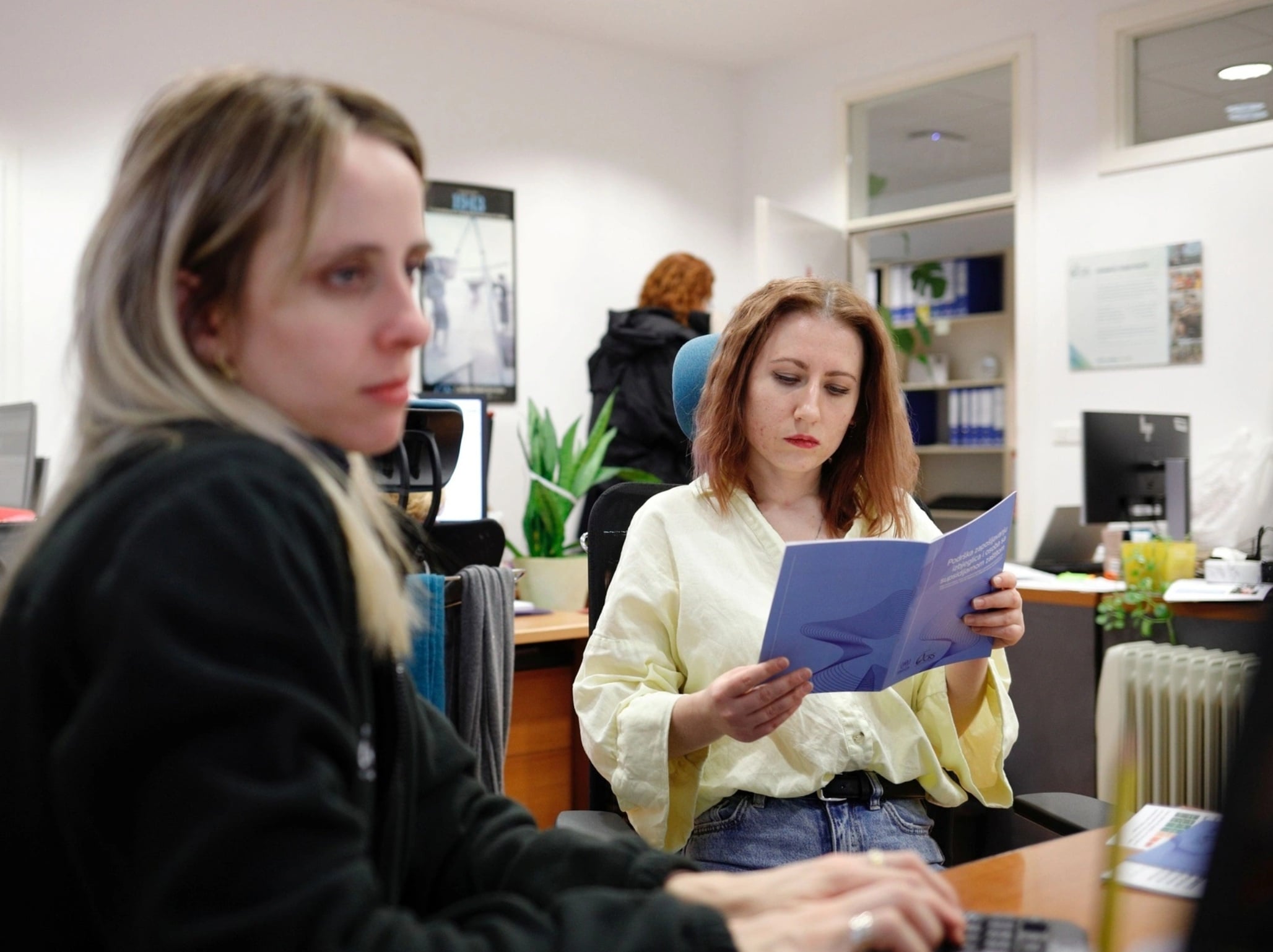
Kateryna Ivinska, a refugee from Ukraine, is rebuilding her life in Sarajevo as an IT administrator.
Kateryna Ivinska fled Ukraine in 2022 with her husband and one-year-old son. Finding safety in Bosnia and Herzegovina, she was supported by UNHCR and partner the Catholic Relief Services in finding employment and training opportunities. Kateryna is now employed at an IT company.
“This job allows her to look ahead with less fear. Each day of work brings her closer to the security she dreams of. “I am grateful to everyone, because now I have a job and the opportunity to work and provide a bright future for myself and my child.”
Inclusion of refugees means less reliance on assistance
Successful inclusion of refugees into host communities means less reliance on humanitarian and government assistance, increased self-reliance and economic contributions, while also helping to address labour shortages. But governments must maintain a focus on raising refugee employment rates, and addressing underemployment, with accessible and progressive local language training and support systems that might remove practical barriers, such as childcare, whilst also strengthening skills recognition, for example through bridging courses, in addition to accelerating credential processes.
For Svitlana, the future may feel uncertain, but having a job provides a sense of stability. “None of us wants to spend life merely surviving. No one wants to see themselves, their children, or their grandchildren hungry, freezing, running for safety, and losing everything. We all want to live a dignified and happy life.”
Related news and stories


