

GET - Section 1: Annual Implementation Planning
Overview
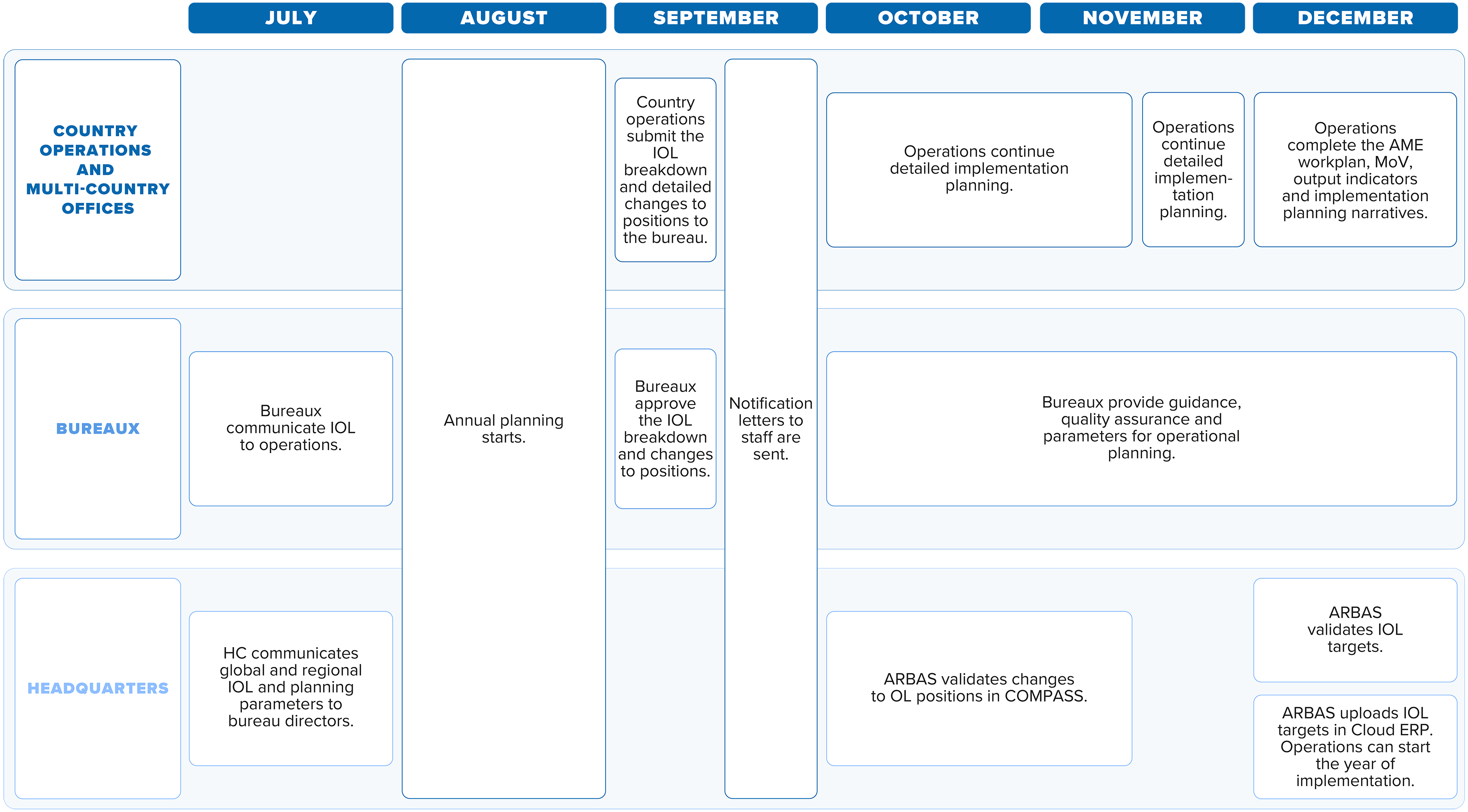
Following the High Commissioner’s July communication of the indicative operating level (IOL) at the regional level, and the bureaux’ communication of the country-level IOL allocation, all operations start preparing to implement their approved strategies for the following year. They prioritize planned results according to expected financial resources, considering specific operational contexts, commitments, anticipated resources, donor earmarking and available evidence, including feedback from forcibly displaced and stateless people.
This ensures that resources are allocated to the most critical efforts. During this phase, each operation refines the results framework and the monitoring and evaluation (M&E) plan, aligns its resources, workforce, and implementation modalities to achieve the desired results, and conducts the annual risk review.
In a nutshell
- Annual implementation planning incorporates prioritization of critical activities based on allocated resources for 12 months.
- The prioritization of essential activities is made upfront so that they can proceed uninterrupted.
- Operations plan for the entire year without assuming additional resources will become available during the implementation later in the year.
- All activities related to confirmed or anticipated earmarked funding and unspent funding from the current year, when applicable, are included in the budget for the following implementation year.
- Budget targets in Cloud ERP are always set in United States dollars. Plans containing activities under local currency are validated using the 1 October UN exchange rate and the spending authority is created based on this target.
The first action in the GET Results phase is annual implementation planning, during which an operation prepares to achieve its desired results for the upcoming year.
Terms and Definitions Operations plan budget (OP): This is UNHCR’s official needs-driven budget, approved by the Executive Committee (ExCom). UNHCR’s Financial Rules refer to it as UNHCR’s “programme budget”. Operating level (OL): This is an internal management tool to guide the prioritization of activities within the programme budget. It sets the maximum spending authority against which commitments and payments can be made based on available funds or total available resources and is reviewed and adjusted against expenditures and available funding regularly. The OL is provided against the ExCom-approved programme budget and used by the High Commissioner per their authority to enable operations to undertake prioritized activities. The indicative operating level (IOL): This is a planning parameter that provides an indication of the funds that UNHCR anticipates being available during a calendar year. It helps operations with detailed planning for the following year and can change based on actual income. |
Once the High Commissioner communicates the regional IOL and the bureaux provide country-level IOL allocation, operations determine specific details for implementing their multi-year strategy in the upcoming year by following these steps:
- Identify priorities: They determine the most critical priorities based on the anticipated resources.
- Refine outputs: They adjust the outputs and indicators.
- Allocate resources: They align resources, workforce, and implementation modalities to achieve priorities and results.
- Update M&E plans: They modify their assessment, monitoring and evaluation (AME) workplan to include the planned monitoring and evaluation (M&E) activities for the implementation year. They add the means of verification (MoV) for the new indicators.
- Establish workplans: They create project workplans, grant agreements, UN-to-UN agreements and procurement contracts for implementation in the following year (see GET – Section 2).
💡 TIP The annual implementation plan reflects a 12-month programming. Eventually, your OL will be your maximum spending authority at any given time. |
In consultation with partners and other stakeholders, operations prioritize their high-level IOL breakdown and detailed OL positions based on UNHCR’s global results framework. This process is guided by the UNHCR Strategic Directions 2022-2026, the Focus Area Strategic Plans, the Policy on Resource Allocation and Management, as well as commitments such as the Sustainable Development Goals (SDGs), the Global Compact on Refugees (GCR) and the Grand Bargain.
💡 KEEP IN MIND While the Strategic Directions provide the organization with a vision and strategic orientation around key areas of work based on UNHCR’s mandate and role, the Focus Area Strategic Plans offer global direction on where and how UNHCR prioritizes its work in relation to the eight focus areas identified in the Strategic Directions. |
When choosing their programmatic priorities, operations focus on optimizing efficiency and coherence between the strategy and the allocation of resources. This involves considering the overall ratio of OPS, ABOD and STAFF costs. They review the previous year’s administrative expenses to guide the analysis and comparison of current estimated administrative costs. Additionally, they consider the outlook of OL in the coming years and document any strategic priorities that have been deprioritized. This approach ensures that operations are well-prepared and aligned with strategic goals and available resources.
During the prioritization process, operations consider the following to ensure effective outcomes:
- Impact, outcomes and outputs: Focus on achieving the best results from the approved OP.
- Specific operational contexts: Understand the unique circumstances in which the response will be implemented.
- Alignment of resources: Ensure that resources, workforce, and implementation modalities are aligned to maximize results.
- Audit and evaluation recommendations: Use these recommendations to guide decisions.
- UNHCR’s comparative advantage: Assess UNHCR’s strengths in meeting specific needs compared to other stakeholders.
- Contributions of others: Map contributions of other stakeholders to the response.
- Criticality of needs: Identify urgent needs and the national capacity or alternative stakeholder availability to address them.
- Donor commitments: Recognize commitments to donors, particularly related to tightly earmarked contributions.
- Future outlook: Analyse donor funding trends to inform future planning.
- Feedback: Ensure inputs from forcibly displaced and stateless people are incorporated.
- Prioritize need and efficiency: Seek efficiencies to prioritize those most in need in line with the 2019 Guidance Note on UNHCR Engagement with the Sustainable Development Goals.
- Data and evidence: Leverage data and evidence to inform the prioritization process.
💡 TIP Undertake prioritization of available resources, with the engagement of your multi-functional team, partners and the communities that the operation intends to work with and for. |
Refining and adopting the human resources action plan
After the communication on the IOL, operations can refine their human resources action plan. The representative adopts the refined plan for the next implementation year and the operation monitors its effective implementation throughout the year. This ongoing monitoring helps inform any further adjustments needed to ensure that the operation achieves its intended results with the human resources it has.
Planning approaches to assistance
When the IOL is communicated, operations also need to plan how assistance will be delivered to households in need.
💡 TIP When deciding on prioritized activities for implementation, ensure that your responses are sustainable, inclusive, and self-reliant, and promote collaboration with development partners. |
1. Targeting and prioritization for basic needs assistance
Many operations provide basic needs assistance, such as multi-purpose cash and non-food items, to households unable to meet their basic needs. During annual implementation planning, operations decide what approaches to implement to identify and determine households in need of and eligible for assistance.
A targeting approach focuses on identifying and enrolling households whose needs meet established criteria, ensuring that assistance reaches those in need. A prioritization approach is developed when resources are insufficient to meet all identified needs. The prioritization approach may involve reducing the level of assistance provided to all, limiting the number of households receiving assistance by setting stricter eligibility criteria, shortening the duration of assistance, or combining these approaches.
Targeting and prioritization approaches usually use various methods to identify, enrol, or register households that are eligible to receive basic needs assistance. These methods may consider factors such as their legal status, geographical location and category, household, or individual characteristics, targeting that relies on community inputs to identify those in need, and scoring systems using tools like scorecards, indexes, or proxy-means testing to assess eligibility.
When the World Food Programme (WFP) assists the same population, it is recommended to conduct targeting and prioritization exercises jointly, as outlined in the UNHCR-WFP Joint Guidance on Targeting of Assistance to Meet Basic Needs. For more information, refer to the UNHCR Assessment and Monitoring Resource Centre.
2. Area-based approaches
An area-based approach focuses on prioritizing available resources and addressing the needs of all displaced and stateless people within a specific geographic location, regardless of their status.
This approach is typically built on area-based assessments, defining an area as the primary entry point for interventions. It aims to enhance the protection environment, ensure access to basic services, improve the integration of forcibly displaced and stateless people, and promote social cohesion.
It is often a long-term and community-driven process, covering sectors such as community empowerment, basic infrastructure and services, peaceful coexistence, and local economic development. Where possible, it should align with national and local authorities’ plans and priorities. It encourages collaboration among various actors, such as government, communities, non-governmental organizations (NGOs), other UN organizations, humanitarian and development institutions, donors, and the private sector.
Area-based programming aims to support the transition from humanitarian assistance to sustainable development. UNHCR acts as a catalyst and coordinator, bringing together different actors to address the communities’ multi-sectoral needs. Joint analysis and interagency collaboration are crucial for positive outcomes.
In some instances, this may involve initiating services or quick impact projects, which other actors then take over as part of their longer-term contribution to local development plans. This creates opportunities for joint programming and engagement with development actors.